

 Come together with the global Drupal community in Rotterdam, 28 Sept – 1 Oct 2026. Sessions, contribution, connection, and Early Bird savings until 8 June.
By j.slemmer on
Dordrechts Museum - Introduction
In 2010 the new website of Dordrechts Museum was launched. The website was part of a bigger rebranding where the museum wanted to invest more in the relationship of visitors who visit often and give new and current visitors a interactive experience of the museum.
With that concept in mind the new website of Dordrechts Museum (www.dordrechtsmuseum.nl) has been developed.

Discover your taste
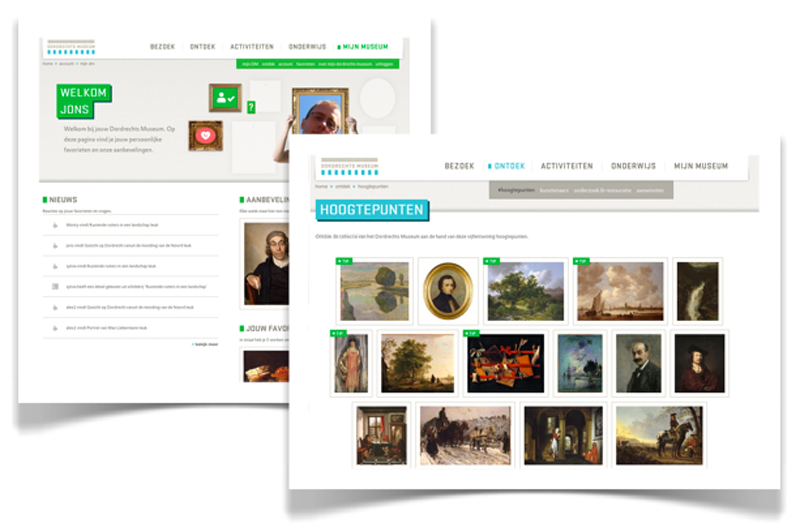
The museum has about 30.000 pieces of art in total, only a selection of art is on display at the museum, on the website however the user can browse through much bigger selection then that are on display in the museum. To help the visitor in finding works they like we created a custom functionalitiy called ‘DNA’.
When the user registers on the site the user is asked to walk through a quick 4 step wizard to gather the first info on the users unique DNA. The DNA is an advanced algorithm which collects data from the user behavior. For example what the user likes, dislikes, adds as a favorite or leaves a comment on.
Based on the users DNA the website gives tips and recommendations of current and new works of art to keep the user coming back for regular visits.
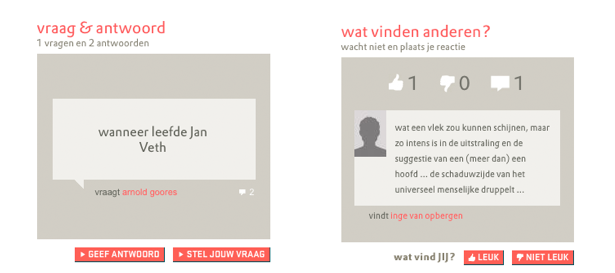
Discussion on art
Just like a real visit to the musuem it is possible to discuss a piece of art, or ask a question with all registered users of the site. Active discussions or questions are shown on the user accout page, once again the personal DNA is taken into account.
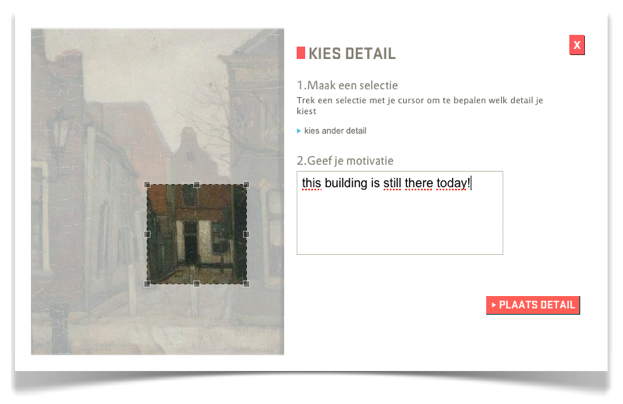
It is also possible to choose your favorite detail of an artwork and discuss it with other users.
Other CMS elements
Apart from the custom build algorithm, dordrechtsmuseum.nl features other elements which can be fully managed through the Drupal CMS. Artists, works of art, exhibitions, personal, news, and much more.
All-in all this makes dordrechtsmuseum.nl a very powerfull and flexible online experience.
Launch
The initial launch was at the end of November 2010. This contained all most all the public facing elements of the CMS. Over the next months we integrated all the user interactive elements and refined the DNA algorithm.
Structure & Modules
For this hole site about 25 content types have been created to contain all the elements that were needed. There is a lot of cross-referencing going on between all these content types and nodes to create certain elements. Especially the interactive elements make heavy use of this. For example: a question about an artwork need to know to what are work it relates and then can have multiple anwsers related to that question again.
The 2 main building blocks we used are Views and Panels this was used to build major parts of the website. Other modules used were:
Rules, Hansel, Flag, Content Profile, Content multigroup,
Translation module, Services module (JSON), Jobqueue
A set of custom modules was build to facilitate the interactive elements as complex content needed to be created from code. Also the DNA algorthim and activity feeds are custom modules.
Imports
One part of the the process was the importing of Artworks and artists form several formats.
Their main dataset is being kept in Adlib (http://www.adlibsoft.com) which has an XML export format. An other dataset came form their old CMS in the form of Waxtrapp (http://www.waxtrapp.com) exports. Like the name says this custom CMS “trapped” it’s data in a kind of XML with unlogical formats and duplicate content which made it pretty complex for smooth importing.
Webservices
An other “cummunity” part of the website is the option to create or access your account from within the museum on ipod’s. When entering the museum you can borrow an ipod and setup your account, which is automatically created on the website then as well over a JSON webservice. Your activity in the museum also impacts your DNA. Those DNA changes are also saved in users DNA chain on the website.
The website is in this case the main database to store user profiles and settings, which then can be accessed or set by extrenal systems.
Challenges
Every project of course has challenges for this this has been the;
- Modeling the user section to the visual concept, including with modal windows for checkin/registration & password reset
- Importing and merging data from multiple different legacy datasets
Team and time
On this project we worked with about 3 developers and 1 project manager. The design was pre-created by an other agency. 1 developer focused on the theming, an otherone on the structure and custom functions and the last one on the webservices and “DNA” algoritms. The first month was spend on the basic theming and structure, the last 2.5 months were spend on the advanced features and user interactive elements.
Hosting
The site is hosted on a (virtual) dedicated server with decent CPU and 4GB memory. This was needed as some of the background processes require some power. The DNA proces is monitored regularly as it needs more power as more users/data are in the system.
About us
Joy Group has done all the technical implementation of the creative concept.
We are a development company based in the Netherlands. More information about us can be found on www.joygroup.nl
