Intuitively, the idea I had of entity translation was that some instances of fields could be translatable.
For example, I had the misconception that changing Page's body field to translatable would not affect Article's body field.
The field modification page has two sections, one, on top, relative to the instance of the field, and the other, on the bottom, relative to all instances of the field. The field translatability option is on the bottom of the bottom section, hence applying to all instances of the field.
Still, even though I am quite used to Drupal, I somehow missed this, and thought I was affecting the instance of the field, not the field itself.
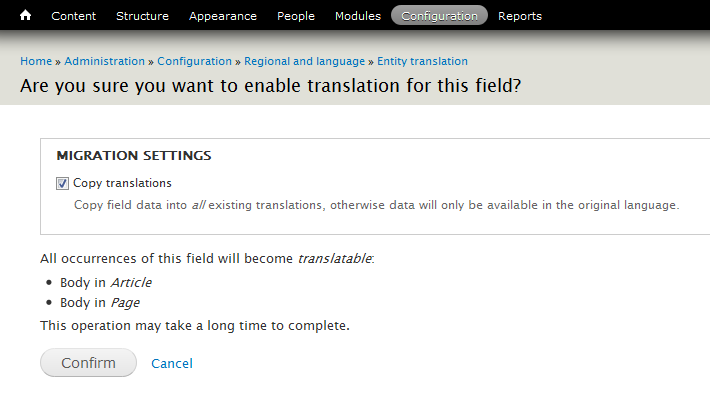
Because this can have some dire implications, including affecting data (see for example #1916712: Provide an API to update content programmatically, not just through the UI (useful for deploying with Features, for example), where the body field was being affected my mistake), it might be a good idea to add a warning or something make absolutely sure that the user knows that *all* fields, not just one instance, are being affected.
See attached.
Cheers,
Albert.




Comments
Comment #1
plachSorry, but the phrase you are suggesting is very similar to the one below the fieldset title, if my french serves :)
I don't think repeating it would be particularly useful: if you didn't notice the former why should you notice the latter?
Comment #2
alberto56 commented@platch you are right, but for some reason it just did not register for me. Either others will make the same mistake, or I'm just weird :)
I know that if I had seen a bold sentence like: "this will make the body field in Article, Page, Event, and Press Release" translatable, I would have been alerted, if the sentence had been just below the widget rather than at the top of the box, where I'm used to just ignoring it.
Comment #3
plachThis sounds a bit overkill to me but an additional warning cannot do too much harm. Care to provide a patch?
Comment #4
alberto56 commentedHere is a patch. The following strings are changed:
example: FIELD = body, LIST = page, article, event
Comment #5
alberto56 commentedHere is one example of what this patch does. (see image)
Comment #6
alberto56 commentedComment #7
plachSorry for being vacant. This looks promising to me but the end result looks a bit redundant to me. I'd prefer something like the following:
Users may translate all instances of Body (Article, Page, ...).
Disable translation
I think we can avoid repeating the warning that translations will be deleted as we already have it in the confirmation form.
Also it seems that you are using the field and instance machine names instead of the corresponding labels.
Comment #8
alberto56 commented@platch thanks, you are probably right on all counts. I'm curious to see if there is more interest in this approach. Cheers.
Comment #9
plachI'm terribly sorry I let all this time pass after asking you a patch, I completely lost track of this issue until now. If you provide a new one implementing #7 I swear I'll commit it asap.
Comment #10
alberto56 commentedHi,
Coming up with a new version of the patch has been a bit more of a challenge than I at first thought! Here is why.
Challenge #1: Fields do not have human-readable names
Field instances have human-readable names, but fields do not. Take this example
In the above example, it does not really make sense to say "All instances of field Body will be deleted".
Challenge #2: Node types are not the only entity types are can have fields
Users, and taxonomy terms, and other entity types can also have fields, so one can have a situation where:
In the above scenario it would be misleading to say "All instances of xyz (user, abc, page) would be misleading because the taxonomy term abc has yxz, but not the node type abc.
Proposed solution
Because fields do not have labels, the machine name will have to be used.
Each field instance is then uniquely defined by its label, entity type and entity.
For examplpe: field machine_name (Body in node Article, Body in node Page, Bio in user User, Description in taxonomy term Tags)
I have removed the warning in disable translations, which makes the whole thing clearer, as mentioned above.
Comment #12
plach"Body in node Article" looks a bit confusing to me: maybe it's just lack of context but it seems we are talking about a concrete node titled "Article" and not about a bundle named "Article". And "Bio in user User" makes this frist impression even stronger. Moreover, this way the line can get veery long. What about something like this?
Users may translate all instances of this field:
Disable translation
Comment #13
alberto56 commentedYes, that's a lot more readable.
I removed the bundle types node and user, but I left taxonomy term; which makes sense for me.
See enclosed image for the results.
Here is a patch
Comment #14
alberto56 commentedHere is a better one: there were some out-of-date comments in the patch above.
Comment #16
alberto56 commentedrelated: #1953672: Make "These settings apply to the field everywhere it is used" clearer
Comment #17
plachSorry, but this won't scale: Entity Translation supports any entity type, there is no reason to special case core ones. Moreover I really cannot see why taxonomy should behave differently.
Comment #18
alberto56 commented@platch thanks for the feedback. You're probably right: there are some edge cases where the bundle type (node, taxonomy term...) could make things a bit clearer, but it's just not worth the trouble and confusion :)
So here is a patche where I dispensed with the bundle type altogether.
The result can be seen in the enclosed image
Cheers
Comment #19
alberto56 commentedComment #20
alberto56 commentedThis one is a bit cleaner. I removed some old code from previous patches in $t_args.
Comment #21
plachLooks good to me.
I slightly improved the formatting of the confirmation form and restored the original wording in the links to make them more compact. This looks good to go to me now. What do you think?
Comment #22
alberto56 commented@platch yes that's cleaner, thanks.
Comment #23
plachCool :)
Committed and pushed, thanks!