

 The 2026 Drupal Business Survey is open. Your response will help shape the future of the Drupal business ecosystem.
Allow a theme to prevent itself from being used as an admin theme
Conversely, what about a theme that is only intended to be an admin theme?
While having themes that are available as both is a good thing, I think it's time that we allow themes to restrict themselves if they want, to not be set as an administration theme. Contributing and supporting a theme that supports hundreds of modules is prohibitive enough, but supporting their backends as well is even more of a barrier, especially since some contrib modules can have, um, 'special' UIs.
Especially with Seven in core, the pressure for themes to be fully admin-supportive seems to be somewhat alleviated.
What about an optional line in the theme's .info file which could specify this? With "both" being the default if not included.
Related issue, since the UI is changing in #491214: implement the top level Appearance / Choose Theme admin page, and would need to have the links reflect what can be enabled for what.
| Comment | File | Size | Author |
|---|---|---|---|
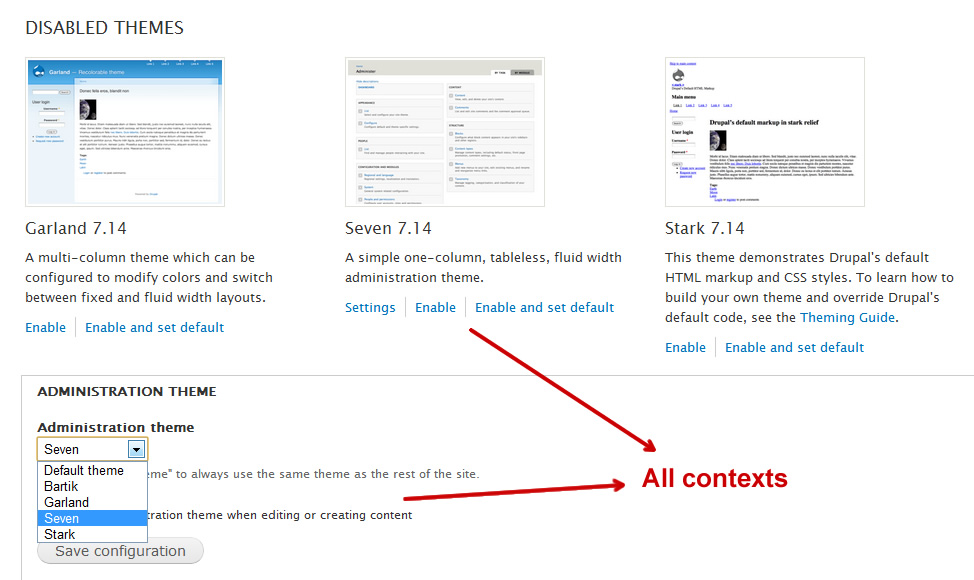
| #32 | theme-type-0.jpg | 146.25 KB | josevitalsouto |
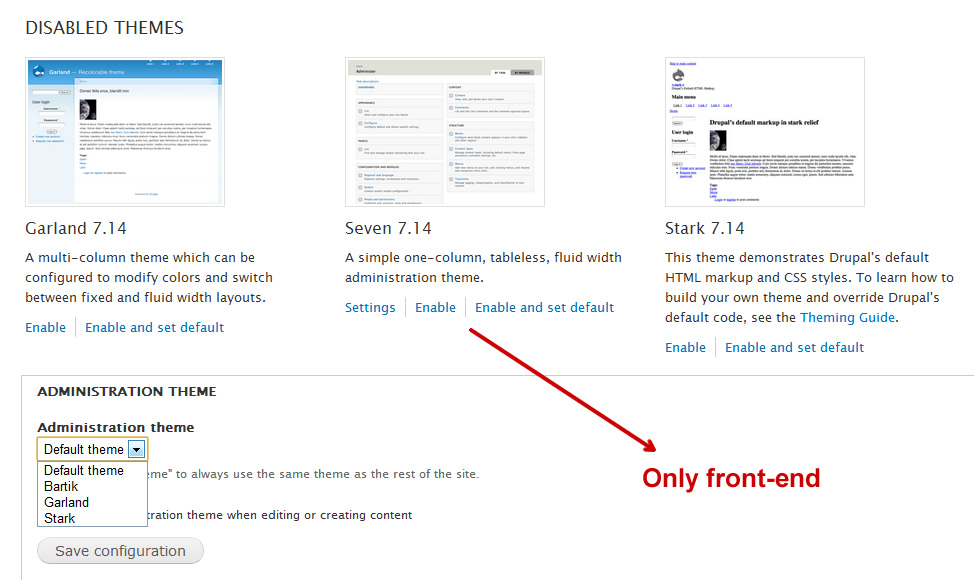
| #32 | theme-type-1.jpg | 144.18 KB | josevitalsouto |
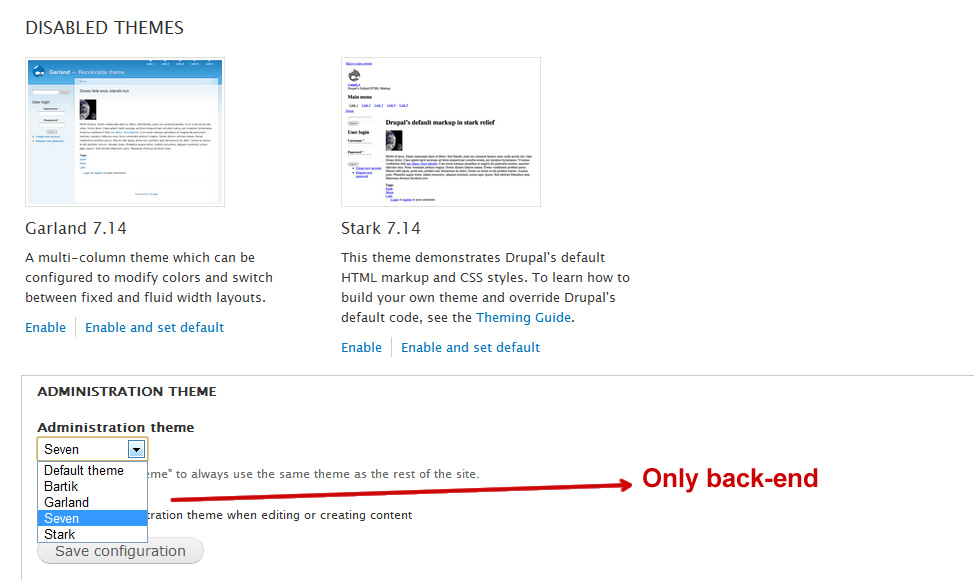
| #32 | theme-type-2.jpg | 121.52 KB | josevitalsouto |
| #23 | adminonlytheme-550102.patch | 3.63 KB | bleen |
| #25 | adminonlytheme-550102.patch | 4.28 KB | bleen |

Comments
Comment #1
Bojhan commentedSo I spoke to JohnAlbin about this as well. It is indeed somewhat wierd to require modules, which live solely in the administration space to work for interfaces such as Garland, and whatever new core theme.
However and this is sturdy said, the use case for both is going to be awkward. I'd rather have something that favors, administration theme - to be able to say, this is only an administration theme. Then themes to say, I am both or not.
Comment #2
stephthegeek commentedHey Bojhan, thanks for your comment. I'm afraid I'm not 100% clear on what your conclusion is stating. Are you saying you support it as a general concept but not that themes should be allowed to restrict this?
Comment #3
Bojhan commentedI support :) I think, this is a good change - however we should definitely look at all the technicalities of this.
Comment #4
gábor hojtsyWell, as far as #491214: implement the top level Appearance / Choose Theme admin page evolves, it might not have links directly in the main theme setup screen. Also, it could easily be a WTF for users if they cannot turn certain themes to be an admin theme or front end theme without further explanation.
Comment #5
seutje commentedcan't help but get the feeling this is a step in the wrong direction, because this would take away the pressure to use generic css techniques and it makes it very tempting to limit support significantly
also it would require quite some work, since an admin theme basically overrides the default theme whenever the context is considered administrative, so what if there's no admin theme active and the current default theme is one that's "not to be used as admin theme", should it then fall back on the bare defaults (these: http://api.drupal.org/api/file/modules/system/page.tpl.php/7/source http://api.drupal.org/api/file/modules/node/node.tpl.php/7/source http://api.drupal.org/api/file/modules/block/block.tpl.php/7/source) or should it attempt to use the default theme anyway?
imo, the opposite makes a whole lot more sense, half the true admin themes out there weren't made to function as a default theme anyway
Comment #6
stephthegeek commented"because this would take away the pressure to use generic css techniques and it makes it very tempting to limit support significantly"
That's what goes in the "plus" category for me ;)
Unless by "generic" you meant "standard", but I don't think that is the case. It *does* mean that designers and themers can get away from the Drupally look more when creating themes. There are themes/designs out there that couldn't really be admin themes in practice anyway, but if you give them the ability (and the default is to use it everywhere), the end users *will* try, even if you tell them not to. This is simply making that social/documentation convention a technical restriction so users don't think their site/theme is broken.
I don't think "you must support the administrative interfaces of X thousand contrib modules" was ever in the intended spirit of creating a contrib theme.
Comment #7
gábor hojtsy@stephthegeek: "you must support the administrative interfaces of X thousand contrib modules" I think was part of the original goal, but the administrative interfaces grown so complex that it is not too feasible, I'd agree.
Comment #8
stephthegeek commentedJust to provide some specific context, a perfect example is Acquia Slate (or any dark theme). Since it has a dark background with light foreground text/links, any module which specifically sets a light background anywhere (say.. Views/Panels. or anything with a light table, coloured divs, tabs, different gallery modules, etc) and doesn't also set a dark text/link colour on these will render its text nearly invisible, which then understandably get reported as theme bugs.
Now, the proper thing to do would be for those modules to make sure they also specify a foreground colour, but they rarely do since the vast majority of themes are light. In order to "fix" this in the theme, we'd have to jump in on each of these modules' class/ID declarations that set backgrounds and also set foregrounds.
That to me is a perfect example of why it's not really feasible.
I'm all about leaving it as an option, and even the default for themes to be available as administrative themes too. But I think it inhibits creativity and means that themes can be incorrectly thought to be broken if they don't support the admin section.
Comment #9
seutje commentedI see your point, and I'm not going to pretend I know more about what making a generic theme that works for everything is about, I usually make a theme based on a design and a spec, so they pretty much only fully support the modules running on that site, and pushing this change wouldn't affect me at all, personally
in your particular example, I'd say it's the module's default theming that doesn't make a lot of sense and I'm sure that there's cases where it's lot more murky
but then why do we have admin themes at all?
Comment #10
jarek foksa commentedThe problem with admin pages is that you can't rely on generic stylings. In order to make admin pages look consistent with other parts of the website you have to write a lot of very specific styles. This is especially true with Drupal 7 and modules such as overlay or dashboard. Needless to say that the markup and core stylesheets on admin pages are awful.
Assuming that all themers will be adding support for admin pages is at least overenthusiastic.
Comment #11
reglogge commentedHere's a very simple patch that would allow a theme to declare itself an admin-theme by adding
to it's .info file.
All the patch does is then not display the link "Set default" for the theme on /admin/appearance. Inexperienced users are then not able to enable an explicit admin theme as their default theme.
In effect this patch adresses seutjes comment from #5
The patch writes this line to Seven theme's .info file to illustrate the effect - and yes, the condition in system.admin.inc could probably be written much better.
Comment #12
reglogge commentedbot.
Comment #13
Jeff Burnz commentedCant we have it both ways - so we can declare either or both?
Comment #14
reglogge commentedThis patch also checks if
type = admin-themeis set for determining the content of the select box where users can select their admin-theme.- The default theme is always there to be selected
- Themes which don't declare
type = admin-themein their .info file are not added to the select list.This would mean that theme authors would explicitly have to declare in their .info file whether they wish their theme to be usable as an admin theme out of the box. Developers would still be able to add this declaration to whatever theme they want.
Also, this would of course have to be documented and probably a test written for.
Comment #16
reglogge commentedHm... this was stupid.
This patch is better:
We now have two possible values for themes
- type = admin-theme puts a theme into the admin theme select box and disables setting it as default.
- type = frontend-theme removes a theme from the admin theme select box and enables setting it as default.
- Themes with no declaration can be a default or an admin theme
So now whenever a theme developer wants to either define his theme as exclusively an admin theme or a frontend-theme, he can do so.
EDIT: The changes in garland.info and seven.info serve merely to illustrate the functionality and have to go out of course. Also, they might trigger some interesting testbot-failures :-)
Comment #17
bleen commentedA) I think this is a hugely awesome idea and should definitely be part of core
2) Sadly, I have a feeling this will be relegated to D8 - I cant think of any way to spin this as anything other than a (super-cool) new feature
III) Patch review:
Shouldn't this:
be
(and the same later on with
($theme->info['type'] !== 'admin-theme'))Comment #18
reglogge commented@bleen: I share your premonitions :-(
However, it's not an API change, easily understood, easily documented and might just slip in. It doesn't change anything for existing themes but might prevent lots of WTFs, when new users enable Seven as the default theme and are disappointed. Also: More power to the themers!
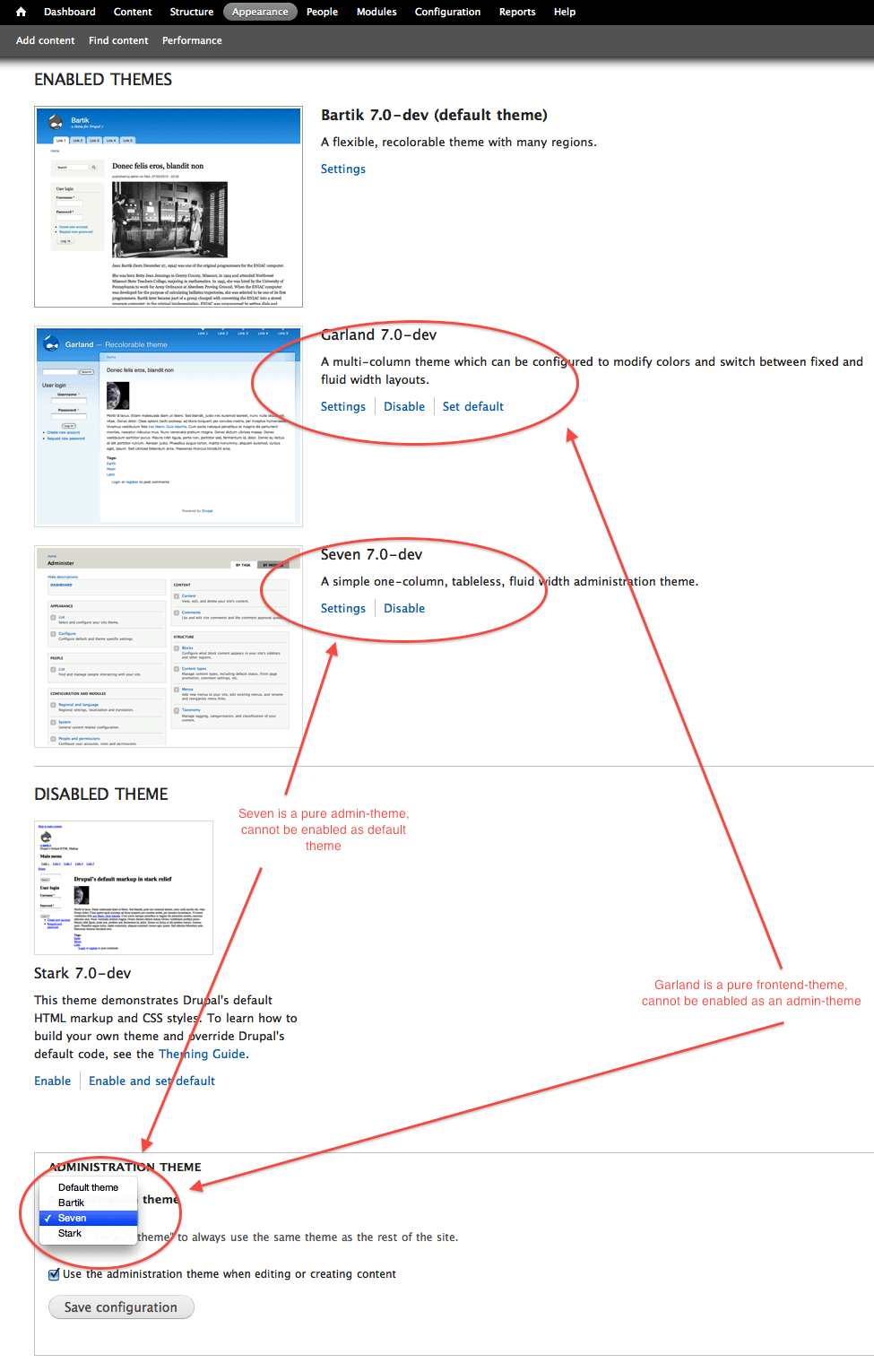
New patch attached for completeness' sake. This time without the changes in garland.info and seven.info so it could be committed as is. Also renaming.
Plus a screenshot of the *new* /admin/appearance when garland is defined as a front-end theme (can't be selected as admin theme) and Seven is defined as an admin theme (can't be set as default).
Crossing fingers and whistling in the dark...
Comment #19
Bojhan commentedWhoa, this does not look right. There are no indicators why Seven can not be set as default. To me its pretty clear that we need to think about designing that page to hold "normal" themes and "admin" themes. I am fine with not even displaying Seven, and just having it in the drop down.
Comment #20
reglogge commentedThis patch is clearer by taking out all the negations with
!==and thusly making the code easier to understand.Documentation would have to go here, I guess: http://drupal.org/node/171205
EDIT: Sorry Bojhan, didn't read your last comment before posting this.
Comment #21
Jeff Burnz commentedIf we scale this back to just preventing a theme from being set as an admin theme perhaps we don't need a UI change, which is certainly going to get this bumped to D8.
Therefor:
- Any theme can be enabled and set to default.
- Not all themes will appear in the Administration themes list.
To do this we would need to:
1 - Add the "type = frontend-theme" option for themes that do not want to be admin theme.
2 - Remove the "Default theme" option.
3 - Add some documentation.
4 - ?
I am changing this to a bug because at the moment any theme can be set to the admin theme, which can cause the site to become unusable, or at the very least important admin pages can become unusable. We should remember that in D7 themes have access to things like hook_page_alter, or even the new proposed hook_system_region_list_alter. Allowing any theme to be set as an admin theme is a major WTF and UX fail.
Comment #22
xmacinfoMoving to 8.x (which could be backported to 7.x).
I prefer adding the “type=admin” line in the info files only for admin themes.
We don't need to add the type line to every single theme since that by their majority they are all front-end theme anyway. We just need to highlight the few exceptions that are indeed of type admin. That way we could hide the few admin themes behind a tab.
Comment #23
bleen commentedre #22: I disagree ... this issue is as much about preventing admin themes from being chosen as the front-end theme as it is about front-end themes being chosen as the admin theme. The former is just plain common sense. A theme like Rubik is simply meant for admin tasks only, so why offer that to users when choosing their front-end theme. The later (as Jeff pointed out in #21) is skating very close to the line of "bug" because a user who chooses most of the contrib themes as their admin theme risk loosing some admin abilities.
That all said, the patch in #20 is careful not to require that a theme add "type" to its info file so we will not be forced to change all of those themes out there; in that case the theme will simply be treated as "both."
Attached is a reroll of #20 with a couple minor changes:
- made "seven" an admin theme
- added an "administrative only"|"front-end only" note to the theme name.
As a side note ... man that theme admin page needs some work!
Comment #25
bleen commentedThis patch fixes the tests...
Comment #26
xmacinfoI do agree. But why special-case all themes (frontend vs admin)?
We need to identify and mark only the admin themes so that:
In other words, all “admin” themes should be invisible on the main Appearance page, or visible only on the Administation theme fieldset (or behind a localtask tab).
Powered by Dreditor.
Comment #27
xmacinfoI see. We have 3 types of themes.
We should special-case only the later two.
type=admin-compliant
type=admin
For the remaining (front-end) themes and new theme, we should not require the “front-end” type.
Admin-compliant themes would show on the Appearance page and be available in the Administrative theme section.
Comment #28
danillonunes commented#27 The trouble with this approach is that any possible-admin theme needs to be explicitly marked as that. Or, if I made an frontend contrib theme, I can say: "I do not support this theme being used in admin, but if you want to use you are allowed to", but I cannot do that with your theme-types, because if I a flag my theme as an admin-compliant, then users will expect me to support it, and if I don't, users will have no way to selectt it as admin at their own risk.
In other words, the theme type attribute might set exclusive-use cases only, like this theme is indeed to be used as admin-only or frontend-only, but if the themer don't set this attribute, the theme will work as a regular theme works today.
Comment #29
bleen commentedI agree with #28 ... setting back to needs review
Comment #30
Jeff Burnz commented#1167444: Not clear which themes are enabled and disabled proposes a redesign of the Appearance page, it will need to take into account changes made by this issue. I tend to like the idea of additional labels but I'm not sure that its enough or that they're being implemented in an optimal way - we need more visual separation between admin and front end themes. We should work on the UI in the other issue.
As for this patch - personally I'm not a big fan of the hyphenation, and would prefer something like:
Comment #31
joachim commented... why do we even need to say 'theme'? We're in a theme .info file; the context is clear :)
Comment #32
josevitalsoutoan idea...
All contexts, no parameters in the .info file
Only frontend,

type = frontendOnly backend,

type = backendComment #33
xmacinfoYes! That makes sense.
Comment #34
marcingy commentedSee also #542828: Do not special case disabled admin theme and this is not a bug it is a task
Comment #36
Bojhan commentedsigh @ always categorizing usability issues, to tasks. There is no reason, a usability problem could not be a bug - its how one defines an "error", somewhere someone decided that should only be limited to a code error message.
Comment #37
Jeff Burnz commented@ joachim #31, I was just thinking to use the theme suffix to be consistent with "base theme" in info files, I am not wedded to any such things, front and admin seem fine to me.
Wooo marcingy, this is bug!
"..at the moment any theme can be set to the admin theme, which can cause the site to become unusable", that is a UX bug my friend, through and trough.
Comment #38
xmacinfoWhichever names we give to “admin” and “site” theme, whether “admin/frontend”, “backend/frontend”, etc., the point raised in #32 still stands.
We should make both theme type optional in the .info file.
type = frontend : Cannot be used as an admin theme
type = admin : Cannot be used as the site or frontend theme
Type undefined : Can be applied as site or admin theme (for example Garland)
There are still a lot of themes that can work in both admin and frontend. That was the case before Drupal 7 and is still the case. It’s just that most users will stick with Seven for administration.
Comment #39
josevitalsoutoI think this is an issue of usability
For new users, the themes together cause considerable confusion
Comment #40
johnalbin#25: adminonlytheme-550102.patch queued for re-testing.
Comment #42
johnalbinI agree with this approach. There definitely needs to be a larger improvement to this page, but we should do iterative changes. This being the first.
Comment #43
josevitalsoutoSounds good to me.
Comment #43.0
josevitalsoutoAdd original title back to issue summary so that first sentence of summary makes sense
Comment #44
lewisnymanI would love for this to happen, but this kind of change is frozen now.
Comment #46
emma.mariaRe-opening this!
As long as themes have an undefined default set which implies that the theme is of both types. And then the options of frontend or admin can be set we can still do this now.
Personal note : I would love Bartik to not be listed as an admin theme option in the select dropdown. The amount of "bugs" for it acting as an admin theme are now getting out of hand. Therefore I'm very happy to help push this issue forward in anyway I can.
Comment #47
rachel_norfolkI really like this and have only two questions:
Comment #48
xmacinfoPlease take a look at #42 and #43.
Defining a theme type should be optional, hence “undefined” for contrib modules. For core, we can make Seven as an #admin type and Bartik as a #front-end type as emme.maria points out.
We can split the work in two:
1. modify all core theme to be either #admin, #front-end or undefined (no change required for the last ones).
2. work on the theme listing page and allow only #admin theme in the drop down.
We could them merge the two patch together.
We can also look at patch in #25 and evaluate how much work is involved to make it work in Drupal 8.1.x branch.
The key in the info file must be something like “theme-type” now, as the main “type” key is used.
Suggestions:
Comment #57
andypostThere's fresher duplicate filed
Comment #58
dwwComing from #3103375, just reading all this now.
Since some sites want an admin theme as the front end (e.g. some decoupled projects), I think the main thing we need is a bool flag for themes to say they can work as admin themes or not, and to restrict the choices for the admin theme selector accordingly. This 3-way flag seems overly complicated. Any theme could be set as the default theme. Only some themes can be set as admin themes. Contrib themes can mostly opt out of trying to be admin themes, unless that's what they want to be.
Don't want to hijack prior discussion here, but if we're going to close #3103375 as a dup, can we re-scope this to be a simple bool and only impact the 'Administration theme' selector?
Thanks,
-Derek
Comment #59
xmacinfoYes, but what do we do for themes that would act only as admin theme? Currently, any theme, including Seven can be set as the front end theme.
Adding a simple admin bool would only help filter the list in 'Administration theme' selector. Of course, that would already be a very nice addition to Drupal.
The question is, though, do we want to block an admin theme from being set as front end?
Comment #60
dwwRe: "do we want to block an admin theme from being set as front end?"
I tried to say 'no':
The theme author can't know if an "admin" theme makes sense for a "front end" theme on any given site - that's up to each site to decide.
But a theme author can know if a theme supports the core admin UI or not.
Hence a single bool, not a 3-way flag.
Thanks,
-Derek
Comment #61
xmacinfoOK. That makes sense.
Now, what would be the changes required in the info file?
type: theme// no change hereadmin theme: true// new bool flagComment #62
andrewmacpherson commentedThe flip-side of #60 is that theme authors also can't know that their theme won't be used for the admin pages.
Community membership sites (forums, etc) are the classic use-case for this. Users join a forum as community member, then later they might graduate to various moderator roles. Sites like this have a good reason to use a single theme, without distinguishing the "admin" areas. Indeed, it's worth remembering that the Drupal originated as software for such community membership sites, and Drupal core didn't make the distinction between a front-end and admin themes prior to Drupal 7.
Comment #63
shaalI thought we can make it with BC, picking from #61
type: theme// no change heretheme: frontend / admin / both / null// optional, new settingMaking this optional, means that old(er) themes can keep being used as they always were.
Otherwise, it can prevent users from choosing a theme that wasn't meant to do certain tasks.
In special cases, advanced users can create a "new" parent-theme, when they want to override Claro to become frontend-able, by changing that setting in the info.yml of their new theme.
Comment #64
dww+1 to #61
-1 to #63 -- I really don't think we want a 3 or 4 way flag, we need an optional bool. But I'll hopefully be able to stop repeating myself about that. ;)
Re: #62: The theme author can know that their theme shouldn't be used for the admin theme. ;) That's the point of this issue. If I haven't done anything to style the admin UI, I want to warn the world: "My thing doesn't work as an admin theme, unless you want to do a lot of custom CSS yourself, in which case, you should make a subtheme and set the
admin theme: trueflag in the subtheme." More or less. ;)Also, thanks to the miracle of
hook_system_info_alter(), it'd be easy to have a trivial contrib module that will ignore this and let site admins use anything they want as an admin theme again. Opt-in to "yeah, I understand it's using something not as designed, I'm prepared to accept the consequences"...Comment #65
andrewmacpherson commentedShouldn't isn't the same as can't. Maybe the theme author doesn't intend it to be used for admin pages, but that's not a good reason to prevent someone using it as an admin theme if they want to. Freedom zero of free software is the freedom to run the software for any purpose; preventing a theme from being used on admin pages because the themer didn't intend it runs contrary to that spirit.
... then that's fine. A lot of the admin UI theming comes from modules, which separate base and admin stylesheets out. Plenty of entity listings just need basic table styling, which any front-end theme might provide. A local action link (e.g. add user) is just a link, and it'll still work fine even if it doesn't have fancy button styling. If any particular admin pages don't look perfectly polished, that's OK because maybe forum moderators won't see that page.
Today I installed the Umami demo, then set the admin theme to Umami. It's perfectly functional! Granted it looks half-baked, not polished or beautiful, but it works. The most noticeable thing which it lacks is nice table styling, probably because the Umami demo doesn't have any tables on show in the front end. Most of the special admin UI pages are have the right layout: appearance, status report, available updates, module installation, block admin, and views UI. The worst thing I noticed was that the arrow icon is missing from drop buttons until you hover on it. Yet none of that would be a good reason to prevent someone from enabling it as an admin theme. (Conversely, the main thing I learned is that Umami lacks a key feature of a general-purpose front-end theme, namely some table styles.)
Just the other day on Slack, in the d9-theme channel, someone remarked that Olivero looked really nice as an admin theme, even though they knew it wasn't intended for that.
This isn't a miracle, or trivial. It's a hurdle which not everybody can get past. Maybe it's trivial for a developer to write, if they know about that hook. A site builder isn't necessarily a developer, but enabling a theme is a site builder task. It's excluding some site builders, on the mere basis that they aren't developers.
Comment #66
markhalliwellI see where you're coming from and can sympathize that some may consider this as just another restriction/limitation.
However, I see this in another light. More of a control/constraint to guide people in the correct direction; a diversion dam if you will.
By placing a constraint on which themes are allowed to be set as an administrative theme to only those themes which have explicitly flagged their theme as such ensures that other people don't start using a theme that doesn't support administrative markup/areas.
On d.o and even custom clients sites, I have only run into a handful of true "administrative" themes over the years; while the majority just use whatever is provided by core.
I cannot tell you how many times I've gotten issues in https://www.drupal.org/project/issues/bootstrap for "This doesn't work in /admin/.../..." and I close them stating "Correct. This isn't an admin theme; it's a base theme."
We actually need more strongly typed verbiage/constraints like this in place when it comes to themes. It's bad enough that people still call themes "modules", the worst thing we can do is continue letting arbitrary front-end themes to continue being used as in an administrative capacity.
---
Regarding the actual property, I personally would prefer just
admin: trueas I'm not partial to delimiters in property keys, however, I can see that since this is in the context of a generic info file, semanticallyadmin themedoes make more sense (just likebase theme). Regardless of the chosen property name, it should definitely just be a simple boolean that defaults tofalsewhen not explicitly set totrue.We don't need a tri-state property.
The easiest solution for everyone is to create an "admin theme" from an existing "front-end theme". All anyone would have to do is create a new [sub-]theme and literally just specify the "front-end theme" as its
base themeadd setadmin theme: trueto its info file, that's it.It would automatically inherit all the same functionality as the front-end theme, so no need to c&p files. It would also explicit that it intends to be an admin theme as well. It's this kind of specificity that is key.
Comment #67
dww+10 to @markcarver in #66.
Re: #65: I didn't expect site builders would know how to use the hook. I was expecting that I could publish a 10 line contrib module called something like "Admin theme override" that lets a site use any theme as an admin theme. If folks couldn't figure out how to subtheme along the lines of #66, they could install this module and directly use umami as their admin theme if they wanted.
Please see #3103375: Let themes indicate whether they work as front-end and/or admin themes where the core front-end framework maintainer, @lauriii, suggested this change.
Thanks,
-Derek
Comment #68
andrewmacpherson commentedCan we clarify what "indicate" means? Is this about describing author's intended use, willingness to support it, or actually preventing it's use?
Comment #69
markhalliwellAll the above.
Comment #72
aaronmchaleI'm just going to quote my comment on #3103375-20: Let themes indicate whether they work as front-end and/or admin themes:
Comment #73
rkollerI've added #2860419 as the parent issue. We agreed in that issue in comment #26 to add #3249371, one of the closed duplicates to this issue, as one of its child issues to break down the initial idea into smaller actionable steps.
Comment #74
aaronmchaleFrom the relevant Slack discussion:
Let's keep this issue as a record of the previous discussion and state from years ago, and direct our efforts on #3103375: Let themes indicate whether they work as front-end and/or admin themes.
Comment #75
aaronmchale