

Closed (fixed)
Project:
Drupal core
Version:
5.x-dev
Component:
system.module
Priority:
Normal
Category:
Task
Assigned:
Unassigned
Reporter:
Created:
31 Jul 2006 at 02:16 UTC
Updated:
18 Nov 2006 at 16:26 UTC
Jump to comment: Most recent file







Comments
Comment #1
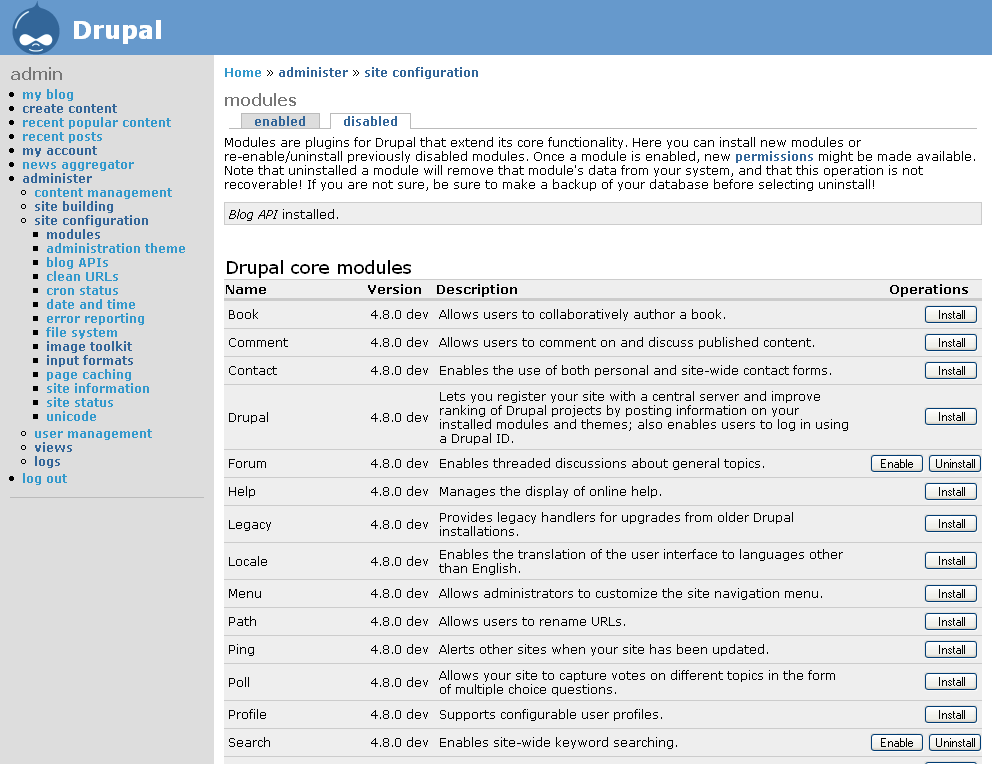
merlinofchaos commentedThe disabled page.
Comment #2
merlinofchaos commentedSo initially I was against switching from the checkbox to just a link, but then I realized that it'll be very confusing to have checkboxes and give people the ability to uninstall disabled modules.
Note that I don't yet have a status line in there that tells you if a module is uninstalled or installed but disabled (though it'll be obvious from the links being different). In the screenshots there aren't any examples of that, and since on that test version my modules page buttons don't (yet) do anything I didn't bother to muck the database to make it appear as though a module had been previously installed but disabled.
Comment #3
Jaza commentedNice work, Earl! Looking good so far.
However, I don't think that the modules listing has been broken up enough. IMO, one of the biggest benefits that we need to see from a 'modules page' rework is a reduction in the number of modules that the user sees on the page at any given time. Breaking it up into 'enabled' and 'disabled' pages is a good step in this direction, but I don't think it's enough. The listing also needs to be broken up according to category.
I have considered two possibilities for achieving this break-up using the menu hierarchy, but I don't think that either of them will work very well. The first possibility is to have all the 'categories' as second-level tabs, beneath 'enabled' and 'disabled'. Considering the number of categories that will probably exist for modules (the Drupal.org module categories page gives us a rough idea), this will result in way too many tabs. The second possibility is to change 'enabled' and 'disabled' from tabs to normal menu items (i.e. menu items that appear in the navigation tree), and to make the categories appear as normal menu items beneath them. Don't think that this would be terribly good from a UI perspective either.
I have another idea, which I think will provide a better UI experience than using more menu items and/or more tabs. We could remove the 'enabled' and 'disabled' tabs, and instead, we could provide a filtering form, similar to the one found on the 'admin/content/node' page (formerly 'admin/node'). The form would look something like this (sorry for the 'ASCII mockup' - it's easier than doing a graphical mockup, especially with the select box options):
"Show only modules where:
Status is: [(select) enabled | disabled | installed | uninstalled]
Category is: [(select) required | core | ecommerce | uncategorized | etc]
[(button) filter/refine] [(button) undo] [(button) reset]"
We could set it to have a default filter of status 'enabled', and category 'core'. What do you think?
Comment #4
merlinofchaos commentedMy current belief is that the categories used for finding modules that you might want to install are a very different set of categories than you would use to list modules that are currently on your system.
What I'm working on right now should theoretically use fewer categories; in fact, the main design goal here is more to keep modules that *need* to be together together (in particular, see the ecommerce package). Which is why I'm using 'package' rather than 'category'.
Right now, if you broke up each page by category, you might see:
enabled, drupal core, contrib, views, ecommerce, cck, links, organic groups
There may be a few other packages here and there...and it would still probably slowly grow, so that's something to consider, but it shouldn't immediately be 20. Still, I'm not sure I like it.
How much does a filter buy us? There's time to develop vs benefit, and I'm not entirely sure the benefit would be enough. I'm definitely interested in opinions here!
Comment #5
gregglesOne comment on the screenshots - I believe the "install" and "disable" links should be buttons. I believe the html spec says that only buttons should be used for operations which impact the server.
In addition to being "what the spec calls for" using buttons prevents problems with some browser extentions. Certain web "accelerators" will follow all links on a page which has disasterous consequences for pages like this.
The only other bit of input I have is the use of the word "enable" in place of "install". It's a subtle difference, but if I "install" pathauto for the first time it does actually install it, and then I can disable it. It looks like your screenshots would then allow an "install" of pathauto when all that is really happening is "enabling" it. If we actually had "install" vs. "enable" vs. "disable" vs. "uninstall" as distinct operations under the hood (which may make sense at some point) then I think the wording would be clear. But from a user perspective right now I think that the tabs and the wording on the page reflect the concept of "enabled" and "disabled" and therefore the "install" link should be changed to "enable".
And...LOOKS GREAT! This seems to me like a definite improvement over the current screens.
Comment #6
merlinofchaos commentedActually, I do in fact plan to use install vs enable, Greg, and thank you very much for summarizing the argument as to why in a way I wasn't able to when someone else mentioned it earlier! That hits it right on the head, IMO.
Also, 'gah' about the links/buttons. I hadn't thought about that. Pity, though, because buttons take up a lot of screen real estate and I really hate them in tables. Lots. :/
Comment #7
greggles"Actually, I do in fact plan to use install vs enable" ok, then I guess that works great.
And buttons don't have to take up a lot of space. Just the default size makes them take up lots of space.
Comment #8
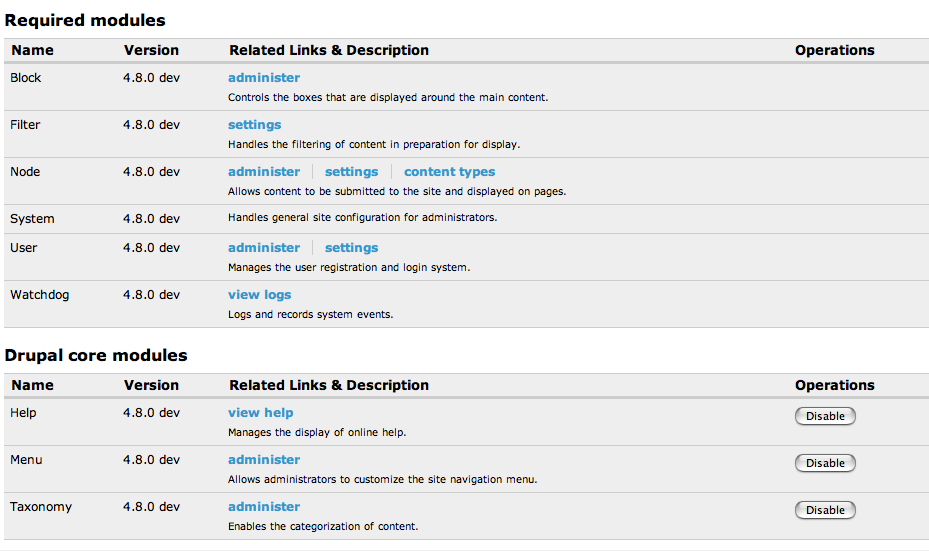
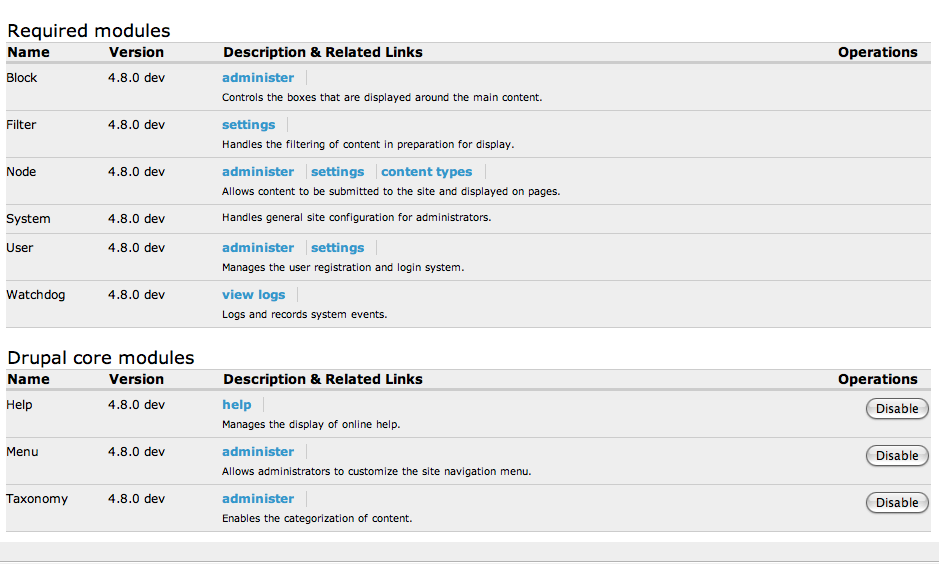
merlinofchaos commentedOk, another screenshot. This version uses a button. Has dependency checking. Heck, the buttons even work now, though the code isn't ready to be released. I've let people in the IRC play on my test site for interactivity.
Comment #9
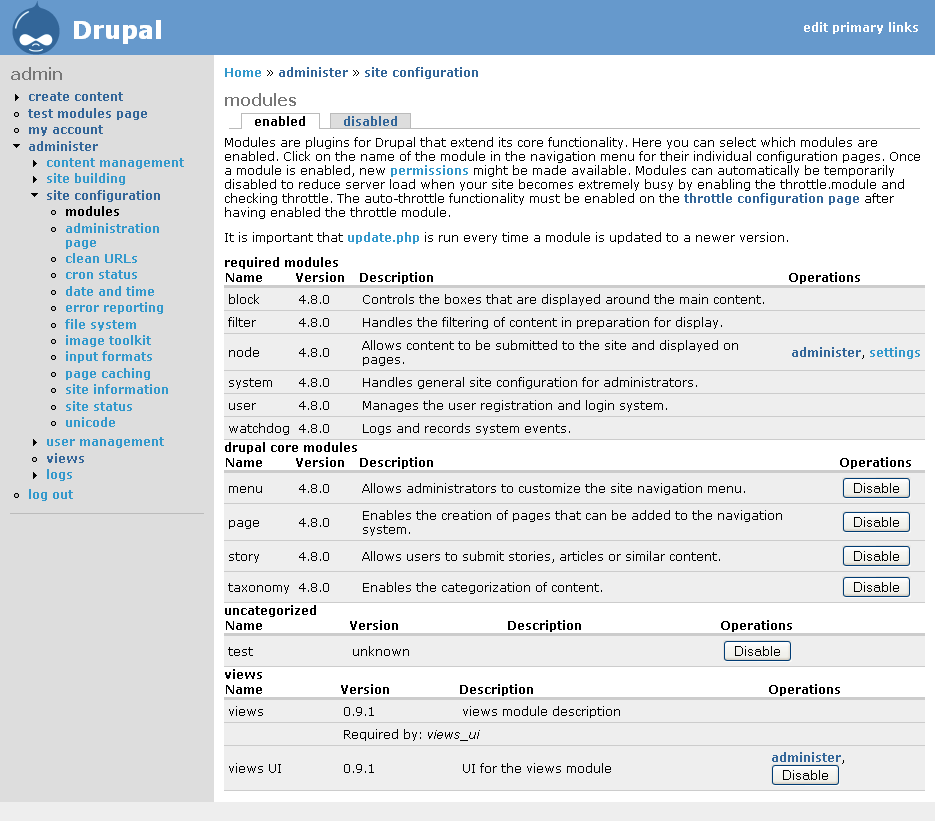
merlinofchaos commentedenabled page
Comment #10
Stefan Nagtegaal commentedTo be honoust, I'm not very fund of the buttons and would be much happier to see the links-like approach. That way it's easier to theme them, and would even improve the look-and-feel of our administration area.
It is also much more consistent with the rest of the administration because mostly, we have links in the 'operations'-rows instead of true submit buttons..
Comment #11
rickvug commented1) I love how everything is laid out but I think that the headings need to be clear and consistent throughout the administration interface. See the admin headers for an idea of how the different sections could look. I'm guessing that somethings like this is in the works, as that was your patch after all.
2) If you are going to be doing the buttons think that they should be somewhat symmetrical. The install button looks small to me.
3) Is it just me who thinks that module names should be capitalized? It makes sense in my mind and would make modules look less wimpy, if that's a good description.
4) How are the sections going to be made? I am currently guessing that this will be based upon the directory structure. If so, are you planning to have nested directories within this structure? This could be a worthwhile feature in my opinion - I'll use the E-Commerce module as an illustration. If this project were to group related modules into folders sorting everything would be much clearer. Payment gateways, product types, shipping calculators and pricing modules would be grouped together nicely.
5) Building off of the last point, is the new block administration system going to address dependencies? If so, this could be done by parsing the directory structure as well. For example, for the ecommerce system to be considered functional core modules plus one payment gateway and one product type must be active. In my opinion, the status of the entire package should be evident in the blocks section for maximum usability. Maybe there would be a small message under the category listing alerting the user that the module package has dependency issues.
Hopefully I didn't go too far with the ideas, scope creep can be a killer. I'm guessing that a lot of this is redundant for those in the know anyways. Thanks again for the mockups.
Comment #12
rickvug commentedTo chime in on the categories vs. packages debate, I'm definitely in the packages camp. Earl gives this list which I think is bang on:
"enabled, drupal core, contrib, views, ecommerce, cck, links, organic groups"
What I propose is this exact categorization with one (and only one) more level of nesting for particularly large projects to break things down further. Top level packages should be distinctly marked while sub-sets of packages should maybe be given a bold header Here is what the structure could look like, with views in the contrib folder to spice things up:
drupal core
- list
- modules
- here
contrib
- views
--- views rss
--- views core
--- views ui
--- views theme wizard
- webform
- tiny mce
- img assist
cck
- content
- date
- text field
- number
- user referance
ecommerce
- core
--- store
--- cart
--- payment
--- shipping
--- product
- product types
--- auction
--- custom
--- service
--- tangable
- payment gateways
--- PayPal
--- WorldPay
--- COD
--- Linkpoint
- shipping
--- shipcalc
--- ship basic
organic groups
- modules
- here
- etc...
I think everyone gets the picture.
Comment #13
asimmonds commentedPlease don't change the title as it affects the whole issue.
Comment #14
greggles@merlin it looks great to me!
@stefan - while links may be more consistent inside drupal, they are not consistent nor very safe for internet use in general. Most of the time in drupal admin interface a link to take an action will link to a confirmation page - the confirmation page will have a button. For example, admin/comment/list/approval has links to "edit" or "delete" but either of those links takes you to a form with a submit button.
In this case I think buttons - themed to be skinny - are more appropriate.
Comment #15
merlinofchaos commentedAttached is a patch so people can play with this. Some notes:
1) I haven't cleaned up the code very much, and there's some stuff I want to re-organize, see if I can compact, and I've left in code that's commented out that will obviously need to be removed.
2) This one uses .ini files, which I'm sticking with *only* until basically everything else is done. Switching to the other files is annoying grunt work, but Steven posted some code elsewhere that will basically allow us to have our own file format that's better and just as safe. I'll go with that over .ini files.
3) Really this is just to play with, tho if you really want to point out code issues, go ahead.
Since I can't put the meta files in the patch, I'll attach a tar.gz to the next followup that contains them.
Comment #16
merlinofchaos commentedmeta files, ini format
Comment #17
dopry commentedSo far the patch looks good.
There is an issue with the sorting on the disabled page...
The 'required modules' key of packages is empty and throws a bug in the foreach on line 1289 of system.module.
I kind of prefer the old checkbox method for enabling and disabling modules. Merlin and I talked about this in IRC... Its technically more clicks with the checkboxes, but I see it as more round trip time to the server...
I'm more concerned about page requests than clicks.
I also see buttons as more prone to accidental clicking.
merlinofchaos, expressed the argument of a rarely used feature after install as a justification for removing the batch capability of the checkboxes. I think the rarely used after install feature should indicate that this thinking is flawed to some degree. If I install e-comm or cck... I've suddenly got a bunch of round-trip page requests to wait on... If I just installed drupal... My first impression of drupal is a bunch of round trip page requests to wait on while I enable modules.... on those rare occasions that I disable or enable a single module after the upload is the two clicks + submit and harder than 1 click + submit...
I also think refining interfaces shouldn't particularly require a slash and burn approach as it involves a change in the expected ui for experienced users, and additional learning curve on upgrade.
I think we can accomplish the same goal of expressing dependencies with less impact on the user interface, without losing the batch operations features by using check boxes and the disabled attribute, and allow on activation setup through the settings link ++ newly installed module indicator or batching the configs for each module into the follow page using fieldsets.
I almost think it would be nice to see uninstalled modules on the second tab, and eliminate the disabled tab. Depending on the checkboxes to indicate enabled and disabled status.
However, the dependencies and groupings that are being included in this patch are far more important than my personal opinions about checkboxes vs buttons. I can form alter to get the ui I want for myself... ;)
so in the end a +1.
Comment #18
nickl commentedI'm submitting this patch to hear your comments before I get too carried away with it.
This patch includes all Earl's previous changes.
Please find the new meta descriptors for testing this patch here: http://drupal.org/files/issues/meta.tar.gz
Comments and suggestion on the descriptors are being followed in this thread: http://drupal.org/node/76549
Progress:
We've implemented Steven's file parser and moved away from .ini files.
Added drupal version checking which is implemented to validate from major version numbers downwards. eg. if the module specifies version 4.7 and the drupal version is 4.7.2 it will succeed. If the module is only written for 4.7.2 then it has to be stipulated as such.
Bug fixes corrected and code has been cleaned up to ready for cvs commit.
When disabling a previously enabled module and it's dependencies you were not able to uninstall it, this is now fixed.
To start prettifying the screens I've placed all the packages in one table to keep the spacings the same. The package header class="modules-header" and the table headings class="modules-heading" can be styled separately. Please give feedback on this.
As per usual your feedback and comments will be appreciated.
Comment #19
nickl commentedDarrel: I agree with you on the multiple round trips to and from the server. You also mentioned the ecommerce set of modules which I experienced in the past if you do not enable all 5 the required modules at the same time that it messes up your whole installation.
The buttons work well and they are very descriptive about the action you are taking. Someone has suggested in the past that we could use javascript to simulate the actions and have the form submitted in one submit.
This will require the dependency checking to move down to the client for you to be able to enable the dependents. The dependency system is much simpler now and this might very well be possible. Setting hidden variables and prompting the user to save unsaved data before submitting. Possible but is it viable?
As far as ui changes are concerned I think its brilliant. Every release should give you a brand new experience. You can still do everything you could with your previous release and the fun part is looking for the screens as you experience the new release that is obviously different than the previous one. It shows that progress has been made and gets me, personally, very excited to discover the new features I've been promised. YMMV
Comment #20
nickl commentedI'll say it again... I'm new here please excuse me. *blush*
Comment #21
nickl commentedTheming to remove hard coded html tags.
Proof of concept for a patch on theme.inc to be able to identify a table's cell as a header. Please have a look and give your comments and suggestions.
Thank you in advance...
This patch replaces all previous patches.
Comment #22
nickl commentedPatched again without overwrite typing mode. *blush*
Comment #23
rstamm commented@merlinofchaos
Why not a hook_meta()? Similar to hook_info(). I think it's much easier to handle.
Comment #24
merlinofchaos commentedBecause the meta files may need to be processed by drupal.org (futre path), and running random PHP code on drupal.org is a nono. Therefore, meta files must be parseable text.
Comment #25
merlinofchaos commentedHere's an updated version. Requires Nick's meta files from #18.
Comment #26
merlinofchaos commentedSomehow I got the wrong patch. No idea how that happened.
Comment #27
merlinofchaos commentedSigh. I keep posting out of the wrong directory. Really. Right patch this time. Promise.
Comment #28
rstamm commentedMissing protection of .meta files from prying eyes.
Comment #29
nickl commentedNew patch as per changes on head.
Fixes:
Removed all tabs and only patched additions and changes.
Typing mistake in variable name fixed
Buttons have classes added for styles sheets
Formatting and coding standard cosmetics
Tested with new head install drupal, enable disable uninstall of modules seems working please test and give your feedback.
Your suggestion and comments will be valued.
Comment #30
nickl commentedStyle sheet patch for drupal.css to prettify the modules table.
You will also need these descriptors: http://drupal.org/files/issues/meta.tar.gz
Unpack into your modules directory.
Comment #31
paranojik commentedReapplied to latest HEAD.
Great work guys. The only thing that bothers me are the operations buttons. I would preffer if they were positioned closer to the module name.
Comment #32
merlinofchaos commentedHere's a major update to head.
I believe this is the roughly 'final' configuration of this patch. i.e, it is READY TO BE REVIEWED for bugs, inconsistencies, etc. It contains everything I want it to, the code is relatively clean, and hopefully I did not forget anything.
First, here are the meta files it requires:
Comment #33
merlinofchaos commentedHere is the actual updated patch. It requires these meta files (From the previous comment)
Comment #34
merlinofchaos commentedScreenshot:
Comment #35
merlinofchaos commentedScreenshot 2
Comment #36
merlinofchaos commentedUpdated patch: Unlocks the width on the buttons (probably wasn't a good idea anyway) and, oh yea, -up is required on diffs. :P
Comment #37
dwwby request, here are the 2 screenshots from safari 2.0.4. first, the enabled page.
Comment #38
dwwand here's the disabled page, same browser.
Comment #39
m3avrck commentedThis looks awesome! Can you really *uinstall* modules? Just comment to track this thread for now, hopefully more thorough review later.
Comment #40
merlinofchaos commentedYes. For core modules I included code to drop their tables.
We're still pondering (and now this issue can ponder) the question of what modules that provide a node type should do.
Options:
1) Create a 'default' node type that node.module understands and revert nodes to that type.
2) Delete the nodes and provide a warning.
The disable modules page is already warning (though I think not sternly enough) that data loss could result, so I believe 2) is a very good option.
Comment #41
nickl commentedTested working looking great. I think Earl has incorporated all the feedback and ideas from the past into a master piece that everyone can happily accept and enjoy.
Lets move this along before HEAD runs away from this patch again. +1 RTBC
Comment #42
merlinofchaos commentedFresher meta file with corrected links.
Yes, it includes meta files for views (which I use to test dependencies) -- it's easier to leave them in and you can use it to test dependencies too.
Comment #43
webchickI absolutely love this functionality. LOVE IT!!
Some comments:
1. It needs to be made WAY more clear than it is right now that uninstalling modules is totally destructive. By playing with the interface, I managed to delete all of my primary links and menu customizations, all comments on my entire site, all the taxonomy terms and vocabs I had setup, etc. It's just a test site, so I don't care. :) However, an new user randomly clicking stuff to see what it does is going to be in for a world of hurt.
Ideally I see this happening like:
1. I go to uninstall the Taxonomy module
2. Drupal checks to see if I have any data in the affected tables.
3. If so, Drupal pops up a confirm_delete form that says:
Warning! You will lose the following data if you uninstall this module:
[insert table containing stuff ... probably like (pseudocode):
foreach ($affected_table):
$results = SELET * FROM $affected_table LIMIT 30
theme('table', $results)
]
Are you sure you wish to continue?
[confirm] [cancel]
2. Stuff in the variable table remains in the variable table for uninstalled modules. Not sure if this is a big enough thing that it's worth bothering with, but figured I would point it out.
3. At the DC training we did a couple weeks ago, one of the students pointed out that one of the biggest challenges to getting around Drupal is that "stuff" for each module is everywhere. While this patch goes a long way towards solving that problem, there are still other places you conceivably have to go. For example:
Obviously, this will get really wonky if the perms continue to be displayed like:
administer, settings, blah, blah
So I'd suggest making them into a bulleted list or something, displayed vertically. Then they can be added to at any time.
4. I see that in the .meta file it defines said links. Just curious, could the same thing be done by parsing hook_menu() , or is it better for it to be created dynamically?
That's about all I can think of for now. Excellent work on this patch. :D
Comment #44
merlinofchaos commentedUpdated patch fixes some text, a colspan, plus fixes a blank page when disabled page is empty
Comment #45
merlinofchaos commented1) I'll have to think about the proper way to do a confirm for the uninstall. It'll definitely take some thought. In the meantime, I made the 'this can destroy data' more emphasized at the top. I'm not sure whether the confirm is a good idea considering the effort that will go into it, but maybe it is.
2) Yea, variables should probably be unset too. That'll require a little research into which variables the modules want removed. And probably we should delete node content.
3) I'll try a variant with a bulleted list and post a screenshot shortly. That should be an easy one.
4) It's possible we could do it by parsing hook_menu but we'd have to tag the links we want to show up that way. For now i think it's better manual, since we can be more arbitrary about which links to use here. We don't want to put every link a module has, after all.
Comment #46
merlinofchaos commentedNew meta files with some more links
Comment #47
merlinofchaos commentedFreshest patch. This one automatically adds 'help' links if they exist, plus uses theme('item_list') for those links.
Comment #48
webchickI don't know exactly what's up here, but when I go to either admin/modules/enable or admin/modules/disable, I get no table of modules. I suspect it has to do with:
Comment #49
webchickComment #50
nickl commented@webchick the test for (!$packages) caused the problem. Changed to (!is_array($packages))
Try the new patch.
Comment #51
webchickYep, that fixed it!
Now onto the review stuff. :P
Comment #52
merlinofchaos commentedThis patch includes the confirm form; however, for reasons I don't understand, it gives a whitescreen instead of redirecting on successful confirm.
Currently only forum.module utilizes the confirm form.
Comment #53
m3avrck commentedHere's a screen of an improved interface.
I moved the links below description, this makes sense, they are *not* operations... operations is really only disable/enable/uninstall ... a link to admin isn't an operation.
It's not 100% polished but I think it works out better. Thoughts?
Comment #54
m3avrck commentedHere's another screen shot, further improved. This one changes the focus to the actual links, instead of description. This makes more usability sense, the description should be supplementary, the links more of the focus.
Comment #55
nickl commentedAdded $confirm and information messages to hook_uninstall on all modules that have drop db queries.
Added variable_del to these as well.
Comment #56
merlinofchaos commentedFreshened meta files
Comment #57
merlinofchaos commentednickl's patch + some CSS updates from m3avrck -- and some more from m3avrck coming
Comment #58
m3avrck commentedHere's an updated patch. A few things:
- all meta files are now part of the patch; no need to download those separately
- lots of CSS cleanups, more tweakings to the interface
- a couple tweaks to the outputted HTML and links
Note, this patch uses a custom system_links to work properly. This patch shouldn't really use this-- http://drupal.org/node/65151 is the real solution, but that needs to be commited. Depending on when that is commited we'll update this patch or that one accordingly. Shouldn't hold up this patch though.
Comment #59
m3avrck commentedHere's a screenshot of what the new interface looks like with the above patch.
Comment #60
m3avrck commentedUpdated patch, cleaned up a few more formatting issues.
Comment #61
m3avrck commentedJust occured to me, if anyone else tries to make a patch they will have to hack their CVS/Entries to include the meta files too. To save everyone the hassle, here is my drupal CVS folder zipped up. Just extract this, run cvs update -dP, modify files and create patches with cvs diff -N to add those new files in.
Comment #62
webchickOk, possibly becaue I'm stupidly tired, I couldn't get the above install to work (kept saying mysqli_something_something was not defined), so here is attached my meta.tar.gz with updated links.
What I did was:
So basically, links: is just a list of kind of "oddball" links that can't be parsed out programmatically (and believe me, I tried ;)).
To be done:
1. Roll a patch for "add X" links for node types.
2. Add back in the aforementioned "content settings" links. They should appear for any node type.
3. Something else that would be *really* cool (don't know if it's possible currently) is create a link for any module that alters the node settings form (comment, upload) to the content settings page as well.
I don't know if I'll be able to work on either of these before the code freeze. :( I hope someone else can pick up the chain here in case I can't. It would be a tremendous usability boost for Drupal.
Comment #63
nickl commentedNew patch including the new meta files from webchick.
Added .install files for hook_uninstall on modules that have variables.
All variables can't be cleaned up properly as we have variable variable names but this should not be an excuse to keep this patch up. ie:
upload.module
amongst others...
Fixed a bug that sidestepped the programatically retrieved links help and permissions.
Moved help and permission to the front of the list, seems more aesthetically pleasing.
Changed heading because there are no links on the disabled page.
Major code cleanup and comments.
I want to urge again please give your attention before HEAD runs away from this patch again.
Lets move this forward... any comments? RTBC?
Comment #64
nickl commentedScreenshot teazer for you guys who just want to comment and add your +1
Comment #65
nickl commentedYou will need to follow these instructions :
http://drupal.org/diffandpatch#comment-147010
if you want to create a new patch against HEAD and also include the new files in the patch.
Comment #66
keithinstone commentedTaking my first look at this. http://drupal.org/files/issues/s2.png
Good overall. What I think improves the usability -
-- Merging "enabling" and "administering" into a single place. Having to turn on a module and then find its settings somewhere else is a pain.
So let's keep going in this direction.
What I believe not a good change (because it would not matter to me as a normal "clueless" admin) -
-- The grouping of "required" modules with "core" modules (and I assume there will be other groupings). Instead, how about if all enabled modules are in a single list, but the ones that are "required" just do not have a Disable button - instead a piece of text with says "Required"?
I know this is what it is like today - in my view, today is better in that regard.
Perhaps as a compromise, a way to sort the modules - default is by name but if someone wants to sort by the last column (or sort by a new column called "Module type"), then you have groupings the user can control. (Being able to group by version could be very useful, too.)
Also, one thing that is not clear to me yet - what happens when you "enable" a module - it SHOULD go to the admin or settings page for that module, instead of returning to the list of modules. After you are done with the admin screen, then you should return to the listing.
But overall, this is a great improvement. It surfaces an interesting issue - what is the difference between "administer" and "settings"? When you bubble up features like this, it makes those subtle differences more important.
Comment #67
sanketmedhi commentedGreat work buddies. The new module page looks awesome!
A few suggestions to make it better....
1. It would be great if we can have links pointing to the module's web page and/or documentation page
2. If possible, using AJAX for editing module permissions, settings, etc. instead of another page
3. Categorization of modules like on the Drupal.org/project/Modules/category page
These are just suggestions. It depends on the devs to decide what is feasible and practically possible to implement.
Thanks a lot for this great patch!
Comment #68
nickl commentedNew feature request as possible fix to issue razed in
#63 problem deleting variables in uninstall with variable variable names
(that's the last time I'm going to say variable variable *dang*)
http://drupal.org/node/79792
Comment #69
eaton commentedThis is more than a good patch -- it's an important patch. As Drupal is dependent on modules for almost all of its functionality, a clean interface for managing them is really, really important. For those who haven't been keeping track, it brings us the following:
I've taken it through its paces installing, disabling, enabling, uninstalling, configuring, etc. It's important.
There are some minor UI tweaks I think could help it -- I'd rather not see the 'required modules' list ever shown, because they are effectively baseline drupal features that *happen* to be implemented as modules, but that's a minor nit to pick. I'd also like to see a more explicit page title saying 'Enabled Modules' and 'Disabled Modules'; it took me a minute to realize that the list was so short because the enabled/disabled tab had been added. But that, too, is a nit to pick with a patch that is very, very important and very broad in its scope. Arguing about those finer details is something that can be ironed out in a subsequent patch, as people figure out whose aesthetic tastes are better.
This patch needs to be committed; 4.8/5.0 is getting major improvements in almost every area, administration being a major one. This is an important part of Drupal's growth into a truly user-friendly (AND powerful) CMS.
This patch is RTBC.
Comment #70
nickl commentedThank you eaton.
This post is probably not necessary anymore but it just dawned on me that I can patch the patch. If you really do want to patch some more on this you can do this cvs patch to your patched cvsroot to create all the entries for new files. Redundant information #65
I'm happy to see the day that this patch is going to lie down and rest with the other great patches in Druplicons warm belly in the sky...
Comment #71
eaton commentedNo, I think patches-on-patches would just complicate this excellent addition. Things like hiding required modules, etc are minor quibbles and really should be left until after the core functionality is committed. Even the *ability* to cleanly hide required modules is something that would be aided by this addition.
Comment #72
merlinofchaos commentedTo follow up on some of the suggestions received:
When required modules were placed with the core modules, several of the attempts we used made it difficult to discern *why* they couldn't be disabled, and breaking them up into their own section proved valuable. They could easily be put back into the drupal core modules section, but I've grown to really like them separate.
Having them not appear at all is a bad idea, since they contain valuable administrative links.
Going to the settings page is not necessarily a good idea; for one, not every module even has a settings page, and for 2 it's not certain where that settings page is, and for three, you may be enabling several modules. People are already going to complain about the checkboxes being gone.
That said, modules that provide a settings page might put a link to that via drupal_add_message, so you can quickly go there if you like, and I may add that and roll a new patch unless this gets committed first.
Modules which have their own documentation page should be able to simply provide that as a link. I'll test that out with Views but I'm pretty sure that will work. None of the core modules are likely to do this since they are documented inline using the 'help'.
Using AJAX to do stuff here is a bit out of scope for what we're trying to accomplish, in part because the jquery patch still isn't in, and in part because my javascript fu is pretty weak.
My feeling is that the categorization used to find modules you may want to install is not very much like the categorization you need to administrate modules you have on your system. With this patch, contributed modules are allowed to categorize themselves as they feel like. Hopefully this won't turn into a giant mess.
This is relatively straightforward, and makes perfect sense.
Comment #73
webchickWe can't really do that... not all modules have admin or settings pages, and some have both. Also, if you want to enable several modules at once, it would get very annoying to have to keep clicking back to the modules list in between.
I think that's out of scope for this patch, but could possibly be added in as a later improvement.
Yep, this happens in the most recent version of the patch -- each module gets a link to its admin/help page, if found. nickl fixed a problem with it displaying.
Comment #74
webchickOops, too slow. :)
Comment #75
merlinofchaos commentedBTW, any existing changes are cosmetic; at this point I want to hold off on making them, and create a second patch of cosmetic improvements. I'd like to get the core of this patch in.
Likewise, as soon as this is committed I'll go edit the module upgrade page and describe the meta file; and create examples for hook_uninstall (and hook_enable and hook_disable if they haven't been created).
Comment #76
m3avrck commentedNot only that, but now I'm off to work on the JQuery patch. Hopefully that will hit too... then we can spice up the admin page with some nice and useful effects, maybe even some AJAX-y too.
Comment #77
eaton commentedI vigorously agree.
Comment #78
m3avrck commentedHere's an updated patch with some more CSS fixes, along with fixing the problem of long descriptions squishing everything else.
Comment #79
Jaza commentedJust tested out this patch, and it works very nicely for me.
One problem that I noticed: forum depends on taxonomy, but this dependency is not specified in forum.meta. The dependency should be defined. AFAIK, this is the only case of a core module depending on another (non-required) core module.
Comment #80
Jaza commentedAnother problem: this patch should be removing all instances of 'admin/settings/modules#description' in hook_help(), and instead using the description from the meta files on the modules page. If I'm not mistaken, the patch ATM is leaving duplicate copies of the description text in both these places.
Comment #81
m3avrck commentedJaza you're right, plus Nickl says we are missing some install files now too. We need to address both of those issue first.
Comment #82
m3avrck commentedUpdated patch. Includes those missing *.install files, along with removing 'admin/settings/modules#description' references in each module file.
Only issue, you can't translate that text unless you edit the meta file. Can we throw t() in there? Probably left to be discussed in another issue.
Comment #83
notabenem commentedsubscription
Comment #84
merlinofchaos commentedSince the last patch was just fixing some errors, I'd like to RTBC this again. Anybody else want to give it a once, twice or thrice-over to make sure we haven't missed anything?
Comment #85
Jaza commentedAdd this line to forum.meta (see #79):
dependencies: taxonomyComment #86
Crell commentedQuestion. If the data in meta files is used at install time for determining dependency and such, why is it not just in the .install file?
Comment #87
merlinofchaos commentedCrell: AT some future time meta data may be used directly on drupal.org for any number of purposes. Having this readable data rather than code is much safer.
Comment #88
m3avrck commentedUpdated patch with Jaza's one liner fix in there.
Comment #89
dries commented(I decided not to review this patch until this late because I'm scouting for developers that make for potential core maintainers for the next branch. While you all do a great job writing code and making this better (really important and good work!), I'm somewhat disappointed by the quality of the reviews, and the fact that no one really questions important design decisions. Pointing out programmer mistakes is one thing, thinking about the overall architecture is another. It's an important quality I'm looking for.)
This patch is going to be a big step forward and I'm confident that it will hit core. It just needs a bit more work, IMO.
Comment #90
webchickTo briefly address #2, since that was directed at my input to this patch:
The reason I advocated for this is based on Lullabot's experience doing the Drupal 101 training in DC and walking newbies through enabling modules and watching their reactions to navigating the Drupal admin interface (which is of course second-nature to all of us so we're immune to this). To be frank, it confused the living crap out of some of them.
To break it down step-by-step (which is what you have to do when you're showing newbies how Drupal works), when enabling a new module, there are no less than 3 places you have to check in order to configure it:
And often times there are more. These don't apply to every module, but they apply to enough that you may want to check those too:
And finally, there's "everything else", all the totally unpredictable paths that a module can add to the system. a lot of them are intuitive, but others are not... for example, tracker.module adds "recent posts" Others are not directly visible in the navigation menu (such as "blog" to view all blogs), and thus people might miss functionality.
Short of reading hook_menu, there really is no way for someone to know all the things a module does when they enable it, other than doing this click-through excercise.
On the topic of bearing in mind who we're writing this for, the kind of "inspiration" for this came from a question by one of the students in the class:
"Well... but wouldn't it be better if you had just one page that showed all of these so you knew where to go?"
And I was very hard-pressed to disagree with him. ;)
Comment #91
Stefan Nagtegaal commented@webchick: I don't think that the links are a bad idea, but I do to think they do not belong where they are now. It looks cluttered (IMNSHO) and the fact that the fontsize of the links are bigger than the module description is - when you ask me - even worse..
What I suggest todo is remove the links from the table, and put it into some drupal_set_message().
So, when a module is enabled/installed we get a message like this:
drupal_set_message("The blablabla.module has been enabled on your site succesfully.\nTo make advantage of the features, you should proceed to the access control panel and check for the right permissions. After that, make sure to visit the blablabla configuration page to setup it's options.");
As some nitpicking asshole, I do still think that links for install/uninstall/enable/disable are better inside the 'operations'-column.. ;-) The more buttons are displayed, the more cluttered it feels.. Just see the difference between these two screenshots here:
- http://drupal.org/files/issues/modules-disabled.png (which looks real clean!);
- http://drupal.org/files/issues/modules-disabled-buttons.png (which looks a little scary, by having so much submit-buttons)..
I say this because I remembered some article about usability which says that users *think* forms are scary.. IMO it would make it's userfriendlyness better..
Last suggestions is to make sure you have helptexts for all the admin-pages. ATM it is quite inconsistent in core. A lot of pages have page descriptions/helptexts above the page, while quite a big group of pages are missing them..
Please I do like the functionaly this patch carries with it, but the standard is impressively high these days.. This patch is very nice already, but it just needs to have a little more userfriendlyness...
Comment #92
eaton commentedI can't comment about the meta file related questions (XSS included), but I'd like to quickly explain the reasoning behind my support for this patch. As of a couple weeks ago, when it was in its early stages, I didn't like it. I didn't like how things were divided up, I didn't like what I felt was 'more clutter,' and I didn't like the idea of providing links for each module.
There were a lot of refinements to the UI over that period, and the folks working on the patch paid a lot of attention to other CMS packages' module/plugin installation pages. Gallery2 in particular was a helpful guide. The amount of time they put into their plugin management UI, and the expert assistance they received, gave Drupal some good work to piggyback off of. The only piece that I've said was 'something that could be patched later' was whether to show the list of required modules; that seems to have turned into a religious/opinion issue with this patch, and the simplicity of changing it suggested to me at least that we shouldn't spend as much energy on *it* as we do on the overall system.
Regarding the buttons for installing/uninstalling/enabling/etc, rather than links: On principle, forms rather than links should be used to initiate actions. We break this a lot in core, but I think it's worth pointing out that it is the 'proper' way to do things. Second, it makes it clear that a user isn't just toggling a setting but initiating an action. Our old way -- using a single checkbox -- was deceptive once we started utilizing .install files, as it could mask the fact that a module's setup code had been run, even though the module was disabled. This makes it very clear what steps are being taken and mirrors the UI used by Gallery and other systems. It's quite possible that we need to add some CSS styling to the buttons to make them more attractive, but I think they are the right choice.
Regarding the use of links, I'm torn. I was opposed to them at first and felt they were both unecessary and cumbersome. Then I actually installed the patch, expecting to pick it to pieces. I realized that it was really, really, really nice. As webchick noted, it's hard to argue with the logic of a user who asks, "Why not just put those links in one place?" We spend a lot of time hammering out the right placement for config screens based on task-oriented administration, but it seems to me that 'configuring an installed module' is a helpful and useful way to get a user to the right screen without a lot of hunting. Many many times I've missed features that were 'hidden away' by modules because I had missed one screen tucked into admin/content or something like that.
Using drupal_set_message() for that purpose is not going to work. It's extremely transient. If I click even one of the links in that message and return to the screen, the message is gone. If I enable two modules, I only see the message for the second. And so on. If there is really a LOT of opposition to the links, perhaps a hook_module_status() could be used to allow modules to inform users of a single configuration step that still needs to be performed, error conditions, etc. upload.module, for example, could use it to notify the user that the /files directory needs to be created.
That hook could, I would imagine, be used both here and on an overall dashboard page.
Comment #93
merlinofchaos commentedThis is a problem I've always had about that distinction not being clear, but I do not know a better way to put it right now.
Given the way this his been evolving, and the general reaction of people newer to Drupal, the links are a very good thing. They provide an alternate path to get to administration of your modules, and for people who don't really know what they're putting together early in the process, the module they just installed is going to be the primary path to get what they want. And as Eaton said, putting this in drupal_set_message isn't enough. That message is transitory and gone in one page refresh. This way, a Drupal administrator who is lost but knows that what he needs to do has something to do with the foo bar baz module will come here, find the foo bar baz module, and at worst will click the help button, and at best will go right where he needs to go.
Tabs should be actions? Nothing in Drupal ever led me to believe this is the case. 'revisions' is not an action. 'outline' is not an action. 'settings' is not an action. 'access rules' is not an action. 'roles' is not an action. 'books' is not an action. 'global settings' is not an action. A theme name is not an action. Seriously, I had no idea this was a design constraint, and if it is, it's one that I am just boggled by.
SYSTEM may've been the wrong keyword there, but I wanted a way for core modules not to have to all have their verison # updated when a Drupal release is made. They all pull their version from the base Drupal version #. I couldn't immediately think of a better way to do it.
Read Steven's commentary on http://drupal.org/node/76549 to understand this one. We just used the code Steven provided.
A little but it seemed the most efficient way to do them, and the confirm form seemed like an important thing since serious data destruction can result if a user is careless.
The thing is, category is the wrong term. I've repeatedly resisted using the drupal.org categorization for this stuff which is both 1) hard to enforce and 2) not (IMO) useful for this page. Breaking up the modules list is, I think, absolutely critical and I know you personally don't believe that modules should put more than one module per module like ecommerce does, but the reality is that modules do and modules will, and module maintainers need a way to group their modules. 'package' is a fine keyword. We don't currently have a keyword to define this, and it's a hidden keyword besides, so even if I called it 'foo-bar-mambots' all it'd do is affect module maintainers. And one of the big things that must be taken away from this, In My Opinion is that people running ecommerce sites need to be able to maintain the ecommerce portion of them. Trust me, without grouping those modules together somehow, it's hard.
.meta files aren't user submitted, they're installed with modules. Dangerous PHP code could be embedded in the module too. What's the difference? I mean, sure, maybe the description should be run through filter_xss(), but the question here is 'why'? This is not user submitted data. It's no less trusted than the PHP code it goes with.
The .meta file starts and ends with information that is necessary to use the modules page without actually loading the module. One of my goals was to NOT load the module into memory. How many new users get hit with the PHP memory limits only on the modules page, because every module anywhere gets loaded just to get a tiny bit of information about the module? Links are in that file because they are on this page and the module is not loaded. No more, no less.
The only fine-tuning I had left was possibly some drupal_set_messages for when modules are enabled -- some messages that I'm no longer sure are really necessary anyway. Perhaps they are perhaps they aren't. I wibble about them.
Personally, I disagree about this UI needing any real fine tuning. Ok, the related links & description thing got capitalized in a later patch roll and that can be undone in the next patch. m3avrck probably hasn't gotten hit by that in the way that I have. On the other hand, when using titling, the Drupal way is also not actually correct, but that's not an argument for this patch.
Stefan: In regard to the links vs buttons, I thought that debate was done with. All I can so is quote greggles from way early in this issue:
When someone uses the argument 'unsafe' we cannot dismiss that. 'looks better' vs 'unsafe'. Which one wins? I prefer the link too, but I cannot in good conscience submit something which could have potentially disastrous results on someone's site if they're using one of those web accelerators.
I think webchick adequately defended the use of links on this page. I think the way that m3avrck laid them out is a very good way to do it, and I think it makes this page look really sharp and really useful. I've shown these mock ups to a couple of newer Drupal users and they all react very favorably to it. The huge list of links is not nearly as intimidating as one might think, because they are all very neatly categorized by module, and that is a categorization that is intuitively understood by anyone who has gotten to the point of understanding what a module is.
Comment #94
chx commentedmy two cents. are there lots of links? surely there are. Is this a problem? nope. the arrangement of the links make it crystal clear.
is this an alternative dashboard? the question implies that "alternative dashboard is bad!". I do not feel so. One can say that there are different ways to think about a problem and this simply supports another way of thinking.
Comment #95
ontwerpwerk commentedI like the links, I like the buttons - but I really get an uncomfortable feeling when they are both on the same page, because the links are for managing the settings of your site, and the buttons are for breaking your site and are dangerous (and the buttons should only be available to #uid=1 or users with 'install modules' permissions)
Maybe the latest screenshots of the enabled modules without the operations column are a good alternative for a general 'administration portal' or maybe in an 'about modules' page.
- I'd really move the installing and enabling of modules to a 'modules installation' page and make that page do one task only: install and enable modules -
Comment #96
webchickWow. I really like that idea.
That would provide a "jump-off" interface for all users with above-average privileges. Or even all users (though that would be kind of weird for them being exposed to individual modules like that.
That brings up another question -- are the links parsed from .meta files checked for permissions?
Comment #97
merlinofchaos commentedI'm not sure that removing the install/enable/disable/uninstall buttons and splitting the page into two completely separate areas really buys us that much, though.
Comment #98
m3avrck commentedUpdated for HEAD with the the "description and links" part fixed correctly.
Comment #99
m3avrck commentedAlso new page title for enabled and disabled pages so it's more clear where you're at.
Comment #100
m3avrck commentedAnd for a 100 and per request of Earl, here is a zip of my hacked drupal CVS so you can use this patch and also generate updates (which will include all new files and etc.).
Comment #101
nickl commentedInstead of using m3avrck's whole drupal cvs archive you can use this patch http://drupal.org/files/issues/new_files_cvs.pacth to update the CVS/Entries and be able to add the new files in your next roll...
Comment #102
merlinofchaos commentednickl: That patch did not work for me.
Comment #103
nickl commented*blush* I swopped new and old around the new being the old and visa versa. Tested against old and deleted all my entries.
Try this patch in your cvsroot:
It updates the CVS/Entries and you can reroll against cvs:
The -N is required to add the new files to the new diff.
Comment #104
dries commentedComment #105
chx commentedin a more general context, there seems to be a new ongoing debate between patch authors who see a basket of features as one patch and the core committers who would like to see smaller patches.
But keeping up with three patches is more work than keeping up with one.
But that's a separate issue.
Comment #106
dries commentedphp's ini parse function does too magic. I know you dislike regexps. Get over that, please!
This adds no value to the discussion. Please explain what is wrong with php's ini functionality, and how that negatively affects this patch. Thanks.
the package functionality is an integral part of the new page. it is much needed, even.
No, it's fairly easy to leave the package functionality out of this patch. And it is fairly easy to add it later on.
Comment #107
Steven commentedDries, why not to use parse_ini_file(): http://drupal.org/node/76549#comment-120240
Also, I've had bad experiences with depending on PHP's built-in parsing functions (e.g. highlight_code() used in codefilter) which tend to change in subtle ways from one minor version to another. The regexp does not change and we can tailor it to our specific needs.
Comment #108
dries commentedSteven, I read your comment but it doesn't make sense to me. Sorry. I've yet to read the first real argument, or see proof of that. Let's start with php's built-in ini functionality, and let us switch to something else, as soon it is really needed. Thanks.
Comment #109
webchickDries and Neil have pretty much stated in no uncertain terms that this patch will not be committed unless it's split up along the following functionality lines:
1. _uninstall hooks,
2. dependency system
3. the notion of 'packages'
4. a new UI for module management
5. meta files.
I'll take meta files tomorrow, and try and take a stab at some of the others as well, time permitting. If other people help out, we can still get this in! :D
Comment #110
webchickOk, here's the meta files patch: http://drupal.org/node/80952
I'll work on the uninstall hook now.
The rest are kind of dependent on these two, so not sure how to proceed.
Comment #111
webchickHere's the start of the uninstall hook one: http://drupal.org/node/81033
I've taken the stuff we can more or less directly copy/paste, but the rest of it will take some work and I don't think can happen exactly as is in this patch atm. My availability this week is not looking that great, but I've done the tedious part of the work, so hopefully someone else can bring this part home. :)
Btw, it's worth pointing out that with these two pieces of functionality farmed out into other patches, the crux of what remains is quite small by comparison -- maybe a quarter of the size. So if those two can be spiffed up and put in within the next day or two, there's still hope for this "little patch that could" yet! :D
Comment #112
chx commentedDries, see proof of what? That parse_ini_file dies on the first tilde character encountered?? tias.
Comment #113
kika commentedfollwing up. It sure needs usablity hand
Comment #114
neclimdulSplit off dependencies Add dependencies to .info files and respect them in modules page
Comment #115
neclimdulpackages split
Comment #116
drummIf there is nothing left here go ahead and close it.
Comment #117
webchickAll the UI changes are now left, but those will go in post-code freeze. Or should we create a separate issue for that as well?
Comment #118
kika commentedperhaps keep it here, this issue contains a lot of related discussion/screenshots. then again, lot of noise as well :)
Comment #119
sunHookin in, maybe will outsource module version display stuff for .info files.
Comment #120
webchickClosing this issue. Basically everything from it went in in other patches. Final one is http://drupal.org/node/87298.
Comment #121
webchickAhem. ;)