

 The Drupal Association has been working to figure out the most effective ways it can help local user groups organize Drupal camps. We quickly realized that there was a lack of data about how past and present Drupal camps were currently being organized. With that in mind, we created an online survey for DrupalCamp organizers that would help everyone understand how Drupal camps currently worked.
Over the course of about 7 weeks, we collected a total of 51 responses, with 6 duplicates and unusable, making our sample size 45 Drupal camps. In a previous article posted on the Drupal Event Organization Drupal group, I posted the results from the first 31 responses. Since that article was published (and because of it), we had an additional 14 responses, making the data that much more valuable.
Overall, the 45 camps that completed the survey had over 6,200 participants, a combined budget of almost $250,000, and were organized by over 400 volunteers.
The resulting data is extremely valuable to both the Drupal Association and Drupal user groups around the world. The Drupal Association now has an idea of how camps are currently being organized and can make informed decisions about how to help future organizers. Local user groups can use this data to help plan future events. In particular, the average cost-per-particpant and participants-per-volunteers data (highlighted below) should be considered when planning future camps.
- 12 were one-day camps
- 28 were two-day camps
- 5 were three-day camps
20 countries were represented:
- Argentina
- Australia
- Belgium
- Canada
- Czech Republic
- France
- Germany
- Guatemala
- Hungary
- Ireland
- Italy
- New Zealand
- Nicaragua
- Peru
- Romania
- Spain
- Sweden
- The Netherlands
- United Kingdom
- United States
It is not a big surprise that most camps were multi-day camps. I was surprised by the number of three-day camps. We didn't collect information about what took place each day, I'd be curious to know if the three-day camps were comprised of three days of sessions or something else (code sprint? coding for a cause?)
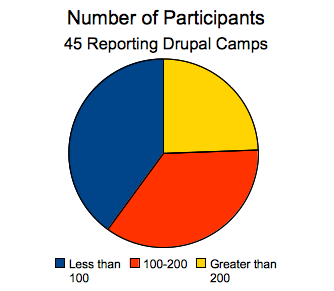
- Average attendance was 138 attendees, range was 20-375.
- 18 camps had less than 100 attendees
- 16 camps had between 100 and 200 attendees
- 11 camps has over 200 attendees
- Largest camp was DrupalCamp Spain 2010 with 375 attendees.
- The total combined number of attendees of all reported camps was 6,247.
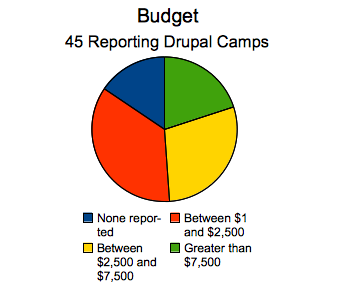
- Average budget was $6,205.50
- Largest budget was $55,000 (DrupalCamp Stockholm 2009)!
- 7 camps reported no budget
- 16 camps had a budget of between $1 and $2,500
- 13 camps had a budget of between $2,500 and $7,500
- 9 camps had a budget of over $7,500
- The average cost per participant was $35.96 (low was $0, high was $343.75)
- The total combined budget of all reported camps was $247,435.68
- (all amounts in USD)
Eleven camps had a cost-per-participant of over $50, including four from the United States. The highest cost-per-participant values occured in Sweden, Dallas, Spain, New Zealand, and Chicago. The median cost-per-participant value was $26.67 - this is probably a reasonable value to use for future Drupal camp planning purposes. Over half the camps had a reported budget of less than $1,000 - showing that it doesn't take a lot of money to put on a successful camp.
With the total number of attendees of 6,247, the reporting camps were collectively twice as large as DrupalCon SF 2010! For all camps, the average cost per participant was $35.96, just a fraction of what a ticket to DrupalCon SF 2010 cost. Clearly, camps offer an amazing cost-effective opportunity for new and existing Drupalistas.
- 26 camps charged no admission fee
- 2 camps charged an admission fee ranging from $1 to $10
- 5 camps charged an admission fee ranging from $10 to $25
- 8 camps charged an admission fee ranging from $25 to $50
- 3 camps charged an admission fee of over $50
- 3 camps had their admission fee provide less than 25% of their total income
- 9 camps had their admission fee provide 25% and 50% of their total income
- 7 camps had their admission fee provide more than 50% of their total income

- 19 camps charged an admission fee to recover some costs of the camp
- 11 camps charged an admission fee to get a more accurate count of attendees
- 9 camps charged an admission fee to appear more professional
- 1 camp charged and admission fee because they wanted active developers, not newbies
- (multiple answers were allowed)
As one of the organizers of Florida DrupalCamp, we debated charging a small admission fee. Our main reason for ultimately deciding to charge $6 was that we felt it was important to have an accurate count of attendees for planning purposes. Obviously, being able to recover some of the costs of the camp was helpful as well, but there appears to be no negative repercussions from charging a small admission fee.
- 23 camps reported a profit
- 0 camps reported a loss
- Average profit was $1,162.30
- Largest profit was $8,000
- 12 camps had a profit of less than $1,000
- 11 camps had a profit of more than $1,000
While we didn't ask explicity what camps did with any operating profit, conversations I've had with other camp organizers indicate that most profit is saved to be used as seed money for a future camp or donated to the Drupal Association. Some of the key questions in the survey had to do with the financial and legal mechanisms used by camp organizers. The Drupal Association sees these areas as places where it might be able to help out in the future.
- 10 camps paid for expenses out of pocket
- 20 camps had sponsors pay for expenses directly
- 14 camps paid for expenses out of a user group or camp account
- 7 camps had a 3rd party manage income and expenses
- (multiple answers were allowed)
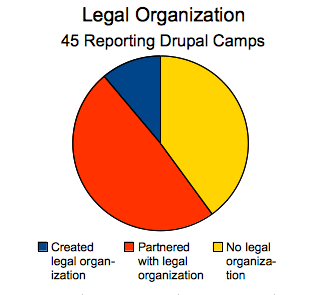
- 4 camps created a legal organization specifically for their local user group
- 1 camps created a legal organization specifically for their event
- 5 camps partnered with a not-for-profit (501(c)3) organization
- 17 camps partnered with another type of organization
- 18 camps utilized no legal organization at all
- 3 camps purchased event insurance from their venue
- 3 camps purchased event insurance from an agent/carrier
Providing a financial and legal mechanism for camps is one way that the association has indicated that it might be interested in helping camps. A bit more than half of the camps utilized a legal entity or a dedicated account to handle finances. Surprisingly, only 6 camps purchased any kind of event insurance. Granted, some venues include event insurance as part of the rental fee, but this is something that should be considered for all camps - especially larger ones.
- 12 camps purchased t-shirts to give away to participants
- 9 camps purchased t-shirts to sell to participants
- 29 camps provided morning drinks/snacks
- 28 camps provided lunch
- 24 camps provided afternoon drinks/snacks
- 12 camps provided evening drinks/snacks
- 12 camps rented additional equipment (chairs, projectors, PA systems, venues, internet services)
Other items paid for by camps included: notebooks, fliers, posters, bags, badges, patches, lanyards, banners, raffle tickets, sign holders. In addition, it is assumed that at some camps, sponsors provided some of these items.
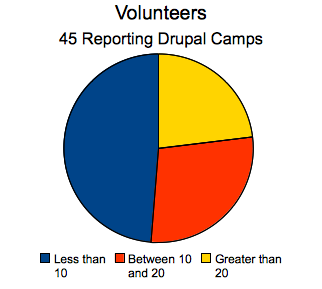
- 19 camps had less than 10 volunteers
- 11 camps had between 10 and 20 volunteers
- 9 camps had more than 20 volunteers
- The average participants per volunteer was 17.7 (low was 4, high was 137.5)
Larger camps tended to have a participant-to-volunteer ratio of between 10 and 15, while smaller camps were a bit lower. Four camps had participant-to-volunteer ratios over over 30, which skewed the average (and probably made for some very tired volunteers!) Ignoring these four camps results in an average participant-per-volunteer ratio of 11.8, which is probably a good value to use when planning future Drupal camps.
- 4 camps organized their camp sessions a low degree ("unconference style")
- 11 camps organized their camp sessions to a medium degree ("seeded the camp")
- 24 camps organized their camp sessions to a high degree ("all sessions pre-planned")
Clearly, the majority of the camps were more conference-like than unconference-like. Conference-like camps add an additional layer of complexity, resulting in the need for additional volunteers (both organizers and speakers), but probably results in better attendance (more people might be willing to attend if they know what to expect) and a wider variety of Drupalistas (especially if there are different levels and topics of sessions). Another possible benefit might be an increase in the number of sponsors - if they see an organized program, they might be more willing to participate.
The last question of the survey was for camp organizers to add any additional comments they thought might be helpful. Here's a sample:
We organized on a Google Wave, letting everyone who was interested join the conversation. We picked a good venue (Temple U, where one organizer works) who also donated the food and took care of a lot. We used a pretty basic site which we built in a one evening open sprint for the previous camp, and updated its theme with a new design. Overall, people step in and do what's needed and we don't do a whole lot of organizing and have no real power structure or people seeking power in the process. On the other hand, we always have our camps on a weekday because we are more professionals than hobbyists, and they've always managed to be smooth and professional.
We held in the camp in a very small village in the West of Ireland. It was held in a beautiful venue - the Burren College of Art which was about a mile from Ballyvaughan village. The idea behind this was that in a small and lovely location, it would be very easy for socialise during the weekend - and so it proved. We found this was as helpful as the pre-planned sessions themselves and people loved having the camp in a place that had a unique character in itself. We also found that staff and management of the Burren College of Art (who gave the use of their venue for free) were also very enthusiastic and helpful as it was an unusual (to them) conference to host.
Focused on track on beginners - soup-to-nuts intro to basics of Drupal core, how to install modules, some basic CCK & Views.
We did a mini, regional Drupalcon for drupal 'professionals' - no newbie track.
Having a focus on developers allowed us to get a lot of high-quality sessions, even with guest speakers from outside the Drupal world (php, mysql). The drawback was less sessions targeted at beginners (even though no restriction was imposed).
"We got it organised, with 45 people signed up, within 2 weeks. Only marketing was through twitter."
We partnered with local university for space, WiFi, most venue infrastructure.
We had a great party the night before and planned sessions. Unconference-style, but with good people ready to give talks.
We asked people to get drinks and snacks as "entrance fee", and we were surprised for the big amount of it, 3 months after we are still using that sodas in our local meetings.
The conference was more like a small DrupalCon than an organically organized camp. It succeeded in drawing an audience consisting of enterprise users. Everyone attending was very positive and claim to have learned a lot. Speakers were invited from all over the world, accommodation and travel expenses paid for. That worked out great and many speakers approached us later and thanked us for the opportunity. The attendees were happy to be able to learn about Drupal from some of the world's best. The camp had planned tracks (technology, business and online media) and one open (ticket not required) evening event which cost just $15 at the door and included drinks and food and entertainment (The Kitten Killers rock band). The conference also featured a parallel training track, which was included in the ticket price. It was very ambitious and took a lot of time and effort to organize. However the outcome was great and the amount of positive feedback overwhelmed us. All major Drupal shops helped sponsor and were on site. The camp was organized by NodeOne staff but we made a clear separation between us as organizers and the topic of the conference. The conference was about Drupal, not about who happened to organize it. The goal was to further interest in Drupal in Sweden and help open people's eyes to open source as a viable option to proprietary software. Judging by the response, we succeeded.

Comments
Drupalcamp naming
Well, this analysis leads to the question I raised a few times before. Drupalcamps originate from Barcamps (or correct me if I'm wrong) where the session content is not not pre-organized. Quoting Wikipedia (http://en.wikipedia.org/wiki/BarCamp):
The above survey shows that the vast majority of camps pre-plan sessions entirely. Not sure "Drupalcamp" is a fitting name if the format is not used, and many events don't use that name either (in Hungary we used "Drupal Weekend" and "Drupal Summer Camp" for the two events included respectively, but many people use "Drupal Day(s)" translated in the appropriate languages). I personally think if we label our events camps and don't use the format, its misleading. What do you think?
pacific northwest summit
The pacific northwest Drupal summit rotates between a few cities in the Northwest of the USA and intends to be a large pre-planned event. Their use of the word summit to mean something more official than a camp and less huge than a Drupalcon seems like a good choice.
I agree that saying "Drupalcamps are based on BarCamps" is somewhat awkward these days.
Calling them "Drupal Days" or "Drupal summit" works for me, though we have a lot of equity built up in the "Drupalcamp" brand that we might lose out on.
Most people don't know about BarCamps, so calling it a Drupalcamp doesn't necessarily bring in the "unconference" connotation.
Great work on this research, Mike! It's very useful.
--
Morris Animal Foundation
WordPress is doing the same, actually...
We recently had a 'WordCamp' here in Boulder, and it consisted of a set track. I suspect the meaning of Camp is skewing to mean 'Smaller/local convention' rather than 'unconference'.
--
-john
Brazil present
Organizers from Brazil just filled the survey, hope that you can include their info too.
Thanks in advance!
--
DevElCuy
Great Article
This is a great article for us in developing user groups. We've been tossing around the idea of a workshop camp for a while now, and having hard data will be helpful. Thanks for putting together the results.
Hi I was part of the
Hi
I was part of the organization team of DrupalCamp Spain (which is the largest in people of the data you collected), and we had to left some people out in the last days because the size of the venue.
We had 4 rooms for talks each of them was used all over the day so we had more than 40 sessions (http://2010.drupalcamp.es/sessions) from begginers to drupal pros, we managed to record most of them and now the videos are public domain.
The entrance was 35€ per attendee (even the organizators, presentors and volunteers), and most of the expenses were spent in venue and catering.
#drupalcampspain was in the top 5 hashtags of twitter in spain the three days and we displayed the twitter messages in a big screen in the entrance of the venue.
We had no help from Drupal Association in terms of organzing but it turned out just fine. People got very satisfied and happy at the end.
We are starting to plan Drupalcamp Spain 2011 right now, we expect to be more than 500 drupalists next year!
That campfire druplicon kicks
That campfire druplicon kicks ass.
DrupalCamp logo
Thanks Moshe! Glad you like it. :)
I originally conceived of it for the t-shirts my partner and I designed for DrupalCamp Toronto '07 (and again in '08). Here's a link to a directory containing a few SVGs and PNGs of the original design: www.substancecommunications.com/drupalcamp
We decided to donate the design to the Drupal community, so use it as you wish!
Thank you for collecting this
Thank you for collecting this data, realy valuable!
Do you have data about participant numbers of all camps over the last years?
Nope
Unfortunately, there is no central-repository for Drupal camp data over the years. The data for this summary was collected via a recent survey. Camp organizers voluntarily completed the survey.
-mike
Updating the Data for 2015
Hello all. @ultimike this is a great survey you conducted. Could this survey be repeated to show the current scenario? For instance, DrupalCamps in India (Mumbai, Delhi) have been seeing a massive upswing in participation and quality sessions. In fact the next DrupalCon is coming to Mumbai in Feb 2016. If this survey could be re-initiated, that would be great help.