Setting a monthly repeating event, as described below, results in multiple occurrences of the event in (usually) the third and subsequent months. The pattern should result in only one event per month. The first couple of months seem to work as expected, but at about the third month into the pattern, an apparent race condition occurs which seems to spawn sibling patterns – multiple occurrences (often a half dozen or more) of same event – in any given month. Screenshot here.
Please note: These duplicate events usually don’t appear until a day or two after the event is created, and they seem to increase in number over time!
Event patterns with “Repeat type” set to “monthly”, “End Settings” at their default values (i.e. unset), “Interval” set to “1”, “Days” to values such as “2nd Thursday,” “4th Thursday” OR “2nd Monday,” and all other values such as “Months” and “Exceptions” unset (i.e. default), produce the condition describe above.
Notes: Using flexinode for custom “event” type. Using cvs, 26/09/2006 - 15:01, build of Event Repeat; version 4.7.0, 18/09/2006 - 20:31, of Event module. Server is currently on daylight time at GMT -7 (GMT -8 in winter). User selectable time zones disabled.
Cron job is currently not running and the cron page is being called manually, approximately once a day or so. This problem seems to be independent of cron, however, as these duplicate events seem to magically crop up between cron calls.


Comments
Comment #1
Snow Valley Consulting commentedwe are having the same issues, but it is not just with monthly events, it seems to be all re-curring events. we didn't catch this for awhile and now we have thousands of duplicated events and are struggling to try to find a way to delete them all.
Comment #2
marcingy commentedWe had(ve) the same problem - we started trying to delete them by hand but it was really slow. What we did we via a SQL script in PHPMYAdmin we set all the nodes that we didn't want as unpublished. We then created a cron job to select and delete the offending nodes. It still took a long time to run but at least it automated the process.
Comment #3
seanbfuller commentedI'm hoping to carve out some time today and look into these issues. Let me know if you find out anything else.
Thanks for the bug report.
Comment #4
seanbfuller commentedskierboy and marcingy, what is the base node type you are using to create events? Flexinode? Basic event? CCK?
Also, what are you repeat end options set to on these? Are they also undefined like Rainy Day's?
I'm trying to test this with flexinode and cck now, but it will probably be at least tomorrow before I would really see the issue.
Sounds like it's not cron, so I'm wondering if the update api is getting called when it should not.
Comment #5
marcingy commentedThey are basic events. The events have a mixture of rules. Some have no end date and are repeating, while others have an end date. Both are weekly and have a day set for reoccurence.
Thanks
Comment #6
seanbfuller commentedI'm still having a hard time reproducing this with my test site. Any other details would be appreciated to try and find the common element that could be the culprit. Given the severity of this problem, it is currently holding up the release of the new 4.7 version of this module.
Comment #7
seanbfuller commentedI'm still unable to duplicate this one, but I was looking through the code today and found this in eventrepeat_nodeapi:
Note the "$_POST['op'] == t('Submit')" check. This would seem to suggest that if you had a situation where you are loading a node and have also just somehow clicked a submit button, nodes will get updated. I tried some of the event view modules that have a submit button, but I was still unable to get this to happen.
hunmonk might have a better idea about this, considering it is from his original code. It might be a red herring, but it was a place I noticed updates were being called in a place where one would not expect. If the three of you have something else that might be relevant here, give a shout.
Additionally, can you let me know what timezones you guys are running your sites in?
Comment #8
marcingy commentedMountain timezone (gmt -7).
Comment #9
marcingy commentedI have copied the data to my development environment I'll see if can spot anything. Also the production environment we use is hsphere based.
Comment #10
marcingy commentedI concur there is nothing obvious that is triggering this. I've tried updating events, creating new one and nothing seems to cause a problem. I'm checked the cron job and it is doing nothing - exec time 0 secs. It certainly seems to be a set of 'events' that is causing this problem. The only thing that I can think of with regards our site that makes our events different from the basic event is that we attach images and locations to events. Rainy Day do you do anything like this??
Comment #11
seanbfuller commentedWhat module are you using to attach images? Image attach?
Comment #12
marcingy commentedYes that is the module we are using for uploading images
Comment #13
greygoo commentedI'm getting the same problem. It's not just for events in third month. All repeat events I create seem to be duplicated twice or three times for the same day. My repeat events are for second friday of every month and last friday of every month. I haven't tried the latest version of Event Repeat though.
Comment #14
scott.mclewin commentedSean,
I found a variation on this within the 'eventproject' module that we've spoken about. I may have found two, see the support request I just filed.
It only happened when crawlers and users were viewing any month after the month in which the event had been created through the calendar of the event module. The hook within event that forces a render before the month display is put up was the culprit - at least it appeared to be. Even though I'd fixed it up I still have the problem, just on a much much smaller scale and I believe from a different root cause.
Because I was not using source control at the time that I fixed this on my fork in August, I don't have the exact delta (shame on me). The principle repair was in fixing an offset handling edge condition. I'll see if I can find the line or two I changed this evening if I have time. As I remember it, the error happened in the eventrepeat_render_nodes() call when calculating what to render. At some stage the last_rendered value was not having the appropriate GMT offset applied, which created a window for any GMT-x based event to get rendered twice. I'm sorry I don't have more information. Frankly I thought that I'd introduced it when overhauling eventrepeat to get rid of node creation and replace it with 'node projections' (small table entries for repeat dates rather than full on nodes) or I would have reported it to you along with the other problems I uncovered. I had seen this duplicating behavior in eventrepeat, but never identified it.
Hopefully this is the same root problem. I'll see if I can get more specific tonight. Without a change history I may not be able to give much more.
Comment #15
scott.mclewin commentedHere we go.
Everywhere else in the rendering function treats repeat_last_rendered as a date/time that needs to have the day offset applied except the line in this stanza:
I believe that last line should be
to keep the treatment of the value consistent. Without adding back in the day offset a teeny window opens up where events start to get created through the event calendar views.
At least that's how I remember it. Testing is obviously necessary as my work is on a fork. And, as noted in the issue I filed today, I'm still getting duplicated events - just not nearly as frequently. Without this one line change event duplication was out of control (in my forked version).
Comment #16
seanbfuller commentedThanks Scott, I'll try and test this tomorrow.
Comment #17
Rainy Day commentedmarcingy: No, not using images. I’m using flexinode to expand the basic event node type to add additional text fields (e.g. agenda, transportation, web page URI, etc.) Nothing exotic or unusual.
By the way, i was able to delete all the extra events by simply deleting the appropriate parent and telling it to delete all subsequent events. Didn’t have to edit the DB manually.
So long as i choose a short horizon for the repeat function (e.g. two iterations), the problem doesn’t seem to exhibit itself. It seems to be around the third or fourth iteration that the problem begins.
Comment #18
samcohen commentedI am having trouble too, and in one case would up with 4000 extra versions of the same event!!
It seems to occur when someone uses the event repeat form in the wrong way, for example, saying it should be every monday but setting the end date to a Tuesday. Anyway, I am really looking forward to the new release.
In the meantime, if anyone needs to delete a whole lot of events, I don't recommend php admin, because if you erase the nodes from the table, it won't erase them from the events, node_revisions and any other related tables. I used this code to ensure the node was deleted properly and it worked well for me. It still only deleted about 120 at a time before timing out and it also depends on no other nodes having the same title as the node you are deleting.
I just refreshed the page every minute of so and was able to get rid of all by events. I added the print line so I could keep tabs of what I was erasing.
$sql = "SELECT * FROM node WHERE title = 'event title'";
$result = db_query($sql);
while ($x= db_fetch_object($result)) {
print "$x->nid $x->title".date('m/d/y',$x->changed)." $y
";
node_delete($x->nid);
}
Comment #19
Anonymous (not verified) commented@Sean: should we look at moving to the latest cvs and see if this fixes it? (btw, I work with marcingy and we just got hit by this issue again)
Just thought that even though the code might not be 100%, it may be close enough and we can help get it closer... But we're on a live site so wanted to double-check. Thanks for your work on this!
Comment #20
Anonymous (not verified) commentedForgot, we're running:
$Id: eventrepeat.module,v 1.28 2006/03/17 21:56:47 thehunmonkgroup Exp $
Comment #21
seanbfuller commentedI believe that Rainy Day committed this on CVS, which means it exists in both versions. I'm trying to run through some of the code that scott pointed to as a possible culprit and hope to have an answer in the next week. You'll probably want to wait, but it's up to you.
Comment #22
scott.mclewin commentedI think I am finally on to another way that repeating events get duplicated. I've opened a new issue for it and placed the details on http://drupal.org/node/93256.
Comment #23
seanbfuller commentedThis is a small patch based on Scott's comment #15 above. It adds $day_offset to the $repeatpattern['repeat_last_rendered'], which seems consistent with the other references to that element. If those people who are having issues could apply the patch and see how it goes, that would be very helpful. Scott's comments suggest that this might not totally solve the issue, but it should cut down on the number of times the duplications are generated.
Comment #24
seanbfuller commentedSorry it's late. Here is the patch that goes along with the post above.
Comment #25
seanbfuller commentedYou may also want to look at this issue: http://drupal.org/node/93256. It's a patch that might help in testing and trying to catch this generation of nodes from another source than the one above. Thanks Scott for your work on this.
Comment #26
scott.mclewin commentedYou are welcome. I hope the mass-testing helps verify that this is indeed the problem. So far my logs continue to show that this is the root cause of the duplicate repeat events. Is it the last cause of duplicated repeat events? I sure hope so. I'm out of ideas.
Comment #27
Rainy Day commented@ Sean: Initially i was running the latest non-CVS version when i encountered the problem, but then installed the CVS version, and the problem persisted. So i can confirm: it is in both versions. (I am still using the cvs, 26/09/2006 - 15:01 build.)
I have just installed your eventrepeat_offsetrender.patch on my site and am testing to see whether that solves the problem or not. Will report back in a few days (the amount of time it sometimes takes to manifest). FWIW: I am running the patched version on a live site visible to crawlers.
Scott’s theory sounds very plausible to me. It would seem to explain quite nicely all the behavior i observed.
Comment #28
dman commentedYowza.
I just had to clear up 57,000 bogus events today.
We released the site to the client all nice last week, and they managed to add a few events nicely, but obviously something went wrong with two of them (one weekly, one monthly) and all hell broke loose.
My quick solution was
UPDATE node SET status=0 WHERE type='event';
to clean up the site, then re-publish the real, individual events that we needed this month.
However, I'm hoping that someone can figure this out soon. Until then I'm disabling the module and telling them to maintain it by hand.
I remember looking at the code long time ago, but couldn't get too deep into the logic.
Good luck, guys!
Comment #29
Rainy Day commentedSo far, the eventrepeat_offsetrender.patch is working on my site. No problems yet. Normally, i would have seen something nasty by now. Will report back in a few more days.
Comment #30
scott.mclewin commentedThat patch will greatly reduce the regularity of the duplicated repeats. Before I made that change to my site I was having duplicated repeats created every day or so. After the change duplicated repeats happened for another reason (http://drupal.org/node/93256) that took me a few months to identify. I'm glad this first run patch is working for you. Keep an eye out for this other version of the problem.
BTW the patch that Sean submitted to http://drupal.org/node/93256 does not reflect the logic in the code I gave him (more is in a comment on that thread), so wait for an updated patch before applying the other one.
Comment #31
seanbfuller commentedI took a shot at updating that other patch as well. If someone can confirm that it works, we can move towards getting those and and pushing towards an official 4.7.
Comment #32
Rainy Day commentedThe eventrepeat_offsetrender.patch seems to work, except that the creation of future events appears to be unchecked (currently up to July, 2008 on an event). It generates a new event (or two) each day on my site.
I installed the latest build (HEAD, 12/11/2006 - 16:20, 48.32 KB), but it demonstrated the original bug. Does it not contain the eventrepeat_offsetrender.patch? I didn’t have the time to look at the code of this build, so just reverted back to my previous (patched) version.
Comment #33
seanbfuller commentedHey Rainy Day,
The current HEAD version does not contain either this fix or the other one.
I was a bit confused by your comment:
The offset patch has stopped the duplicate events from being generated, but you say it is still generating an extra event or two every day. Are these the events at the end of the rendering period that are getting properly created by cron or are these druplicate events?
Thanks in advance.
Comment #34
Rainy Day commentedUnder the patched version, i never saw any events duplicated (i.e. multiple events for the same date). So i would say, based on my experience, that eventrepeat_offsetrender.patch seems to solve the duplicated event problem.
However the other problem (which is a separate issue and probably should have its own bug report) – of events proceeding into the distant future – remains. There appears to be no throttle as to how far into the future it’ll generate events. It had zipped right through 2007, and was well on its way to finishing off 2008 when i decided enough was enough. I deleted the Jan 2008 event, and all future events. All seems quiet now.
It is important to note this is on a site exposed to InterNet crawlers, but does not have a regular cron job running. The creation of these events cannot be attributed to cron.
Also, these events had no termination set when they were initially defined.
Comment #35
seanbfuller commentedHey Rainy Day,
What is your "Render support period" setting defined as? The default is 2000 days (about 5 years) As I understand it, eventrepeat was written so that when you view dates in the future, the module checks to see if it needs to render additional events. So as long as you are within the render support period, new nodes get created when view a period of the calendar outside of the initial render period, as long as they have not already been rendered. If you are outside the render period, you get a "you are outside the repeat render period" message.
Could it be that the crawler is somehow hitting those dates in the future and generating the events? If so then, is this actually working as intended? If it is working as intended, is that OK and it was just unexpected or will this cause problems?
Comment #36
seanbfuller commentedRTBC unless there are any problems based on the last two comments above.
Comment #37
Rainy Day commentedSean: Ah yes, that’s very likely! Yes, it is set to the default of 2000 days. I wasn’t entirely sure what that option did, and the last clause of the instructions discouraged me from experimenting with it to try to learn more: “Default is 2000 days, and it's recommended that this value be kept.” [Emphasis added.]
So if i set it to 365, then it will never generate repeat events beyond a year into the future, at any given time, but will create new events as need as time progresses? If so, then yes, the crawlers were likely progressing events into the future on my behalf! That being the case, everything was probably working as it should and i simply need to change the setting to something more suitable.
I would recommend rethinking the instructions on that field, but otherwise i think you’re looking “good to go” on the commit.
Thanks for all your work on this!
Comment #38
scott.mclewin commentedRainy Day - FYI the nodes you deleted are likely to not come back when 2008 rolls around. Eventrepeat keeps track of the furthest out date it generated and only creates new repeat nodes beyond that date and up to the "render period" of 2000 days [default]. Because it already creates these nodes in the future and moved forward in time it does not know that you deleted them.
I guess if you keep getting duplicated repeat events then they will come back. Heh.
If you knew that and already addressed it, just ignore my FYI. If you were not aware of it, reopen this issue in 2008 and ask for help in fixing the handful of your longer running repeat events that just won't show up on your calendar rather than creating a new issue. We'll be able to pick up right here where we left off. ;)
Scott
Comment #39
seanbfuller commentedCommitted to HEAD.
Comment #40
Rainy Day commentedScott – Thanks for the heads-up. I figured as much though.
Of course, it might be nice if the ol’ gang were to get back together in 2008 for a reunion, so you never know! ;-)
Thanks everyone. See you in 2008. Cheers!
Comment #41
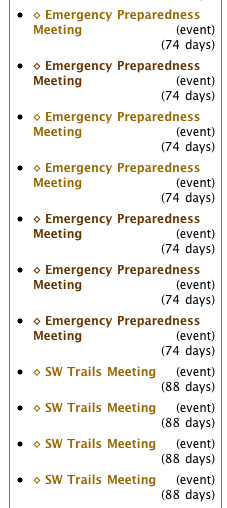
t4him commented(See attached image) Is this related to the issues posted here or do I need to use views to produce this list without the repeats. I checked the eventrepeat.module file and it does have this patch in it (head version).
Comment #42
seanbfuller commentedt4him, It looks like those events are not on the same day, which was the problem being reported in this issue. Please confirm whether those events are supposed to be mapped to those days. At first glance, it would seem that your block is correctly reporting the repeating sequence. Please correct me if I'm missing something.
If you are responding to the repeating event showing up multiple times in the upcoming event block, that is a known limitation with how event repeat currently builds out the repeat sequence. Let me know.
Comment #43
t4him commentedSean, That is correct. I simply activated the 'canned' 'recent event' block, installed eventrepeat, created the [R]ecent event, and . . . 'the photo shows it'.
Maybe the second part of my question . . . Is there a way to 'suppress' this with 'views'? Anyway, I will continue to work with it AND monitor this post. Thanks for the quick response as well.
Cheers,
t4him
Comment #44
scott.mclewin commentedOn supressing the event instances so that only the 'next' instance of any given repeat pattern is in the upcoming events block....
Views did not support that in July when I explored it with merlinofchaos, the author of the views module. The challenge is the group by on the repeat ID that is needed, which views did not support well. Even if it did, the query to pull back the 'next' instance of a repeat pattern AND regular event entries which do not repeat is too complex - as far as I know - for views to handle out of the box. My hand rolled solution used a UNION, which is not something that I believe is in line with Drupal's database abstraction layer guidelines and thus is not a solution that can be comitted.
This would not complicated to do if eventrepeat stored a single node for the full repeat sequence and kept just the upcoming dates in an ancilary table, which is a one of several design that Sean is contemplating in a significantly redesigned eventrepeat module.
Comment #45
seanbfuller commentedMoving this back to fixed. If you want to create another issue concerning the block, feel free to do so.
Comment #46
seanbfuller commentedComment #47
(not verified) commented