

 The 2026 Drupal Business Survey is open. Your response will help shape the future of the Drupal business ecosystem.
By Amazon on
This post is part of a series to inform the Drupal community about the drupal.org redesign project, and the work the Drupal Association is funding to help get the redesign completed. If you would like to contribute to the redesign as a volunteer, see the community initiatives redesign page. If you'd like to contribute to the redesign financially, see the Drupal Association memberships and donations pages.
Project management changes
Since our last update, we’ve been busy with the following changes :
- We are now running the Drupal.org redesign project in two week sprints. Each sprint begins with a planning meeting and finishes with a demo meeting. During the planning meeting, the contractors and project managers set out tasks to complete during that sprint with an effort score for each task.
- We have Skype check-ins with the contractors three times per week.
- The project managers meet separately for 1 hour per week to discuss resources, coordination, and budget issues.
- Key redesign team participants can assign issues in the drupal.org issue queues (and have issues assigned to them). This functionality was chosen over moving an external (and therefore less open and transparent) project management system
- The redesign issues are in many different issue queues, so we initiated the drupal.org redesign tag last year. We are also interested in tracking progress by sprint, as well as the overall visibility by type of work. Therefore, issues are now tagged more thoroughly, for instance, a single issue will be tagged drupal.org redesign, drupal.org redesign sprint 1, drupal.org redesign solr or drupal.org redesign, drupal.org redesign sprint 2, drupal.org redesign content
- Revamped and improved the community initiatives redesign page to provide clearer starting points to those who would like to help.
Project management accomplishments
- Recruited theme implementers, and Git contributors
- Created a detailed 1000 hour Git migration plan
- Organized standard meeting infrastructure, shared calendars, conference lines, etc
- Worked on new hosting ads redesign
- Finalized the content migration plan
In an ideal world...
Ideally, a small team of experts would have been able to implement the full redesign in their spare time, but during the last two years we realized this was not pragmatic. Some companies offered to implement entire parts of the redesign, but the dependencies on infrastructure, search, and project module proved too difficult without a dedicated architect, and dedicated support in those areas. Our expert volunteers from the infrastructure team are in high demand and their contributions often focus on maintenance and innovative new capacities that are developed without a schedule. For the redesign, we needed to involve a wider implementer group, and that has meant we’ve had to build out a new drupal.org infrastructure and development process.
The drupal.org redesign is different from other projects in the following ways:
- Most Drupal development projects are done by relatively small teams of full-time, paid developers. Our project teams big, very geographically dispersed, and up until recently, 100% volunteer.
- These contributors work for free (the exception being our contractors), but are personally motivated to improve drupal.org, our community's home.
- We’re empowering 50+ people to contribute to the development of drupal.org
- The infrastructure team is a small team of highly competent volunteers who are granted access based on established trust and expertise built up over years
- We have a responsibility to deal with access control, privacy, and security when offering volunteers access to private databases, themes, and development, and staging infrastructure
Infrastructure update
In the past, the code relating to the drupal.org infrastructure has been held in a variety of version control repositories and external systems, depending on the team responsible for it. Thanks to the efforts of David Strauss who was willing to step up to handle implementation and maintenance, we now have a single, cohesive BZR code repository for all of our infrastructure efforts.
To allow developers to freely work on development and staging infrastructure we’ve allowed their SSH accounts access to Hudson. Hudson monitors executions of repeated jobs. Many of the jobs that developers need to do are repeatable and a common subset of development tasks such as checking out code, updating a database, deploying a new site, or creating a new Solr search index. Hudson allows us to give a wide variety of developers the ability to do common development tasks without tripping over each other on a shared infrastructure. See http://wiki.hudson-ci.org/display/HUDSON/Meet+Hudson for more information.

Of course, most developers want to be able to work locally. Automating the creation of drupal.org database copies that have been scrubbed for privacy and security has been a top priority for a long time. A lot of the redesign is about implementing search-related features. It is also important to provide scrubbed Solr indexes to download. If a developer were to accidentally delete their local copy of the entire drupal.org Solr index, it could take days to re-index drupal.org on a local computer before they could get the live results they need to keep working on a search feature.
Infrastructure accomplishments in Sprint 1
For this sprint, Narayan and Rudy from Tag1 consulting focused on implementing Hudson jobs, providing BZR access, making databases and providing a Solr index.
Solr: Making it easier to find what users want
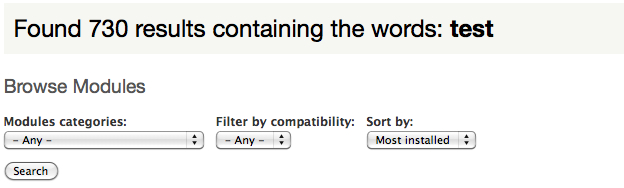
In order to make it easier to find projects on Drupal.org, the redesign emphasizes project-based search forms in project sections and search results. For example, people should be able to sort the main modules page for Drupal 7-only modules. The project and Solr developers decided to abstract out their search forms to be re-used in the Download and Extend sections as well as for project-based search results.
Example search form
The common search form for search results:
And project browsing:
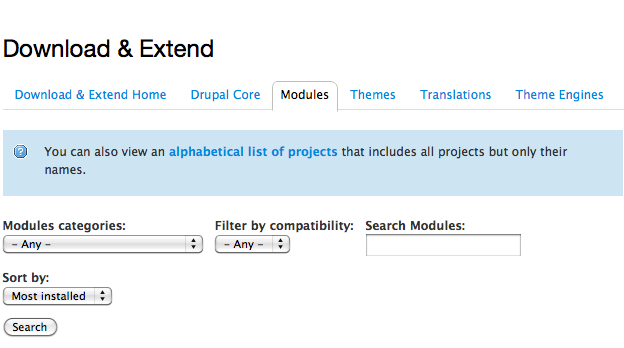
They also decided that displaying faceted search results in blocks was generally useful enough to make this part of the base Apache Solr project. For project module-specific searches, like “Most installed” and “Most downloaded,” we added these facets to the Solr project module. These results would then just show up in a faceted search result block for the Download and Extend pages, or the search results page.
If the search results are faceted on the project content type, then we automatically make a project search form available for further searching.
Once project searching is implemented we are going to be focusing on multi-site search. The proposed plan is to have all search results appear on drupal.org, no matter which sub-site you search on. If the user wants to search only the current sub-site, a tabbed search form will be available.
Solr issues for Sprint 1
- #865510: Add project_solr_browse_projects_form as a block on the main search page when a project type facet is selected
- #867490: Call modify_query for drupalorg_order_facets
- #862240: Provide additional solr facets for advanced project browsing
- #867312: Adding Solr content for the main download page
- #867526: Multi-site search functionality
- Documented what themers can/can't do
Project module
The Project module is the most important software in the Drupal project as it allows the community to collaborate to build Drupal core and the 8700+ contributed modules, themes, translations and installation profiles which make Drupal so successful.
A key improvement of the redesign is to make discovery of projects easier. In order to improve the Project module, several facets were added the Solr Project module which allowed for “Most installed, Most downloaded” search results. These are now part of the new project-type landing pages.
In preparation for the Git integration the project module will now lock the project shortname as the repository directory name.
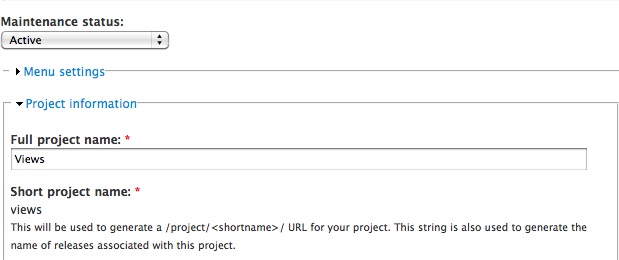
Project module issues worked on sprint 1:
- #781300: option to lock project short name
- #868794: Add an apachesolr_result_block module to render solr facet results as blocks
- #867312: Adding Solr content for the main download page
Architecture
Another huge challenge with the redesign has been explaining the development standards and development culture that drives the development of a large community site. Drupal developers who have participated in module, theme, or core development have learned “The Drupal way”. We quickly realized that a huge portion of the redesign effort was explaining “The Drupal.org way” to volunteers.
To help explain the drupal.org site development culture we documented it.
Community initiatives - how you can get involved
In order to bring focus and consistency to the technical implementation, the redesign architect has listed all the parts of the redesign that are not currently being implemented by the redesign contractors. In addition to themer and developers, we could use people with content skills, particularly IA.
http://drupal.org/community-initiatives/redesign
Paying for the redesign
The Drupal Association currently has five contracts that involve as many 8 paid contractors working on the redesign, not including the association’s general manager. We also rely on ongoing volunteer contributions from the project management team, the infrastructure team, and the redesign implementation volunteers.
In the last 6 weeks the Association has spent approximately $60,000 on the drupal.org redesign, even with significant volunteer contributions. In order to complete the redesign, the Association will be spending well over $200,000. This money is coming from donations, memberships, affiliate programs, DrupalCon sponsorships, and advertising.
The Association plans to increase the quality of advertising available in the sections of drupal.org which currently have advertising and expand advertising to additional sections, as defined in the advertising section of the redesign prototypes. The advertisements will remain contextual, relevant, and useful to the Drupal community. The goal is to make improvements to drupal.org sustainable and empower the community to make drupal.org a home worthy of the Drupal community.
What's next?
- Sprint 2 is now under way and on schedule. Major work items include removing blockers to the Git migration from Project module, further enhancements to the underlying functionality for the Download & Extend pages, further infrastructure automation, and establishing AMI-based infrastructure to enable Git migration volunteers to help more efficiently.
- At Drupalcon Copenhagen, we will be talking about The Future of Drupal.org and doing a Redesign BOF
- We look forward to having more community members step forward to take advantage of our new processes for contributing
Where can I see what's done in action?
Head to http://redesign.drupal.org/ (username: drupal, password: drupal)

Comments
Needs more contrast
The color scheme used with the redesign really falls short on adequate contrast for accessibility.
The green background for the "Search" label lacks sufficient contrast.
The lighter blue can't be used against white for text — unless it's large.
Can't we come up with color schemes that work for everyone, including people with low vision?
It really would be worth it to find an accessibility expert who can focus on this project, even if it meant paying them. We've built a lot of features into Drupal to help people create accessible sites. It really would be a shame if our showpiece site, d.o itself, wound up being inaccessible in spite of all those features.
– Cliff
It was evaluated by a
It was evaluated by a accessibility expert(I think?), so I think its best to take it up with her on why certain things aren't accessible.
the design is fine.
the design is fine. It just needs a few interesting pictures and interesting data, right now it's like a canvas ready to display stuff.
It's sorta like a an empty modern kitchen; minimalist; where the food, plates, cups, utensils, etc will be the focal point.
If you start making buttons or other things very 'contrasty' it will lead the eye away from what's important, the interesting pictures and data.
The design as is now, will appeal to a vast majority (I think)--sure there will be some that will like it this way or the other--but in the grand scale of things, it won't *offend* most people...
That's how design should be when creating something for such a various community... we're not trying to strike emotions or feelings as with expressive art (well not initially; this would come later from the visitor by her own vision, of her own project)...
Drupal simply trying to show what data is there in the most efficient way possible.
The "test description" that
The "test description" that is displayed in the cloud on the map (in the front-bottom-left region) overlaps the text next to it and above it. Maybe make the cloud go on top of the map only and not get out of there?
Also maybe add a little border around the block to the right of the map? There is a border on the top with the tabs, but to the left, right and at the bottom a border would increase readability.
Have suggestions? Get involved!
These last few comments represent a wonderful opportunity for more people to get involved with the redesign! :D
Here are some helpful links to get started:
Hope to see you in the issue queue so we can make our new home awesome that much sooner! :)
Just wanted to say thanks to
Just wanted to say thanks to everyone who's busting their butts on the redesign. You've had your work cut out for you, and it's great seeing it inch closer and closer. Special thanks to Lisa Rex and anyone else who's been liaising on the Docs stuff!
Thanks arianek! I have a
Thanks arianek! I have a feeling we'll be "seeing" a lot more of each other (and a lot more docs/redesign collaboration) once D7 docs are all RTBC and we move on to the next phase of docs. Looking forward to it!