

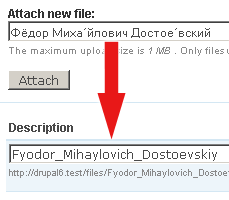
Provides one-way string transliteration (romanization) and cleans file names during upload by replacing unwanted characters.
Generally spoken, it takes Unicode text and tries to represent it in US-ASCII characters (universally displayable, unaccented characters) by attempting to transliterate the pronunciation expressed by the text in some other writing system to Roman letters.
According to Unidecode, from which most of the transliteration data has been derived, "Russian and Greek seem to work passably. But it works quite bad on Japanese and Thai."
Do I need to use transliteration for uploaded files?
This question can't be generally answered, rather it depends on what you want to do with user submitted file uploads. There are two simple cases when you might not need transliteration:
- you let users upload files to your site and offer these files as download without PHP processing, and you're on Drupal 6 or later, and not using a Windows-based web server. Or,
- you are sure your users won't upload files or images containing non-ASCII characters in file names.
However, whenever you want to process uploaded files on the server, you most likely need transliteration. For example, if you are using ImageCache to provide modified versions of uploaded images. The reason is that PHP 5 doesn't fully support Unicode characters in filenames, and may not be able to access those files.
Whether you use transliteration for URLs (when using Pathauto 2.x), however, is a matter of personal taste. For example, the russian Wikipedia does not transliterate, but uses full Unicode in URLs. On the other hand, as a user noted, links containing Unicode look quite ugly in e-mails sent from your site.
By enabling this module, it will be easier for people to search with or without accents. Thus, if someone wanted to find references to the word 'conteúdo' they could type it with an accent or 'conteudo' and get the same result.
On Drupal 5, transliteration is required since Unicode characters in generated URLs (for example, file attachments) are not properly encoded in certain cases (#191116: Make drupal_urlencode RFC 1738-compliant).
Credits
Authors:
Current maintainer:
- Andrei Mateescu (amateescu)
UTF-8 normalization is based on UtfNormal.php from MediaWiki and transliteration uses data from Sean M. Burke's Text::Unidecode module.
Development was sponsored by UNLEASHED MIND.
If you would like to help make transliteration data better, the following sources might act as a starting point: CLDR — Unicode Common Locale Data Repository, especially the guidelines and available transliteration charts.
#D7AX - I pledge to make this module as accessible as it can be. If you find any flaws, please submit an issue and tag it D7AX. Help me fix them if you can.
Project information
- Project categories: Multilingual, Site search, Developer tools
 63,816 sites report using this module
- Created by smk-ka on , updated
 Stable releases for this project are covered by the security advisory policy.
There are currently no supported stable releases.


