Problem/Motivation
When deleting large datasets the delete multiple API does not invoke all dependent hook_[node|comment|user]_delete.
e.g. deleting a node does not invoke hook_comment_delete()
Proposed resolution
Use the queue API to delete large datasets so we can invoke all hooks.
Remaining tasks
This issue is looking for further direction. Some of the questions/issues are:
- Does this issue cause problems/confusion for users that are expecting all records to be deleted?
- Should the user be aware that the operation is happening via queues/cron?
- If the deletes are happening through the UI, the batch API could process everything. Could the UI create a queue and parse to the batch API to process so you don't have to wait for cron to complete?
User interface changes
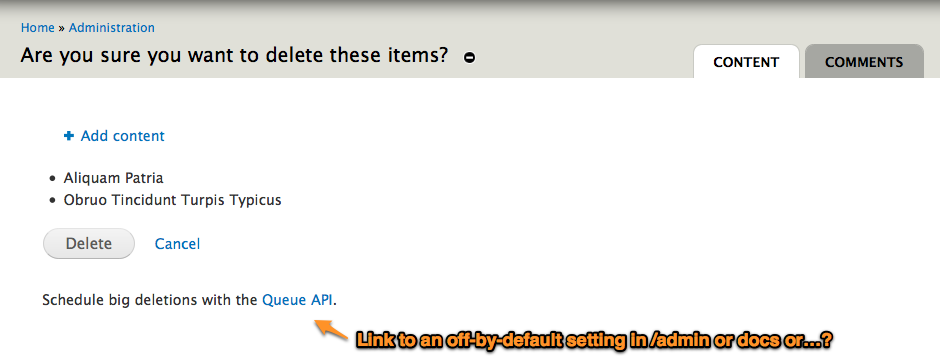
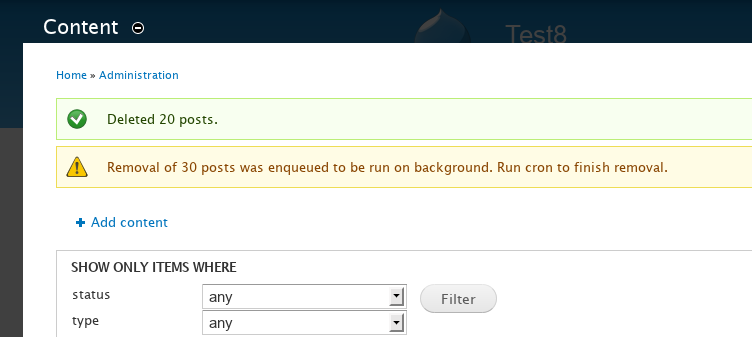
When deleting large datasets, you are advised that only a subset of the objects have been deleted and the remaining will been queued to be deleted on cron. A link is shown to run the cron manually if user has permission to "administer site configuration"
API changes
[node|comment|user]_delete_multiple no longer will always delete all items instantly, instead it deletes the the first 20 (or the defined queue threshold number) with the remaining items deleted on cron through a queue.
If the number of items being deleted is less than the queue threshold number, then the current behavior of the system will remain unchanged.
Original report by fajerstarter
Deleting a node that has comments deletes its comments. The problem is that this doesn't initiate hook_comment($op='delete'). Modules using hook_comment need this. This might be the case for Drupal-cvs as well though this hasn't yet been tested.





Comments
Comment #1
Arto commentedAttached is a patch against DRUPAL-4-7 CVS that invokes hook_comment('delete') on each of the node's comments before they are deleted.
Comment #2
Zen commentedI don't understand the need for $comment->name in the patch. Please explain and add comments to the patch if it is non-obvious :)
Thanks,
-K
Comment #3
Arto commentedThe
$comment->namehandling isn't my idea - the patch is simply replicating the way comments are loaded everywhere else in the comment module code. I might add that none of the other identical lines (of which there are half a dozen) are commented, either ;-)That said, its purpose seems simple enough: if the comment was created by a registered user, set the
nameproperty to the user's proper name, otherwise use whatever name was provided by the anonymous user who submitted the comment.So this is simply API consistency towards third-party code.
Comment #4
Zen commentedCool. Won't it be better if the ORDER BY was c.cid DESC rather than timestamp? It's the primary key and this will also ensure that comments are deleted in reverse order of creation thus ensuring that no "hierarchical" mishaps occur in any contrib module.
Please also submit patches against root.
Cheers,
-K
Comment #5
killes@www.drop.org commentedPlease fix in HEAD first.
Comment #6
stevenpatzhead is now 6.x? right?
Comment #7
panchoRerolled against HEAD, also incorporated Zen's suggestion to use ORDER BY c.cid DESC.
Please test.
Comment #8
catchAgree with ordering by cid instead of timestamp - this recently fixed a bug with comment display.
Added two nodes with some comments, deleted one via edit tab, one via admin/content/node. Comments went too. Don't have a hook_comment example to test with but it seems fine.
Having said that, is that while loop going to eat memory on hundreds or thousands of comments? Does it need to be batched instead?
Comment #9
moshe weitzman commentedit is a bad API omission to skip this hook. promoting to critical. we could get away without batching here but it would be nice.
Comment #10
jvandyk commentedJust an observation that on a large comment tree if actions are assigned to the "after deleting a comment" trigger, that's going to be a lot of actions running.
Comment #11
dropcube commentedThe patch follows all the suggestions above, implementing a batch processing to prevent timeouts when deleting a large number of comments where actions may be triggered, etc.
I have generated with devel_generate several nodes each with 50 comments. Tested deleting a node from the node edit form and the mass deletion of nodes from the content admin pages. The comments are being deleted, the hook is being invoked and assigned actions to 'After deleting a comment' are being executed as well.
The problem I see here for the batch processing is when
comment_nodeapiis reached without a form submission (programmatically) . Any suggestions ? Please test.Comment #12
catchBatch processing on lots of nodes and comments looks fine, also tested with 1 node/1 comment, but
1. It introduces strings
2. the strings needed some work
Rather than set to needs work, I've edited the patch to change some of the strings and tidied up some of the phpdoc since these are all trivial changes.
Comment #13
gábor hojtsy- I don't think the batch processing stuff deserves a "NOTE:", it can be a simple explanation sentence there
- t('Deleting node comments') should not use the word "node", it might be clear enough still if we remove that word
- what's an item in "@count items successfully processed"? We are talking about comments or blocks of comments in 10?
- there is some inconsistency in how this works... we call the delete operation on comments but do not delete any data until we called all delete hooks... this means that we might end up in the middle with a broken batch with modules informed about comments being deleted, which are in fact not. unfortunately it is far from convenient to delete comments one by one, because we would need to keep the threading information, etc.
After all I am not convinced that this is a serious API omission and deserves to be critical. Those implementing hook_comment could just as well implement hook_nodeapi() and act on its delete operation as well. Thinking that we are consistent in calling these before the act (ie. node deletion, comment deletion), so that the given module could just as well act there.
I believe that it would be great to polish up this part of the API as well in Drupal 7. More consistent APis was one of Dries' Drupal 7 goals as well :)
Comment #14
dropcube commentedI agree with Gábor.
Also, as I stated at #11 there is a problem with batch processing when
comment_nodeapiis not called from a form submit handler.Comment #15
yched commentedMoshe pointed me to that thread a few days ago, but I've been mostly afk since then.
Yes, 'nested' batch processing are indeed problematic. Batches are a neat tool for simple workflows (typically, form submission), but they're probably not (yet ?) the answer to all timeout issues, esp. in API functions or hooks.
Batches are highly context sensitive :
- they require a browser to iterate the requests (through ahah or redirect) - thus, non cron-friendly; and any API / hook could potentially run in cron...
- they require that the current page execution is interrupted at some point to be redirected (drupal_goto) to the batch processing page. FAPI takes care of doing this at the right time when the batch is set during a form submission, but nothing 'catches' a batch set during an API call.
- they can make a convoluted execution sequence (your function returns without having its publicized task performed yet).
We're facing the same sort of issues in using batches for CCK cleanup (which, er, was the original reason I started the work on batches...).
Comment #16
dropcube commentedComment #17
dropcube commentedI still think this is critical as it is an API omission.
Comment #18
decipheredSubscribing to this issue due to the creation of a duplicate issue... I did search, I swear.
Comment #19
catchSome of this went in with http://api.drupal.org/api/function/comment_delete_multiple/7 vs. http://api.drupal.org/api/function/comment_node_delete/7
However:
1. hook_comment_delete() isn't multiple
2. field_attach_delete() isn't multiple
3. We don't use batch there.
So bumping this and tagging with performance. Actual patch will need a lot of updating, but would be good to clear up these cases which could easily bring your site down if you have a node with a few thousand comments that needs deleting.
Comment #20
catchComment #21
sunYes, this code is horribly broken. Not sure whether a proper fix can be backported, so we should get this done before ALPHA1.
I'll try to work on a patch, if no one beats me to it.
Comment #22
dev.cmswebsiteservices commentedBatch processing has been implemented in this code.
I found that comments are also not deleted when a node is deleted from the system. So updated the code for this too.
Comment #23
dev.cmswebsiteservices commentedComment #25
dev.cmswebsiteservices commentedComment #26
sunThis issue is critical, as it seems to solve the following issues:
#355905: node_delete_multiple() has to use batch API
#355926: Add comment_mass_update()
If one of those is not fixed by this patch, then the corresponding needs to be re-opened, since both are critical for D7.
Comment #27
sunBatch API takes over this "splitting" for you, no need to do it manually. Just process one item per invocation and be done with it.
Powered by Dreditor.
Comment #28
dev.cmswebsiteservices commentedThanks Sun,
attached patch is the updated patch as per #27 update.
Comment #29
dev.cmswebsiteservices commentedComment #30
moshe weitzman commentedwe are about to add user_delete_multiple in #705306: user_cancel_delete method calls into a "standard" user_delete_multiple API. if that gets in first, then this issue should batch user deletion as well.
Comment #31
catchThat's in now, so we need an update here (or decide to commit #28 as is and do users in yet another issue).
Comment #33
sunTrailing white-space here.
Superfluous blank line here.
Duplicate newline here.
The finished callbacks display both error and success messages in the error case (only).
The 3rd parameters can be removed here, '=' is the default.
Does it make sense to output a link to a node that has been deleted? :)
148 critical left. Go review some!
Comment #34
yched commentedAs I wrote in #15, using Batch API in an API function is dangerous...
Batch API assumes a client browser handle the redirects -> no batch in cron, for instance.
If your API func relies on batch API, then it's not an API func anymore (cannot be called safely from anywhere)
Comment #35
catch#34 makes sense, and we have a shiny new queue API which could handle this instead.
Comment #36
catchComment #37
mr.baileysHere is an attempt at converting this to use the Queue API instead of the Batch API. Processing for multiple node and comment deletes starts immediately, but if for some reason (execution time?) the processing gets interrupted, the next cron invocation performs the remaining deletes.
Comment #38
moshe weitzman commentedNice approach.
We have a more terse 'Implements of ...' instead of 'Implementation of hook_cron_queue_info().'
Comment #39
mr.baileysvariable_set('queue_class_comment_deletes', 'BatchQueue');. I guess the default Queue implementation is adequate, and we should not force a certain implementation.Comment #40
yched commentedshould not use BatchQueue indeed.
I'm wondering about the "process til timeout and do the rest on cron" approach, though.
- what if cron runs while the initial pass is still running ?
- timeout might happen in the middle of a node/comment deletion. Unless deletion is atomic, this semi-deleted node / comment might cause trouble ?
Comment #41
mr.baileysMy understanding is that since we are using queues, cron and the running process will both be emptying the queue simultaneously, and given the fact that claimed items cannot be claimed by the other process, this should work fine, right?
With the current patch, node_delete_multiple is basically saying: a) I'll delete all the nodes, b) as quickly as possible, but c) might not have finished when I return(*)
(*) actually, not yet implemented. I guess we should cap the number of items to process during each batch to actually prevent time-outs and then have node_delete_multiple return a value indicating whether or not all nodes were deleted? This way the user can be warned through the interface ("xx nodes were delete, the remaining nodes will be deleted during the next cron run").
Yes, it might, and unfortunately the delete operations are not atomic. Additionally, while the expiring lease on the queue item will ensure the item is processed again later on, the current patch prevents this from working since the deletion logic is wrapped in a
if ($comment = comment_load($cid)) {block (so if aborted halfway through, the comment itself has been removed, but might still have field values). Attached patch removes the load check so that aborted deletions can be processed during a subsequent run.The deletion of the actual node/comment record is the first action taken when processing each item, so worst case scenario the processing is aborted and we end up with, for example, an orphaned node revision or field values which no longer have a node to attach to (although just temporarily, it'll be cleaned up automatically later on). Not sure if this poses an issue, and if it does how to solve this. Capping the number of items to process as indicated earlier in this comment might provide the solution, at least when it comes to timeouts.
It also does not seem to be specific to the implementation of the queue: both in the current situation (looping through all nodes/comments without batch/queue) as in the batch implementation there is the risk of the operation being aborted, but I guess that only when working with the queue, these half-deleted nodes are cleaned up automatically at a later stage.
Comment #42
mr.baileysAttached patch should take care of aborted node/comment deletions due to timeouts during the initial invocation by limiting the number of comments/nodes to process.
Comment #43
moshe weitzman commentedI might be misreading this patch (hopefully).
I'm not OK with the amount of defensiveness we are introducing. If we want protection against half deleted nodes, we should add a transaction like node_save() has. We worked hard during this release to speed up deletes with node_delete_multiple which deletes many nodes from 3 node tables in just one query. AFAICT, this patch is neutering that.
Comment #44
mr.baileysNeeds work for #43:
@moshe
are you referring to the fact that we're blowing the cache on each delete (whereas node_delete_multiple only cleared the cache after deleting all nodes) or the batch size limit?
Comment #45
catchIt feels like we could keep the existing node_delete_multiple() logic up to a certain number of items - let that be set by a variable, then use queue for any nids or cids left over, at which point we only want to do one or a time for simplicity.
Comment #46
catchcross-posted.
Comment #47
moshe weitzman commentedI'm not too keen on dropping into one at a time mode, even during cron. We should batch there too ... I'm have no opinion about when we clear static cache.
Comment #48
mr.baileysOk, what about this approach (for node deletions):
This basically follows the current approach in HEAD, where all nodes are deleted from the database first, and then clean-up is done node-per-node. The only difference is that this node-per-node post-delete-processing is now batched/queued.
Advantages:
Disadvantages:
Comparing this to catch's suggestion (do XX deletes in one go, process the rest individually) or to not queuing at all, I honestly don't know what the best solution would be.
Also, this issue was originally marked critical because the missing hook_comment('delete') invocation on node deletes. It seems that this has since been addressed via comment_node_delete(), so should this issue still be considered critical?
Comment #49
catchIf we can stick arbitrary stuff into the queue items, what about chunking the $nids array at a certain size, then adding an array of nids for each queue item instead of one at a time? WIth a variable batch size that could then be 50 or 500 at a time - we'd want a different variable for nodes and comments.
On creating queue items, it's a shame that it requires a db query per item, but it's also possible to use a non-SQL queue backend (and one already exists in mongodb module), so high performance sites can skip some of that cost. I'm not sure that's too much of an issue.
I think the reason this is critical is because of user_cancel() which can potentially lead to the deletion of every node and every comment a user has ever posted. Cancelling a user with thousands of nodes and comments is an edge case though, so certainly this would be major if and when we get that priority.
Comment #51
mr.baileysOk, reworked this using catch's approach (just doing nodes for now, comments are easy once we've settled on an approach):
Advantages:
to further improve performance.
Disadvantages:
Comment #52
catchThanks for rolling this one, overall this feels like a better balance of performance and scaling to me.
I really like that _node_delete_multiple() is just a renamed node_delete_multiple(). On the other hand, node_delete_multiple() starts to look a bit weird when all it does is build a queue and hand it off to a worker. This makes me begin to think we might want to instead add a new node_delete_batch() function - which we call when there's not a finite amount of nodes to delete, leaving node_delete_multiple() as a top level API function. Depends whether we want to give people the choice or not.
String changes - yeah it'd definitely be weird to see comments or nodes hanging around after you deleted them, we might want to even give people a run-cron link as well?
Comment #53
chx commentedI am deeply concerned by the fundamental misunderstanding of what this queue API is good for. Did we did not document enough? We mention that "there is no guarantee that items will be delivered on claim in the order they were sent" and that "The system also makes no guarantees about a task only being executed once" -- hm, that needs to be changed to "The system also makes no guarantees about a task only being executed once or at all".
It's awesome for cron-ish like tasks which noone cares when they will be executed like aggregator refresh. It's less awesome when you want some content disappear for good. If you want to use the queue for that you better bolt down the queue backend to be used to SQL or face some frightening consequences like the delete simply not happening.
Comment #54
catchWell curently the delete won't happen if you nuke a user with thousands of comments and hit PHP max execution time. However I agree that trading "might not delete if you hit max execution time" for "might not delete due to a known limitation in the API" isn't a good plan.
That leaves us creating a comment_delete_batch() which only ever gets triggered from submit handlers - would solve the user_cancel() case. If you trigger a delete from command line max_execution_time isn't an issue anyway. The other option would be moving this to D8 and creating a distinction between lossy and non-lossy queue implementations (and possibly some cleverness to try to maximise work done on the form submission in cases like this where batch processing is a last resort anyway - mikey_p mentioned that jobqueue module has something like this already).
Comment #55
chx commented#782616: Provide a reliable queue interface
Comment #56
chx commentedComment #57
mr.baileys@chx: While I was aware of the "no guarantee about order" and "possible duplicate execution" risks with the Queue API (and I don't think either of those poses a problem for this issue), I did not know that the API does not even offer guarantee of execution at all (in which case, yes that should be documented ;) ). I've opened #784962: DrupalQueueInterface offers no guarantee about execution. for this.
Re-rolled the patch with catch's suggestion of introducing
node_delete_batch. Leaving this to needs work to address the queue issue. If I understand it correctly, we have the following options:node_delete_batch-option, but ensure that SystemQueue is used (or at least ensure that the used Queue implementation guarantees execution). Using the variablequeue_class_node_deletesallows us to set the Queue implementation for the mass node deletion while still allowing it to be overriden.I like the visual feedback offered by the batch solution, although when deleting multiple users and a significant amount of nodes on large sites, the queued approach might be better.
Comment #58
yched commentedAs a nitpick, '*_batch' in function names is currently always related to "Batch API" batches. Batch and Queue APIs being "kind of adjacent but clearly distinct", using the word 'batch' for a function using queues is really confusing.
I know, an API stealing a common-language word is always unfortunate (Views, Field :-p). No other candidate showed up when designing the Batch API...
Comment #59
jbrown commentedDoing all mass node / comment operations with batch api / progress bar would be very cool.
Comment #60
chx commentedWould be cool -- but we do not want API functions to fire up batch API.
Comment #61
jbrown commentedProgress bar could be implemented for the Update button on admin/content as part of hook_node_operations() .
admin/content/comment also
Comment #62
yesct commentedwondering if the test bot will notice the patch
Comment #63
yesct commentedre-attaching the patch from #57
Comment #64
yesct commentedopps I might not have needed to re-attach it. (sorry, trying to learn the test bot)
Comment #66
catchThere's a whole series of related issues to this:
#814990: node_mass_update() can't rely on a browser session means that node/8 changed node_mass_update() to a form submit helper to an API function, but API functions can't rely on batch API.
#814884: comment_user_cancel() should use comment_save() needs to happen, but would be better with the equivalent of a node_mass_update(), if node_mass_update() was in a fit state to be copied.
So... we need all multiple updates, for all entities, to go through a helper, which at this point in the cycle, should probably use batch if it's possible, and if not just load and updated/delete everything and hope.
Comment #67
yesct commentedIn preparation for the new "major" issue priority, I'm tagging this (not actually critical) issue as priority-major.
See: http://drupal.org/node/669048#comment-3019824 (#669048: We should have four priorities not three (introduce a new 'major' priority)) for more information about the coming major issue priority.
Comment #68
chx commentedDrupalReliableQueueInterfaceat your service.Comment #69
catchI've given this a lot of thought, and we can neither use batch API nor queue API for this as they currently exist in D7 - both are at least as risky as just a PHP timeout, so I'm moving this to Drupal 8.
Comment #70
damien tournoud commentedI opened #832572: Add a standard worker queue as a push forward to provide a way for modules to easily register long-running bulk operations.
Comment #71
marcingy commentedChanging to major as per tag.
Comment #72
mustanggb commentedTag update
Comment #73
tizzo commentedThis patch is based on the central job queue chix posted at #832572: Add a standard worker queue.
It adds a simple bit of logic to node, user and comment delete to split up deletes that are more than 100 items and adds them to the central job queue for later delete_multiple without otherwise altering the guts of any of the delete_multiple stuff and without introducing any new functions (aside from the ones added by chix's patch).
Comment #74
tizzo commentedComment #75
tizzo commentedI inadvertently added some code to delete all nodes of the type with this patch, that should really be separate and at this issue: #874000: Automatically remove module's nodes upon module uninstallation. Updating without that portion.
Comment #76
tizzo commentedCleaned up a the patch a bit and removed a one more thing that found its way in from #874000: Automatically remove module's nodes upon module uninstallation.
Comment #77
moshe weitzman commentedNow this is terrific bug fix, that addresses the root cause. I'm going to ask chx to take a look.
Comment #78
tizzo commentedForgot to take out the stuff I had added to node_cron before using chx's central queue. Updating...
Comment #79
sunIdeally, we'd perhaps use a (single) 'queue_bulk_treshold' (or similar) system variable for that 100 and set the default to 20. Also accounting for a variable value of 0, which would mean that the entire update goes through the queue.
Powered by Dreditor.
Comment #80
chx commentedAlready #79 needed work but this deifnitely needs comments to mention that after the if we have less than 100 or 20 or whatever.
Comment #81
tizzo commentedWill reroll tomorrow as per feedback.
Comment #82
sun.core commentedStill a major problem. @tizzo, any chance to resurrect the issue?
Comment #83
tizzo commented@sun.core Yeah, this totally fell off my radar. I'll pick it up and run with it tomorrow AM.
I also have a fix that uses a batch operation to delete all the nodes of a type when you delete the type at the time. So this would work for programmatic deletions and that would work on manual ones. Assuming that hasn't been fixed.
Comment #84
catchMoving to Drupal 8, we could backport if it goes in there.
Comment #85
catchComment #86
franzI've reworked the patch and refactored the code. I believe this way we simplify and improve clarity. Also, the new function added contains documentation to explain #80 and a single reference to the variable suggested in #79.
This can be widely used for a whole range of mass operations. I've been directed to this issue, as an example, from #1065814: Content remains tagged with a taxonomy term (via the {taxonomy_index} table) even after its corresponding term reference field is deleted and purged which I'd like to make use of this implementation. This can become a robust way to work with any mass operation.
Comment #87
franzI've read the whole thread, and now I'm confused. Why did the code in here duplicates what is being addressed at #832572: Add a standard worker queue ?
Comment #88
franzWould be easy if I had a better summary before =)
Comment #89
moshe weitzman commentedThis still applies fine but doesn't seem to work quite right. I generated 40 nodes with devel_generate and then attempted to delete them all in one click using admin/content. That worked without this patch but with the patch it takes two tries. It seems to delete half of them during each submission. If this is expected behavior, the drupal_set_message() is wrong (it says that we deleted 40 during the first try).
Comment #90
franz#86: 89181-bulk-operations-using-reliable-job-queue.patch queued for re-testing.
Comment #91
franzI'll try this manually and we can then write some automated tests with this.
Well, it should do 20 each time, and it should run the 2nd time on cron.
Comment #92
franzIgnore this comment, wrong issue...
Comment #93
franzI changed a couple of things here.
First, the original worker split function was returning the last set and not the first (the last set is usually smaller than threshold).
Second, I changed the node_delete_multiple to return the number of nodes actually deleted. Then I used this to warn the user if content removal was enqueued. I'm providing a screenshot to demonstrate.
Comment #94
franzIf that's a good logic, need to apply to other bulk deletes...
Comment #95
moshe weitzman commentedIn general, this is a good approach IMO. The wording and code comments could use some work. I will do that in a follow up. But first, I am having doubts about a global variable 'queue_bulk_threshold'. Some mutiple operations will be very light and thus their threshhold could be much higher. Ciould we not leave this up the caller somehow?
Comment #96
franzWhen working on wording, you can make the "run cron" a link for that, I was too lazy to do it. =P
For comments, nodes and users the threshold can be the same, but it's true, sometimes it would be best to have an override as an argument.
Comment #97
devin carlson commentedI believe this issue addresses part of #1270100: Search module loads every comment into memory.
Comment #98
franzI've applied same logic to comments and users. I'll set this to needs review to get a review on the current code first, then we can work on wording and on tests.
Comment #99
dixon_subscribing
Comment #100
moshe weitzman commentedI think the approach is good.
the word 'enqueued' is rarely used. i would say that 'Y comments have ben scheduled for deletion. You may run cron to delete them immediately.'
Comment #101
Désiré commentedhere is a rerolled patch to further work
Comment #103
franz#101: 89181-bulk-operations-using-reliable-job-queue-101.patch queued for re-testing.
Comment #104
xjmThanks for working on this patch. Looks like the rerolled version now passes testbot.
I took a close look at the documentation and UI text and found several things that should be cleaned up a bit. Reference: http://drupal.org/node/1354#functions
As has been mentioned above, the word "enqueue" is uncommon (even if it is delicious). Also, the message should be clarified a bit. Perhaps:
I would change this to:
I'd change these to:
This comment should have a period. Also, let's add an inline comment above the return 0 line. Perhaps:
Both of these need one-line summaries, 80 characters or less and beginning with a third-person verb, that explain what the function does.
For the second, I'd suggest:
The words "helper function" can also be removed.
I'd add a blank line after the summary I suggest above, and then reword this as:
The descriptions for @param and @return should be on separate lines, indented by two spaces. Also, these should be capitalized and have periods. For the @return, I'd suggest changing the text to:
Should begin with "Adds..."
I think this should be "when the queue is next processed" or just "when the queue is processed"?
I'd change this to:
Comment #105
franzLet's see, now with those suggested changes.
Comment #106
franzRemoving whites...
Comment #107
moshe weitzman commented. Should be s/have/has.
We should not use 'warning' when content has been enqueued. Thats a normal occurence. Just remove the second param to druapl_set_message().
Comment #108
franzOk, fixed those minor issues.
Comment #109
moshe weitzman commentedThanks Tis ready.
Comment #110
xjmMmm, somehow this got to be "Add" again instead of "Adds." (Sorry!) Totally RTBC when that is fixed.
Comment #111
dave reidI think this might need some usability review as to why we'd have a regression why content would still be listed and visible even though the user ran the delete operation, especially since we do not have a concept of 'trashed' in core.
Comment #112
xjm1-character adjustment. :P
Comment #113
xjmSo to clarify Dave Reid's comment, if you delete 500 nodes and they're still visible (until cron), that could be confusing, even if there's a message. (Because who reads UI text really?) So we might want to consider that.
Tagging.
Comment #114
moshe weitzman commentedWhat is a "usability review"? Do we have to wave a magic wand and ask Yoroyjan to come in and bless this node?
Anyway, we don't really have a choice but to do this. We are crippling Drupal by not having this. We don't allow you to delete a text format because if this problem. We can't, in the context of a real time web request, find and migrate all your content that uses that text format. Similarly, we can't really find and migrate all the content that might have been authored by a user that is cancelling.
As for usability improvement, we might consider polishing and putting Queue UI into core. That way folks monitor the progress of their deletes.
Sure, this is a change for long time users of Drupal. They cope with this sort of change all the time.
Comment #115
franzI agree with moshe.
The thing is, we can work on the UX later after this comes in (another issue). We have many issues that are just waiting for this to be pushed.
Comment #116
aspilicious commentedWhat if you want them to dissapear now? Do you always have to unpublish first?
Comment #117
catchSee #1189464: Add an 'instant' queue runner for instant deletes. I haven't reviewed the patch here yet.
Comment #118
webchickCould we link the "Run cron" text here? As of D7+ you can no longer just manually go to cron.php, so that would be a helpful shortcut.
Comment #119
xjmHrm, I swear I suggested that earlier. I'll reroll with that.
Comment #120
xjmMight be better to define a constant rather than hardcoding 20. Also, beejeebus suggested it might be better to do something like
or
Comment #121
Anonymous (not verified) commentedfollowing up on 120 - how many items we want to chunk really depends on the operation - it's really not a one-size-fits-all deal.
i'm not fussed about whether we pass in the threshold with a default, or allow for a per-callback override, as long as we don't force a single site-wide default.
i'm happy to reroll with those changes.
Comment #122
xjmThis is just the
comment changemessage link because it's before 6:00a.Comment #123
xjmDoh crossposts.
Comment #124
Anonymous (not verified) commentedok, cross post. we can add the overrideableness later if need be.
Comment #125
xjmOkay, kids, don't make patches before 6:00a. Links in #122 are missing url(). Fixing that now.
Comment #126
xjmComment #127
dave reidNot sure what the path admin/logs/status/run-cron is but I'd assume we want the path admin/reports/status/run-cron? Also, we'll need a destination parameter on the link otherwise users clicking on 'run cron' will get redirected to 'admin/reports/status' (due to the drupal_goto() call). This could also pose some permission problems as users without the 'administer site configuration' permission will get an access denied when clicking the run cron link. This is very likely considering how separate the node edit/delete permissions are.
Comment #128
xjmI copied the path
admin/logs/status/run-cronfrom a similar message insystem.api.php. Was that the path in some previous iteration of D7? If so we should fix it there as well.The cron path itself already has:
So I think actually, rather than a destination param, we need to only append that part of the message if the user has that permission?
Comment #129
dave reidI'll file an issue because that path in system.api.php is dead wrong. We will still need a destination parameter to avoid the unintentional redirect after clicking the run cron link.
Comment #130
xjmConfirmed that
admin/logs/status/run-crondoes not exist, and opened #1339292: hook_requirements() documentation references incorrect path for cron in system.api.php.Comment #131
xjmI'll test/correct this tomorrowish if no one gets to this first. Unassigning for now.
Comment #132
xjmAttached:
administer site configurationpermission.drupal_get_destination()so that the cron link redirects properly.DRUPAL_QUEUE_DEFAULT_THRESHOLDfor the default threshold of 20.$thresholdparameter tosystem_workers_bulk_split()Based on the past 20 comments, I think we should have a few people test this patch manually and report the results (concisely!). To test:
Screenshots would be helpful for reviewing the issue (but use a small browser window and crop images to only the relevant portion of the screen). Make note of anything that is confusing or unexpected.
I'll have people work on this during office hours on Wednesday if no one gets to it before then.
Comment #133
dave reidFor you, it is easy to understand what you need to do to 'run cron' but for a lot of our end users who will be the ones actually doing the deleting of content in production, it is a much harder concept. I feel adding this queue functionality without first implementing #1026908: Trash bin or #147723: Deletion API for core is flawed and doing our users a disservice.
We do have a choice. We can step back and ask how we should actually be handling deletions. We've had how many major version of Drupal with the current behavior so far and we've all been fine?
Comment #134
droplet commentedbig usability issue.
I read the code, it looks like no UI changes, only an info message. When I first time using VBO + admin_view, it use Queue API for deletion, I'm totally lost and thought the module is broken.EDIT: I do real test. and it has UI changes.
Comment #135
tizzo commentedIt seems like anywhere we're triggering this activity from the UI we should be running a batch operation in real time.
Comment #136
bojanz commentedI agree with #135.
Comment #137
yoroy commentedSo the move from where deleting actually means deleting to this new situation where deleting means 'will delete soonish' (press here for now) is an step back in UX.
beejeebus was so kind to check for me if content gets unpublished immediately and it seems not.
Relying on a link in a message is brittle then, because I will of course simply not see that. If these content items are not unpublished and/or not somehow labeled and styled as being in a scheduled-for-delete state, that's a serious UXWTF, because I just deleted all those and there they still are?
Do we want to move towards a model where you have a trash can with automatic deletion options? Does cron not run too often for maintaining a reliable trash can? I mean, on my computer I manually empty trash, spam in gmail gets auto-deleted after what is it, 30 days? If there's only a likely *short* intermediate stage where stuff is not deleted yet I don't think that ultimately maps to a trash can metaphor. Triggering an automatic delete would be more fitting then.
I think we need a clearer action plan in follow-ups on what needs to be done if this bit of plumbing is to be put in place first. Right now this intermediate state seems to introduce a temporary black hole.
## About the user interface text
Good to see the 'enqueued' word being designed away already :)
The messages can be less wordy. Currently:
Shorter:
1 comment scheduled for deletion. <a href="@cron">Run cron to delete it now</a>.Is 'trigger an immediate batch when done through the ui' a viable option or can of worms?
Comment #138
yoroy commented#132: job-queue-89181-132.patch queued for re-testing.
Comment #139
xjmSo yoroy and I talked about this. It would probably be better from a UX standpoint to divorce this a bit from cron. Workflow:
That's the general idea, though the exact text/markup/layout of the form needs refinement. yoroy said he'd look into it a bit.
Comment #140
yoroy commentedFor example:
By all means move the plumbing in but at this time show restraint and keep current core workflows unchanged, or mimick it to appear so. That 'Queue API' link has to go somewhere too, I don't know where yet.
Comment #141
catchTo make the deletes instant (or nearly instant) we can do #1189464: Add an 'instant' queue runner.
The workflow then would be:
1. Submit the form to delete the stuff (same as now)
2. Form submit puts the entities into a deletion queue (same as the patch here)
3. Form submit makes a non-blocking http request to a queue runner, which then deletes as many entities as possible within 30 seconds.
4. While #3 is running, the form submission continues and the next page gets loaded. It would also be possible to then set a message if there are still some items left in that queue to inform people that they'll be deleted when cron runs.
For UX, when deleting < 100 items or possibly more this is probably going to look exactly the same as now (depends how many items the queue manages to delete before the next page loads).
This still means that if you're trying to delete several hundred, or thousands of nodes/comments at once, that some will be sitting there waiting for the next cron run, but that is only going to happen for extremely long comment threads.
So, if we're able to put that in, then there would be no UX regression 90% of the time. For the other 10% of the time, it's balancing having some items left in the queue, compared to what would happen now which is the form submit hangs for 30 seconds then times out or wsods.
Comment #142
xjm@catch: So are you saying you'd like to see #1189464: Add an 'instant' queue runner fixed first? I do think the workflow in #140 is much better whatever we do, and it wouldn't require too much additional work on the existing patch here.
Untagging, 'cause we have a new direction or two to follow before this is ready for testing. (Also, we need test coverage.)
Comment #143
bojanz commentedThe question is, how much do we want to solve in one issue.
One thing that we started doing here is:
Modify delete_multiple API functions to queue excess items
That's cool. And that's where #1189464: Add an 'instant' queue runner comes in handy, though it's not critical to have it right away.
I'm wondering though if the API changes we are proposing are good, because it changes the meaning of "delete multiple" to mean "delete some now and do some magic to delete others later in order to to make your life easier". Perhaps it might make sense to have it in separate functions? I'm growing more and more used to the idea in the latest patch, but it still feels a bit unexpected.
I see the UI multiple deletion as a separate thing. I think the user should never know about queues, delayed deletions, scheduling. There's no reason for that.
When multiple items are being deleted from the UI, it still makes sense to fill the queue, but the queue should then automatically be processed by batch api.
The problem is, we are filling one queue with all delete operations across the system, which makes sense for non-UI deletions, but doesn't for UI deletions, because batch api can't be precise. If I'm deleting 20 nodes I don't want to have it delete pending files or products as well.
Would make sense to generate a queue per operation, then pass that queue name to batch api. Which means that we'd have to go around the code in delete_multiple, once again raising the question of whether that code should be separate.
There's also the question of queueing and batching any core action, not just deletion, so this really smells like "VBO in core" (at least the BO part :P).
Comment #144
moshe weitzman commentedAnyone care to push this along or state what they think should happen (as few dependencies as possible, please).
Comment #145
yesct commentedI think we still need direction and next steps here.
Comment #146
yesct commented@univate thanks for the issue summary update. (updating tags)
I think VBO got in. Does that help here? (reading the end of #143)
Comment #147
bojanz commentedVBO in core currently uses no batching / queueing.
It's definitely relevant though (if we use views + vbo for every core listing, we only implement the batching / queueing once)
Comment #148
berdir#132: job-queue-89181-132.patch queued for re-testing.
Comment #149.0
(not verified) commentedCreating issue summary - http://core.drupalofficehours.org/task/1354
Comment #150
joachim commentedWhat happens when one of the queued deletions then incurs more multiple deletions?
Say I queue 200 nodes for deletion, and each node has 200 comments.
Do a node's comments need to be deleted before the node itself? If so, how can one of the 20 items in the current queued item handle that?
Comment #152
vijaycs85may be config(system.settings)->get(queue_threshold) ?
Comment #153
joachim commentedI've been pondering this problem, as it's come up over at Flag module, where we possibly need to delete a large number of flagging entities when a user account is deleted, or when a node and its comments are deleted.
What I've come up with is this: the entity delete system should have two phases: a simulation phase, and an actual deletion phase. In the simulation phase, the hooks are invoked, but with a parameter to tell implementations not to delete anything, but to merely assemble the entities and update a count of how many entities are involved in total. If this count reaches a predefined limit (from experience on large sites I'd say 50; maybe 200 if your site's timeout is set high), the whole process breaks off and reports that the limit has been reached.
This would get used for both the UI and API routes:
For the UI:
- The user edits a node and presses the 'delete' button
- They are taken the the delete confirmation form. This form runs the entity delete simulation. If the count is less than the limit, it's a plain delete form. If it's over the limit, then the form gives them the choice to either run a batch now, or queue the entities for deletion.
For the API, the caller of entity_delete() would be expected to call the simulation first, and would get a count back. Based on this, the caller can either run the deletion immediately, or queue it. Or for easier DX, we could add an option where you just say: entity_delete(ENTITY, and do the best thing for it, and let me know what you've chosen).
Comment #154
joachim commentedThinking about this more, the threshold count should possibly be something passed in by the caller.
For example, on Flag module, if the flag is an AJAX flag, you really don't want to be doing more than deleting one entity, so the site feels responsive -- so anything more than that should be queued. If the flag is using the page reload method, you can delete a few more. If it's a confirmation form, then we can show the user the option of running the batch or queueing.
I think the idea of deleting some entities right away and queueing the rest warrants more thought. It certainly seems like it could be useful -- eg delete just the flagging now and queue up any chain reactions for later. But I'm concerned it could leave the relationships between entities in an unstable (or at least unexpected) state. The way round this might be for the simulation phase hook implementations to be able to say whether their entities are essential or ancillary.
Comment #155
xjmThis improvement should now be targeted for the next minor version per https://www.drupal.org/core/d8-allowed-changes#minor. Thanks!
Comment #157
lliss commentedComment #158
joachim commentedUnpostponing now we have 8.2.x.
Comment #159
catchBumping to critical since this blocks #1239558: Deleting an entity with revisions and file/image field does not release file usage of non-default revisions, causing files to linger.
Comment #161
xjmComment #162
alexpottWe've decided to unblock #1239558: Deleting an entity with revisions and file/image field does not release file usage of non-default revisions, causing files to linger by deleting non-default revisions prior to an entity delete. I think that this means this is no longer critical because this is not blocking that.
Comment #163
jonathanshawVery similar issues occur with #2723323: [META] Clean up references to deleted entities, suggesting there is a wider need for an architecture that can navigate the tension between providing immediate vs scalable cleanups.
Comment #164
jonathanshawComment #170
andypostComment #175
larowlan