

 The 2026 Drupal Business Survey is open. Your response will help shape the future of the Drupal business ecosystem.
By jimkeller on
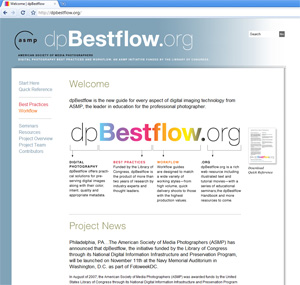 After a highly successful Drupal deployment for the American Society of Media Photographers (ASMP) national website, the ASMP decided to again use Drupal for their next project: Digital Photography Best Practices and Workflow, or dpBestflow for short. DP Bestflow is a Library of Congress-funded initiative to provide an all-encompassing resource for digital photography best practices.
The ASMP once again teamed up with Chicago's Grillo Group for graphic design, and Philadelphia-based web development firm Context to perform the Drupal implementation. The most impressive part of the site, however, is the immense amount of rich, useful content, the majority of which is the handiwork of digital photography gurus Richard Anderson (author of Digital Photography Best Practices and Workflow) and Peter Krogh (author of The DAM Book: Digital Asset Management for Photographers).
Per DP Bestflow author Peter Krogh,
The Library of Congress came to us with a simple request - help professional photographers preserve their images, so that we don't have a giant cultural hole where a few decades of digital photography should be. Our method to address the problem was equally straightforward - help photographers understand how digital photography works, and how to create safe and effective workflows that will help them preserve their images (while getting their jobs out profitably).
Why Drupal
Constructing Content
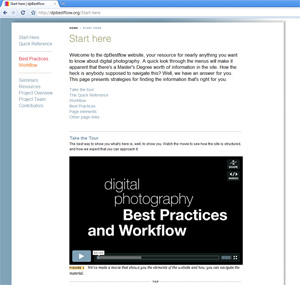 Even when production of the website was in its infancy, the team immediately faced a problem: how do we define the information architecture and create a sitemap for a site that will have as much content as a book, especially when much of the content isn't even written yet?
The answer, not surprisingly, was to leverage Drupal right from the get-go. Long before a design was in place or any content had been finalized, we provided the DP Bestflow content team a basic Drupal install for them to start building on. Using the menu editor, taxonomy, and WYSIWYG, they began to create placeholder pages, menu items, and embedded links for each page they expected to need in the final site. It wasn't too long before the structure of the site materialized, and we were able to clearly see what design elements would be needed to allow us to present the text, images, and video in a digestible fashion.
Peter Krogh, on using Drupal to construct the content architecture:
The flexibility of the Drupal architecture - the ability to combine and recombine - made it possible to find the best way to present the information. In many other approaches, the cost of seeing a method - and then recombining to try it another way - would have been so prohibitive that the first approach would have had to be the final approach.
Ultimately, the flexibility of the modular Drupal architecture not only let the authors present their information in the most compelling 3-dimensional matrix - it even helped them to better understand the interrelationships that were already part of the material.
Technical Challenges
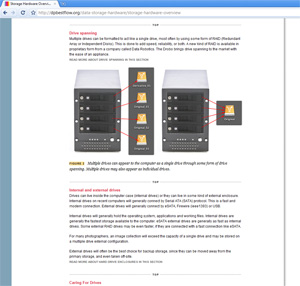 Since this project was so largely content based, and since Drupal is so good at content management, we were actually able to keep the technical challenges to a minimum. One interesting point, however, is the File Delivery Checklist, which allows visitors to fill out an HTML form and then export their completed form to PDF for emailing or printing.
We used TCPDF to translate HTML to a PDF format, but ran into a problem: It seems that when a user checks a checkbox, the DOM document itself is not updated with a "checked" attribute. As a result, when we passed the HTML to TCPDF, none of the checkboxes were checked. The solution was to first pass the HTML through a jQuery method that appends the "checked" attribute to all checked boxes, then passes it to TCPDF.
You can view the File Delivery Checklist here
Modules
Menu Breadcrumb – the Menu Breadcrumb module allowed us to achieve the nice breadcrumbs you see throughout the site.
WYSIWYG with TinyMCE – I think everyone on the project got a bigger dose of TinyMCE than we may have wanted, but despite its quirks, we still find TinyMCE to be the best editor out there. By giving the content team a set of styles to apply throughout the content, we were able to maintain a consistent look and feel despite having many different people working on the text
IMCE – Throughout the site, there are embedded images alongside the text content. The IMCE module and the IMCE Wysiwyg bridge made adding these images a simple exercise.
Other Notes
To get non-standard fonts present on the site (as in the main page headers and breadcrumbs), we utilized Cufon, which we have all been consistently impressed with.
Minimizing Cost, Maximizing Scalability
Drupal also allows the DP Bestflow project to remain adaptable as new ideas and features come out.
Peter Krogh weighing in on how Drupal has been an integral part of the DP Bestflow project:
And in the finest tradition of open collaborative projects, new ways to make use of the material are already in the works. A Dutch writer has proposed an alternate presentation of some material, and the authors like it very much. Moving these pages around in Drupal will be a breeze. A photography teacher in South Africa has asked for permission to create a curriculum based on the material, and, once again, Drupal offers a modular solution to the problem.
In the end (which is really more like the beginning than the end) it's nearly impossible to overstate how integral Drupal has been to the project. The web design and production would have cost at least ten time more without the use of the existing Drupal installation. And the Drupal environment has been a friendly and flexible way not only to present the content, but to understand the content - even for the authors. And the flexibility to remix, and redesign the content has offered a freedom to create the perfect vehicle for the presentation of a complex and important topic.

Comments
Good stuff.
"Help professional photographers preserve their images, so that we don't have a giant cultural hole where a few decades of digital photography should be."
Now there's an interesting idea. The site seems to be filled with quality content, too. For example:
http://www.dpbestflow.org/node/393
Good work! :)
I'd suggest using the pathauto module to generate some relevant URLs, it will help with SEO, among other things.
interesting stuff .....
nice stuff!
-- Sree --
IRC Nick: sreeveturi
effective
site is really fast man!
pathauto module it's a must
pathauto module it's a must have module.
I think dev it's all over because I still find links link node/nodeid
---------------------------
nodeid
good content in that site!
How funny!
Over the last month or two I've been referencing DPbestflow regarding metadata practices, trying to look for rules and guidelines for publishing workflows and these sort of subjects. Excellent writing BTW! ... I'm trying to work metadata support into the Drupal image management pipeline better. (Auto-importing descriptions from images to Drupal data, Inserting captions etc into the image itself, Getting image derivatives and thumbnails to retain their metadata)
And I never stopped to notice that the site itself was Drupal! Cool.
.dan. is the New Zealand Drupal Developer working on Government Web Standards
Adaptability, the moust important thing
The important thing seems to me that this site can be developed further. With such an explosion of technology, as we face today, everything is doomed to oblivion static. So the main advantage is adaptability.
Good Work
I especially like the Cufon implementation in the breadcrumbs and titles.
All in all great job!
Yeah, we use Cufon whenever
Yeah, we use Cufon whenever possible since it works so well and is dead simple to implement
Fast
The site loads fast.
What did you do to make it this fast?
http://drupal.org/project/boo
http://drupal.org/project/boost is good for such sites
Fast
Aside from being on a rather robust server, the site has caching and asset aggregation enabled.
http://asmp.org/content/membe
http://asmp.org/content/member-roster
Windows 7 / FF 3.6 and there seems to be a slight bug with the design: http://ioj.com/v/5eefw
Again, just a small blip but figured you may wanna fix it. Good site overall though!
very good documentation...
very good documentation... The site is very good and fast.
Great work!!!
Well done people!!!
And since I am a photographer the site is already a valuable tool!!!
I have being already posting various nodes via my profiles in Facebook to let people know about this excellent site.
Again, a well done job, built around one of the best (trying to be humble..... :-D) CMS in the free market!!!!
+100
This is really an awesome
This is really an awesome site and I'm glad Drupal finally featured it
Well done.
Wow, this is the fastest site I've ever met. The Drupal technology is very efficient it seems. I'm particularly interested in the Drupal Modules and I've started to study the IMCE, because I want to simplify the process for adding images on my portals . TinyMCE is kind of complicated for me atm, I think I should start with simple things in order to "Drupal" my work - in any way, I'm very excited that I found this website. Thanks for all the work you're putting in here!
Drupal technology is very efficient
I think so,. Drupal technology is very efficient,. I use it for some Digital web of photography,.
I love Drupal,. Thanks for Drupal,. Success !!
new
Thanks for sharing this application here. I needed it for my project. The reason i liked it because it is very simple and easy as you told above. I admire you for making very simple and useful application.