

Dropsolid Ties DrupalCon Rotterdam Sponsorship to Governed AI and Shared Infrastructure
All Hands on Deck: Tag1 Is Headed to DrupalCon Rotterdam
The DrupalCon program is always more than any one person can take in, so ahead of Rotterdam I want to lay out where Tag1 will be and how to connect with us. We have seven talks across Tuesday the 29th and Wednesday the 30th.
If you are coming, treat this as a map to where we will be and what we will be talking about. If you are not, the lineup is a fair read on where our heads are this year. A good deal of it is AI a team can put to work in a Drupal project today. More of it is the unglamorous work inside Drupal core, the parts nobody demos but everything else leans on. And one talk is the client story that keeps the rest honest. The full DrupalCon schedule covers everything beyond our own sessions; the times below are all local CEST.
Managing untracked files in Drupal with File Inspector
Any long-lived Drupal site, whether it stores files in a local folder or a remote bucket like Amazon S3, holds hundreds of files, and there is no easy way to see which ones Drupal still tracks and which it has lost sight of. The files come from four places: live content, leftovers from nodes deleted years ago, migration and backup residue, and direct uploads, such as a PDF dropped onto the server because it was faster.
This is a common problem in the sector, and it does not depend on the technology in use. Every content system faces it sooner or later. The root cause is two stores that must agree: the bytes in storage versus the database that is supposed to keep track of them. The moment both stores exist, they drift. It happens in three ways: records get deleted but the files stay, files get uploaded but never registered, and jobs fail halfway.
These accumulated unreferenced files are untracked files, a kind of dark data: information an organisation keeps but no longer uses.
The cost of untracked files…Generate Drupal local actions from Views configuration
On an editorial site, it is often useful to give articles, documents and other content types their own administration listings. Editors can then work with one type of content at a time, with an "Add Article" or "Add Document" button alongside the relevant list.
Maintaining a separate button definition for every listing means keeping the same relationship in two places. Whenever we add a listing or change which content type it shows, we need to remember to update its creation action too. This article shows how to avoid that duplication with a local action deriver.
When those listings are built with Views, their content-type filters already tell us which creation form belongs on each page. We can use that information to generate the buttons, keeping their definitions in step with the listings they belong to.
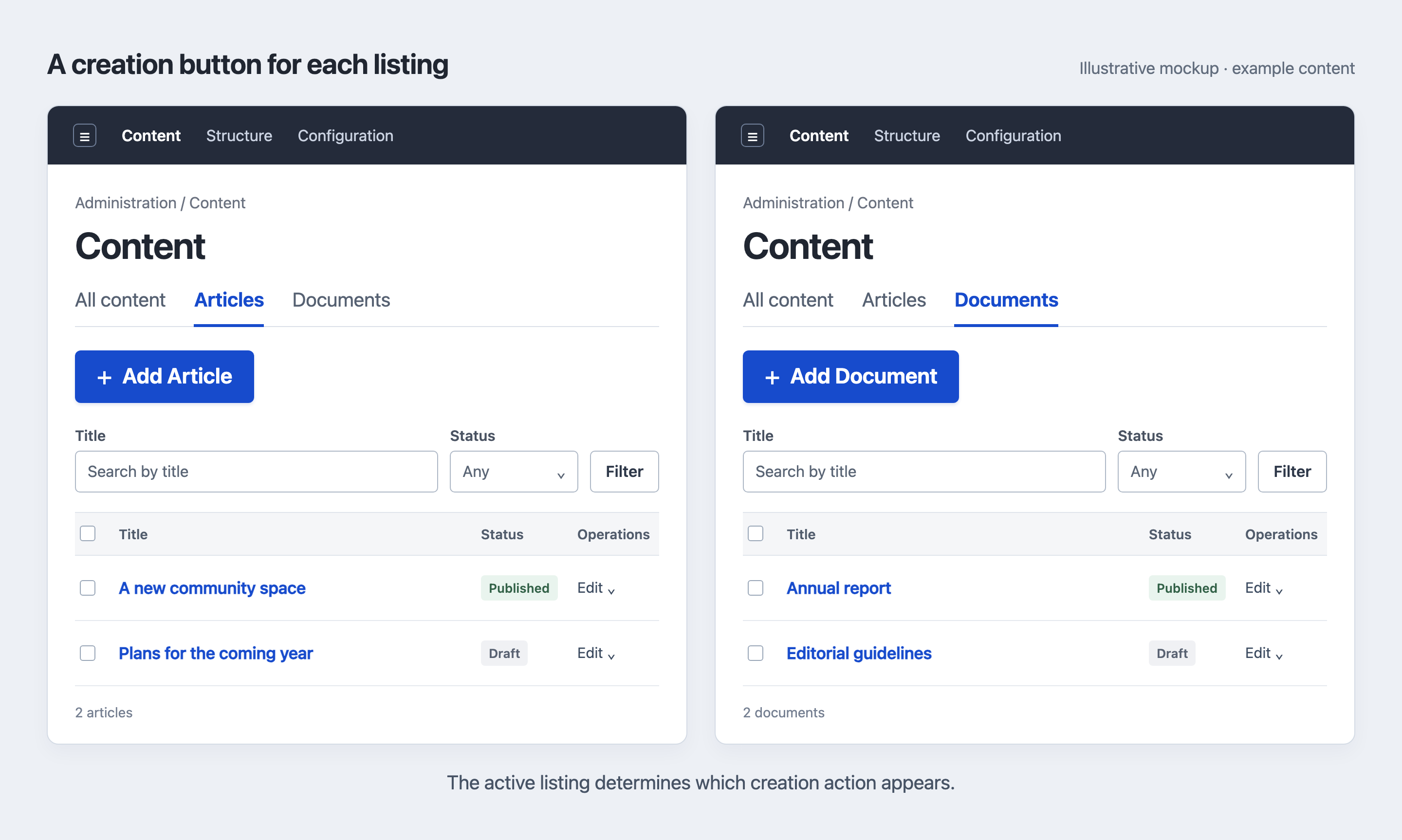
Illustrative mockups with example content. Each listing offers its own creation action.
A creation button for each listingDrupal provides these buttons through local actions. To add one, we specify its label, where it links to and which page should display it. For an article listing, that could take a short YAML definition in listing_actions.links.action.yml, assuming the custom module's machine name is listing_actions:
OpenKnowledgebase Beta 1 - try the knowledge base for people and AI agents now!
 jeremy.chinqui…
Wed, 23 Sep 2026 - 17:56
The first public beta is out: the knowledge base for people and AI agents. Agents edit as governed collaborators, every answer cites the block it came from, and all of it is open source.
Drupal 11 as the Governance Layer for an Open Health Platform
Drupal multisite in the AI era: when shared code is not enough

Sharing Drupal code across country sites does not sync product specifications, documents, or company claims.
Drupal multisite vs multilingual teams must decide where authoritative facts live before AI assistants encounter contradictory pages. Maciej Lukianski compares multisite, one multilingual Drupal, and Domain Access for market-aware publishing.
Eight Posts on the Fun Part. One on the Bill.
 Photo by Kamil Foatov on Unsplash
Jürgen Haas
Wed 23 Sep 2026 - 15:00
In Post 8 I described my monthly billing run. One client never gets an invoice: the Drupal community, which has had almost all of my working time since July 2025. This post is that invoice. The eight posts before it showed the fun part: the Modeler API, the Workflow Modeler, test and replay, the ECA Guide, orchestration. This one shows the ledger underneath: 87 actively maintained drupal.org projects, the Gin admin theme, the Admin theme subsystem in core, 293 public projects on the LakeDrops GitLab, a calendar of weekly and monthly community meetings, two DrupalCons a year. Innovation gets applause; maintenance gets a green badge. Every funding conversation so far was about a feature. Nobody has offered to sponsor a security release. Since July 2025 the revenue has been zero, paid for by earlier years. Dries' cost-allocation posts explain why. The menu at the end has prices: sponsor maintenance through Open Collective, a service agreement, hiring for ECA work, funding the next innovation. Total: roughly €10,000 a month.
TDT September Townhall Discusses Drupal Jobs, AI Visibility and Community Participation
Who provides Drupal development in Estonia and how do you choose the right partner?
Who actually controls your company website?
Zoocha Puts Contribution at Centre of DrupalCon Rotterdam Plans
ExperienceKit: Drupal Canvas and AI Page Generation - What Digital Teams Should Know
The countdown is on: sovereignty on the Enterprise AI Summit
The Enterprise AI Summit takes place in one week, on 28 September aboard the SS Rotterdam, and the countdown is a good moment to properly introduce a session that's been on the agenda for a while: sovereign AI with Julien Blanchez.
Digital sovereignty has moved from a policy discussion into a boardroom question. Regulators, procurement teams and public sector organisations are asking the same thing in different ways: can we use world-class AI technology while keeping control over where our data lives, who can access it, and under what conditions?
With over a decade at Google working on data protection, security and digital sovereignty for large, highly regulated organisations, Julien will walk us through what's driving rising sovereignty expectations and how to keep access to leading AI technology on your own terms.
He joins a day full of similar questions answered with real numbers. The European Personnel Selection Office deployed a RAG-powered instant answer engine inside Drupal in under eight weeks, running in all 24 EU official languages, with 90% fewer repeat support questions and zero hallucinations on manual review. The American Diabetes Association will share what happened when editorial teams got real AI tools in their hands, including the honest lessons that came with it. And Moritz Arendt takes on a question that sits right next to Julien's: can AI strengthen digital communities, or does it risk hollowing them out?
With just days left, there’s still time to check the full agenda and save your seat. Tickets and details are available on the Enterprise AI Summit page.
Drupal vs WordPress enterprise: AI-era content operations

Choosing a CMS for a multilingual product catalogue is a content-operations decision, not a plugin shootout.
Drupal vs WordPress enterprise teams must compare field-level translation, moderation, entity APIs, and AI-ready outputs before assistants read conflicting specs. Maciej Lukianski explains when WordPress still wins, when Drupal fits connected complexity, and how to pilot migration without guessing.
Fifteen of 28 Drupal Core Maintainer Vacancies From 2025 Remain Unassigned
Your Drupal government website needs to meet WCAG 2.1 Level AA by April 26, 2027. Here's what's in scope, how Drupal helps, and how to plan your government site's remediation.
Drupack: Drupal infrastructure in a single binary
A few years ago I said Drupal needed infrastructure innovation, and I finally took the time to do something about it. While I really like DDEV, I'm really not a fan of having to use Docker for everything so I'm trying to do something about it.
theodore September 22, 2026New Engine, Same Keys
 The database under a hosted Drupal or Backdrop estate has to change generations one day, and that is the day most operators find out what their migration tooling was hiding. On a BOA box the move across Percona generations is a rehearsed road: a readiness check names the one account which would block the whole box, the single-account mover carries an account to the newer server with passwords, PHP versions and search indexes intact and the old box relaying traffic until DNS moves, and the whole-server mover refuses to cross a version at all, on purpose, because it replicates rather than dumps. Every transfer and every cutover is a dry run first, every dry run is spent on use, and the watchdog which rescues stuck databases stands down for exactly the minutes it would otherwise rescue you from your own migration.
Pages
