

Speak the Language of Your Audience
I’ve worked in several settings where technical people announced their focus was on the technology, not the user of the technology. They would say things like: “I don’t care what they do, I just want to build it.”
This is a terrible way to work. It leads to bad solutions and miscommunication.
You cannot find the flaws in the spec, and there are always flaws, if you cannot sanity check it yourself. You cannot know for sure your solution worked if you don’t know what the data means and how it is used.
The Importance of UnderstandingWhen my wife and I attended the Polo match pictured above we tried to ask some of the regulars basic questions about what was happening. They responded to us using all the words of the sport, but not in a way we could understand. If they wanted to attract new fans to the sport, they needed to explain the game to us in words we understood. It got even worse when a horse got injured and no one really explained what was happening until the ambulance trailer pulled onto the field.
To do our best work we need to understand the end goal of our users. The most effective way I know to communicate clearly is to use the same language as my audience does when talking about their work. If you try to force them to use the terms and phrases you know best they will likely make mistakes that cause you problems.
We must meet our audiences where they are.
When I was a Drupal developer, I was creating web sites that were customized to a specific organization’s needs. When I was a Salesforce consultant and developer, I was tailoring the platform to handle the specific needs of those users. In my role inside a nonprofit energy company I am making sure our Salesforce org meets our needs.
Human in the Middle: The Review Is Still yours
How Tag1 Reviews Code with AI covered the tools Tag1 built to put AI into the PR review process. This post shows the pattern: AI drafts your whole review into GitHub pending reviews or GitLab draft notes, and you decide, line by line, what gets published under your name.
Where AI Fits in Code ReviewAI is good at the unglamorous parts of review: actually reading every line of a large diff, knowing the obscure API pitfalls no single reviewer carries in their head, checking the change against the rest of the codebase for consistency, and asking every "what if this input is empty" question without getting bored. What it can't tell you is which of its twenty comments actually matter.
There are two ways to put that to work, and they're not in competition. The first is the one most people have seen: a bot that reads the pull request and posts its review straight to it. That's a good fit for CI and merge gating. Tag1's own ai-pr-review runs on every push, combining deterministic scanners with AI reviewers, and can gate merges on what it finds: a leaked credential, a known CVE, a phpstan error, or a logic bug an agent caught.
Getting to Your DDEV Projects Fast: Filesystem Navigation Tips

A recent post on Bluesky asked a common question: with dozens of DDEV projects, what is the fastest way to get to one? The current routine was to open Finder, dig three folders deep, drag the folder into an editor, and then run ddev start. Another post mentioned 52 projects and no idea which ones are running. Here are the techniques we use and that came up in the replies.
ddev list
ddev list shows every project DDEV knows about, with its status, location, URL, and type. The underlined locations and URLs are terminal hyperlinks you can click.
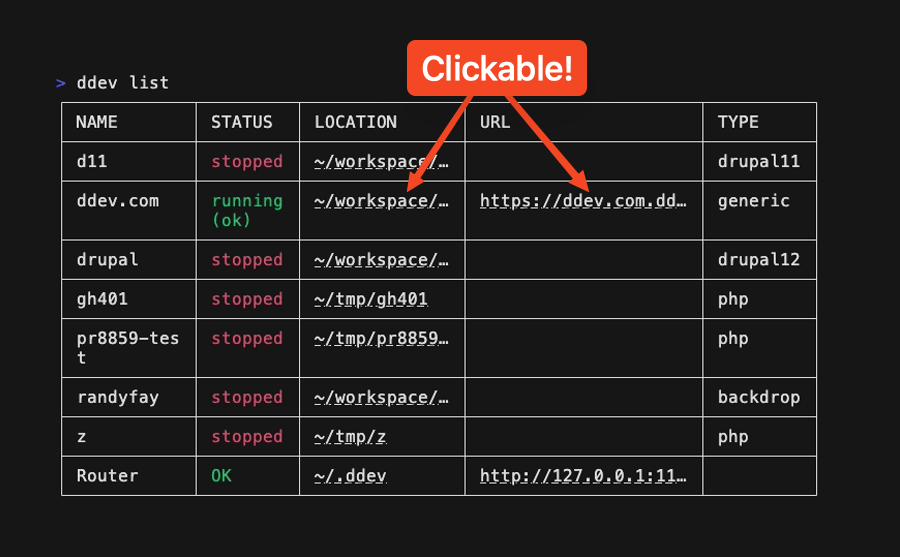
To see only the projects that are running, use ddev list --active-only (or ddev list -A). ddev poweroff stops every running project at once.
Clickable Links
Hold Cmd (macOS) or Ctrl (Linux and Windows) and click a link. A location opens in your file manager, and a URL opens in your browser.
DDEV adds links only in terminals it recognizes, including iTerm2, Ghostty, WezTerm, Kitty, Alacritty, Windows Terminal, VS Code's integrated terminal, GNOME Terminal, and Konsole. The macOS Terminal app doesn't support them, so on a Mac, iTerm2 is a good choice if you want clickable links or even if you just want to live a long and happy life.
If nothing is underlined:
The Cost of Waiting: Why CMS Maintenance Belongs in Every Website Budget
Launching a website is a major milestone, but it does not mark the end of the investment.
Drupal, WordPress, and Backdrop are actively maintained software platforms. Core software changes. Modules and plugins release updates. Security vulnerabilities are discovered. PHP and other underlying technologies move through their own support cycles.
During a long website build, teams should be paying attention to those changes and applying updates when they make sense within the project cadence. That does not necessarily require a dedicated line item for updates. It does require recognizing that the software will continue to change while the site is being built.
The more important planning conversation is what happens after launch. Post-launch budgets often focus on new features, enhancements, and fixes specific to the site. Routine platform maintenance has to be planned alongside that work, or it is easy to defer indefinitely.
Updates are part of operating a CMSDifferent content management systems handle releases differently.
Drupal has a well-defined release cycle, including regular windows for bug fixes and security releases. Backdrop similarly publishes scheduled minor releases and security release windows.
Celebrating Excellence: the Women in Drupal Awards Shine a Spotlight on Women Shaping the Future of Open Source
The Women in Drupal Awards returned this year to celebrate the outstanding achievements of women making remarkable contributions to the global Drupal community. Presented during DrupalCon Rotterdam 2026, the awards recognize women whose talent, leadership, creativity, and commitment are helping strengthen the Drupal community and shape the future of open source.
Now in its fifth year, the Women in Drupal Awards continue their mission of amplifying women’s voices and recognizing the many different ways they contribute to technology and the Drupal ecosystem. From technical expertise and project leadership to community building, mentoring, advocacy, and innovation, the awards celebrate women whose work creates meaningful impact across projects, organizations, and communities.
Three awards celebrating three different forms of contribution
This year, the Women in Drupal Awards recognize three outstanding nominees across three distinct categories:
Drupal CMS & Drupal AI: The Future of Content Management At DrupalCon Rotterdam
Today at DrupalCon Rotterdam, Dries Buytaert presented the future of Drupal CMS and Drupal AI. The key message: Working with content is becoming dramatically easier, more flexible, and more intelligent for editors, marketing teams, and organizations.
DriesNote Targets Drupal's Reputation Gap With Advocacy Credits and Rosetta Sprint Proposal
No Removal Van
 Most Drupal 7 sites keep the crossing to modern Drupal parked for some day, and some day has a habit of never arriving, because the crossing as we all learned it wants a second machine, a dump shipped across, credentials pasted into one more form and a rehearsal budget which runs out after the first try. On a BOA server the two ends sit on one account: the Drupal 7 site keeps serving while a fresh Drupal CMS site goes up beside it, one Ægir task lends the new site read-only eyes on the old database (enforced by the database server itself), and Drupal's own migration engine pulls content, files and users across in place. Rehearsals are throwaway site tasks, the wizard says what will cross before it starts, and the cutover is a move onto your own build and two renames, the old site kept intact. The front end is still a rebuild, your theme, custom code and views; only the logistics go away. Capabilities rather than an enforced workflow, and nothing here picks your exit for you.
 International Splash Awards Celebrate Excellence in Drupal Innovation at DrupalCon Rotterdam 2026
Rotterdam, Netherlands, 28 September 2026. The International Splash Awards 2026 concluded today during DrupalCon Europe in Rotterdam, celebrating the world’s most outstanding Drupal projects, agencies, and developers. The annual awards recognize excellence in design, innovation, technical achievement, and community impact across a range of categories.
ImageThe range of entries shows how powerful Drupal as an Open Source system truly is. From municipal websites to apps that connect parents in developing nations to expert childcare advice, the competition this year was fierce.
— Hilmar Kári Hallbjörnsson, head of jurors, International Splash Awards
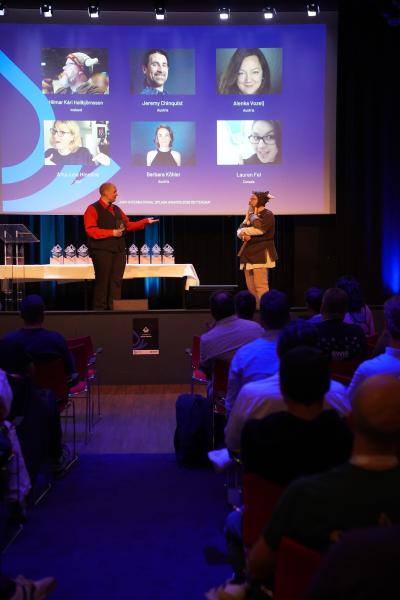
Photo Credits: Joris Vercammen
Following the successful return of the International Splash Awards in 2025, this year’s competition saw an even greater participation from across the global Drupal community, receiving 40% more submissions than the previous year. A distinguished jury of independent experts in web design, user experience, open source development, and digital strategy evaluated entries across criteria including concept, execution, emotional appeal, accessibility, performance, innovation, and social relevance.
Acquia Cuts DrupalCon Booth Spend to Donate $50,000 to Drupal
Tired of adding Webform fields one by one? AI Webform Generator builds Drupal forms from a single sentence and checks every AI output first.
What's new in the Drupal AI Views Agent: Simpler prompts and a build assistant
DriesNote Rotterdam: Drupal is light-years ahead of its reputation
Dries Buytaert opened DrupalCon Rotterdam with a tour of a platform moving at remarkable speed. Multilingual sites that take a fraction of the effort to build. Components written in React. Headless delivery across five frameworks. AI assistants that connect directly to your content. A pipeline of innovation that has Europe's push for digital sovereignty looking closely at Drupal.
Then he named the problem: hardly anyone outside this community knows. The market's picture of Drupal runs years behind what the platform can do today.
Rotterdam has a saying: "Niet lullen maar poetsen." Stop talking, start working. Dries argued we have taken that advice almost too well, and he flipped it. The work is done. Now it's time to talk louder about what is working, and for the first time, that work earns contribution credit.
Here is what he covered.
Europe needs digital sovereignty, and Drupal is readyDries opened with a challenge facing Europe: reducing its dependence on technology it does not control. When the European Commission asked for feedback on digital sovereignty, Dries submitted his thinking, and his writing was referenced in the official policy recommendation that followed.
His point: open source projects like Drupal offer more than software. They offer ongoing maintenance, security releases, and a global community of care. He gave it a name he hopes will catch on: Stewarded Open Source.
For governments and organisations that need control over their digital infrastructure, Drupal is exactly that: open source with a steward, proven at scale, and owned by no single vendor. As Dries put it: "Europe needs Drupal. And Drupal needs Europe too."

ExperienceKit: Web Accessibility at Scale - Audit Components Once, Not Pages Forever
Vibing Drupal: Tale 1 - Using AI to build and contribute a module
Introduction
I use AI every day to accomplish a variety of tasks. I'd like to share three tales about building, maintaining, and contributing to different Drupal modules. My goal is to discuss how I use AI and what I use it for.
At the same time, I am not trying to teach you how to use AI because I've noticed a nuance: AI can teach you how to use AI. For example, you can point an AI at this post and ask it to read the post, follow the links, and explain how things are being done. For me, open source and Drupal have always been more about sharing ideas, experiences, and stories, as well as code, allowing humans and their AIs to learn from or be inspired by each other's experiences.
My three tales are meant to be told in a specific order: building a greenfield project, maintaining a brownfield project, and contributing to someone else's project. Because of how AI works and the increased use of spec-driven development, people are discussing projects in terms of greenfield vs. brownfield. Ironically, I don't think of Drupal as greenfield or brownfield, but as infrastructure that fields and projects sit on top of. The most fundamental greenfield project in Drupal is building a new site for an organization, and for contributions to Drupal, building a new module.
Building a module using AI
Rotterdam Puts Drupal’s Biggest Bets to the Test
Perhaps the most revealing thing about DrupalCon Rotterdam is that its programme does not tell one tidy story. Drupal is preparing to discuss its transformation into a production-ready Agentic CMS while another session asks, quite directly, why developers still do not choose Drupal. Canvas has become central to Drupal CMS, yet Rotterdam will also put it against Display Builder in a real-world project. Those collisions matter because Drupal’s next phase depends less on any one initiative succeeding than on whether these different bets can reinforce one another without carrying old friction forward.
Connecting Drupal to models and agents is no longer the difficult part of the AI story. Rotterdam moves quickly into hallucination, reviewer trust, orchestration, governed workflows and human control because production use raises harder questions about what an agent may do once it can act rather than merely answer. Permissions, auditability, validation and human approval are becoming part of the product itself. If the Agentic CMS idea is going to mean more than a collection of AI capabilities, those boundaries have to become as deliberate as the capabilities they constrain.
A great leap backwards: fixed configuration
Drupal's configuration system has at its heart a key concept: the site owns the configuration. What that means is that after a module has provided install configuration, it no longer has any control over it. You, the site admin, can change that config or even delete it. The module is no longer involved.
This kept the configuration system simple (up to a point); after all, the development of this system was one of the harder parts of the lengthy and difficult Drupal 8 cycle ("The ConfigImporter class was written with a get this done and working attitude" wrote @alexpott on a core issue, and I think the same could be said of the configuration system as a whole).
Since then, the config transformation API was added, and various modules have been created that take advantage of this, such as Configuration Split and Config Merge. These still work in the paradigm of the site owning the configuration. But what if we could turn the clock back, just partially, to when modules could own config too?
The (different) old daysIf you were around in the days of Drupal 7, you may remember the various default hooks. Modules such as Views and Flag exposed a hook which allowed modules to define configuration items. (These were not configuration in the modern sense, because there wasn't that concept at the time, but referring to them as such makes things simpler.)
These were thus a code-defined instance of a type of thing that could also be defined in the UI by site admins. A module could supply a default view, and rely on it always existing. A new release of a module could come with enhancements to a that view, and they would exist on the site as soon as the module code was updated to the new version.
Measuring ChatGPT ads on Drupal, from the browser and from the server
Since September, advertisers in Europe can buy ads inside ChatGPT, and the Ads Manager asks for two things before it can tell you whether they work: a measurement pixel in the browser and, ideally, conversions sent from your server. On a Drupal site that usually means pasting a snippet into the theme, writing the order_created call by hand in a template, and trying to hide the whole thing behind the cookie banner. Then the order paid by bank transfer or payment reference hours later, confirmed by a webhook, never shows up, because no browser was there to see it.
Even when a browser is there, the pixel loses part of the picture. Ad blockers stop it outright, Safari caps cookies written by scripts at seven days, and iOS removes tracking parameters from links shared in Messages and Mail and from links opened in private browsing. OpenAI's own documentation calls the Conversions API "a more reliable tracking source than the pixel alone".
We have released a module for this on drupal.org: ChatGPT Ads, free software under the GPL, for Drupal 10.3 and 11, covered by Drupal's security advisory policy. It plugs into Drupal Commerce, Webform and the Klaro consent manager through sub-modules, and sends events through both OpenAI's Measurement Pixel and the Conversions API. It is a community module, not affiliated with OpenAI.
Drupal's Got Talent at DrupalCon Orlando 2027!
The inaugural DrupalCon Talent Show is happening at DrupalCon Orlando on the evening of Tuesday, March 23, 2027 as part of the community party!
We’re planning about two hours of entertainment and looking for roughly 10 acts to take the stage (5–7 minutes for the act, plus up to 3 minutes for stage setup).
This is DrupalCon. The goal is to learn, network, and have fun. Expect jokes, friendly razzing, questionable decisions, and plenty of laughs. You don’t need to be a professional. You just need to be willing to get up there and attempt to entertain your fellow Drupalers (within our Code of Conduct https://events.drupal.org/code-conduct, of course!)
What are we looking for?
Pretty much anything entertaining:
- Musicians
- Bands
- Stand-up comedy (keep it PG-13 please!)
- Magic
- Singing
- Dancing
- Juggling
- Puppet shows
- Ridiculous feats of skill
- Weird talents you didn’t think anyone wanted to see (we do)
Got something that doesn’t fit on the list? Even better. Solo acts, groups, first-timers, seasoned performers, and wonderfully questionable ideas are all welcome.
Think you’ve got something? Sign up here and show us what you’ve got!
FAQs
When is the deadline?
The absolute last deadline to sign up is Friday, February 19th. However, submissions are reviewed on a rolling basis as they come in. Once all ~10 spots are filled, sign-ups will close early. We strongly encourage you to submit as soon as possible.
Is there a prize?
Likely, but this hasn’t yet been determined. Suffice it to say that the primary prize will be bragging rights!.
Drupal to WordPress Migration: When Downgrading Is Right
Pages
