

 The 2026 Drupal Business Survey is open. Your response will help shape the future of the Drupal business ecosystem.
A bridge between frameworks, Drupal in the back, Nuxt.js in the front.
Features
- One permission for read-only access to the JSON:API resources Druxt needs.
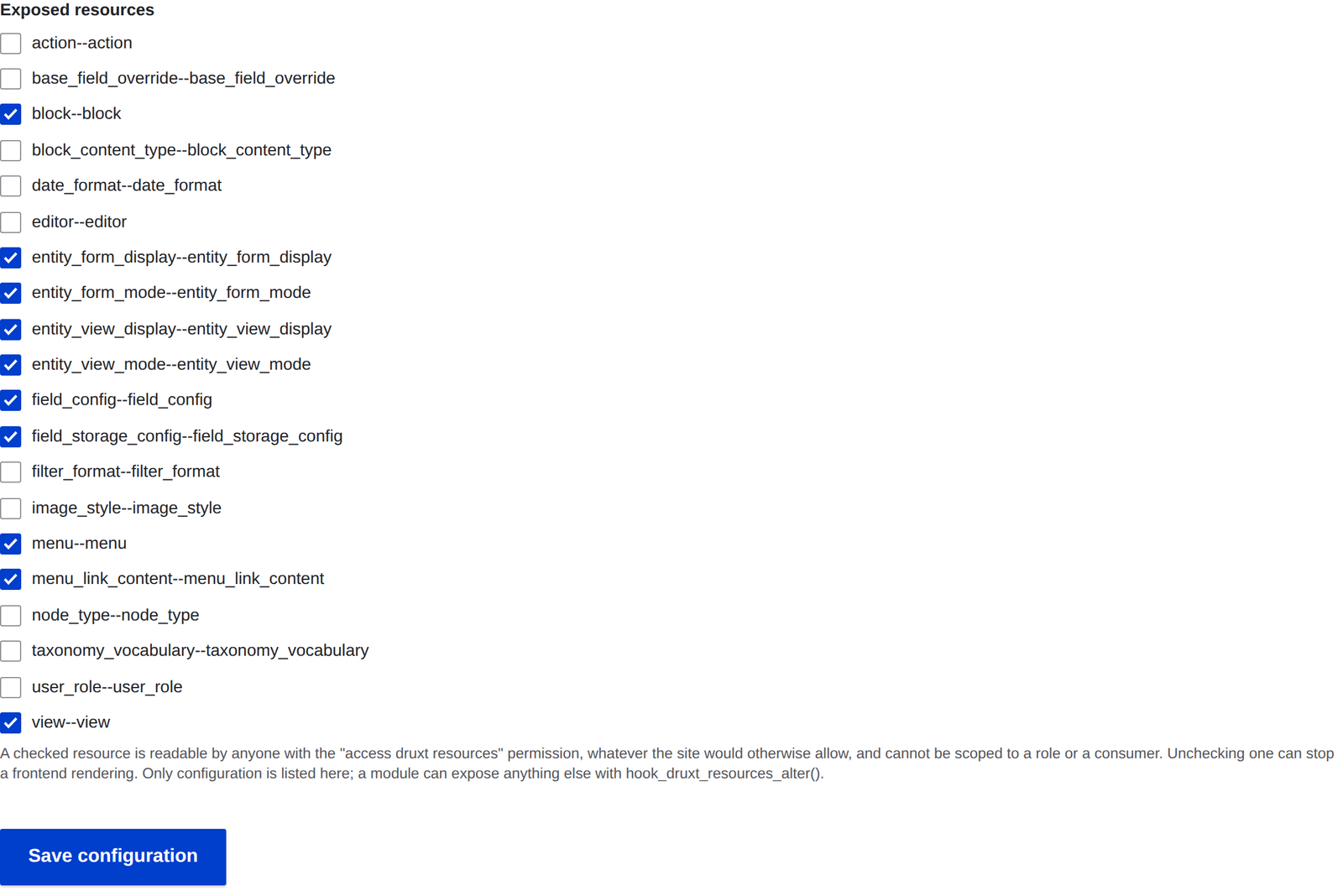
- The exposed resource list is configurable, behind a separate "administer druxt" permission, with
hook_druxt_resources_alter()for modules that know what they need. - Support for Views routes via the JSON:API Views and Decoupled Router modules.
- Support for Contact form routes via the Decoupled Router module.
- Improved support for menu items via the JSON:API Menu Items module.
- Condition plugin bypass for Block resources.
- Enables Cross-Origin Resource Sharing (CORS) support.
- Ensures EntityViewDisplay configuration is available to the DruxtSchema module.
Requirements
- Drupal 10 or 11.
- Core's
jsonapimodule, plus Decoupled Router, JSON:API Menu Items and JSON:API Views, which Composer installs with this module.
Installation
Druxt requires a Nuxt frontend and a Drupal JSON:API backend. Prepare the Drupal backend covers the module set, JSON:API configuration and the permissions the frontend needs.
Drupal
- Install Drupal.
- Download the Drupal Druxt module:
composer require drupal/druxt - Install the Druxt module.

- Add the "access druxt resources" permission to a user or role.
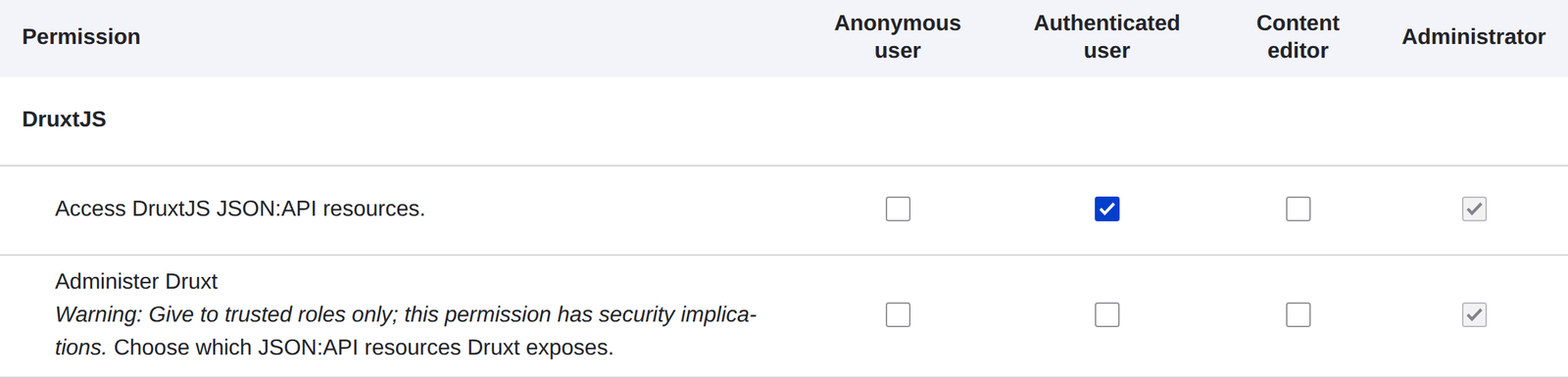
- Review which resources are exposed at
/admin/config/services/druxt. The defaults are the set every earlier release exposed, so there is nothing to do here unless a frontend needs more.
Nuxt
- Install Nuxt and Druxt.
- Install the Nuxt Druxt Site module:
npm i druxt-site - Add the module and configuration to
nuxt.config.js:
module.exports = {
  modules: [
    'druxt-site'
  ],
  druxt: {
    baseUrl: 'https://api.umami.demo.druxtjs.org'
  }
}
The JavaScript side
This module is the Drupal half of Druxt. The frontend is a set of npm packages for Nuxt 2 that turn Drupal's JSON:API into Vue components: routes, content entities, menus, blocks and views, each themeable without forking the framework.
You can take as much or as little as you want. One package gives you a complete decoupled site driven by your Drupal display configuration, and the others add individual pieces to an existing Nuxt project. The current list, with installation instructions for each, is at druxtjs.org/modules.
If Nuxt is new to you, Nuxt for Drupal developers maps it onto the Drupal concepts you already know, and says which parts you can skip.
Community
Druxt development happens in the open. The fastest route for a bug or a feature request is the relevant issue queue:
- This module, the Drupal side: use the issue queue on this project page.
- The Nuxt packages: the druxt.js queue on GitHub
For questions and discussion there is a Discord server at discord.druxtjs.org. It is a small room rather than a busy one, but questions posted there do get answered by the maintainer.
Documentation is at druxtjs.org.
Supporting organizations:
Development
Project information
- Project categories: Decoupled
- Ecosystem: JSON:API
 465 sites report using this module
- Created by deciphered on , updated
 Stable releases for this project are covered by the security advisory policy.
Look for the shield icon below.
Releases
1.3.1
released 9 September 2026
released 9 September 2026
Works with Drupal: ^10 || ^11 || ^12
Fixes a fatal when adding the module to a site that already has JSON:API enabled, and a false status report warning about resources for modules the site does not have.
Install:
Development version: 1.3.x-dev updated 9 Sep 2026 at 06:18 UTC
1.2.2
released 5 September 2026
released 5 September 2026
Works with Drupal: ^10 || ^11 || ^12
Restores Decoupled Router 2.0.7 compatibility, guards the Views path translator against a missing JSON:API Views route, defaults CORS allowedHeaders, and drops Drupal 8 and 9 support.
Install:
Development version: 1.2.x-dev updated 5 Sep 2026 at 05:06 UTC


