


Arts + culture portal software for regional marketing and digital souvereignty
OpenCulturas is built as a pre-configured platform for cultural-focused communities, empowering actors in the cultural field to own their data and make their information accessible to a wide audience.
How do I download OpenCulturas?
composer create-project --remove-vcs drupal/openculturas_project example.org
For contributions, get the source at OpenCulturas Project page.
Any facet of an arts + culture community, infinitely interconnectable
- Calendar: Add event dates and list them in a filterable event calendar (plus map)
- Locations: Create event locations that can be referenced and are aggregated on a map
- Personal Profiles: Create your profile and showcase your information
- Group Profiles: Create a profile for your group, such as a band, performance group or theatre ensemble
- Magazine: Publish magazine articles on spotlight topics, such as artist interviews or concert reviews
- Event Catalogue: Re-usable event (or workshop) descriptions, displayed in a catalogue with search filters
- Tagging in many dimensions, each tag automatically comes with a promotable landing page
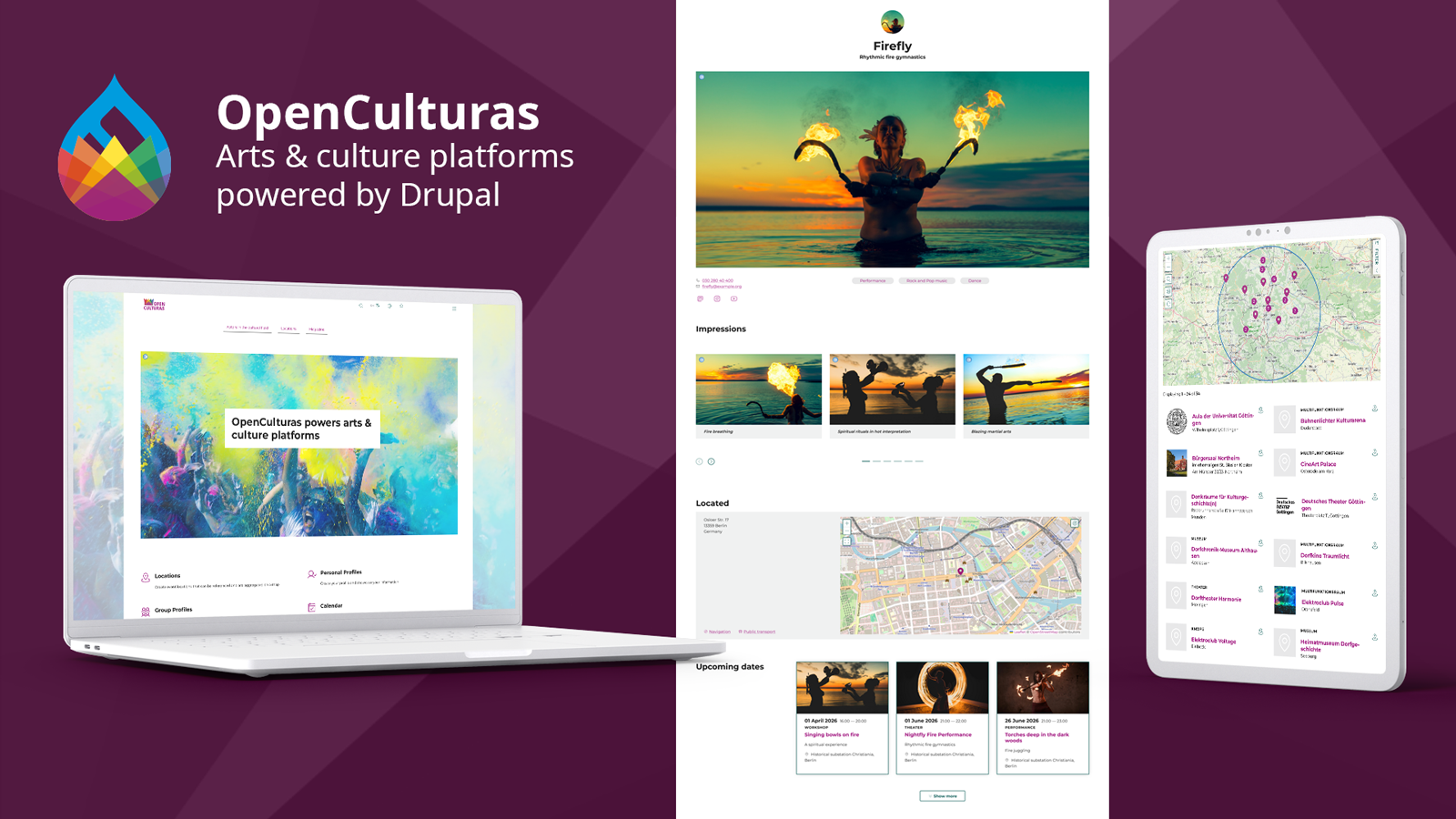
Features
- Filterable overviews for all types (locations on a map, calendar, profiles overview, magazine
- Category pages aggregate context-filtered content
- Pre-configured "related content" blocks, e. g. a calendar related to a location/profile, connections to artist/ensemble profiles, referencing magazine articles
- Hierarchically structured taxonomies like focus categories, accessibility features, trigger warnings
- Interaction options like bookmark links for individual watchlists, public recommendations
- Review workflows
- Focus on user-generated content, with moderation workflows, abuse flags etc.
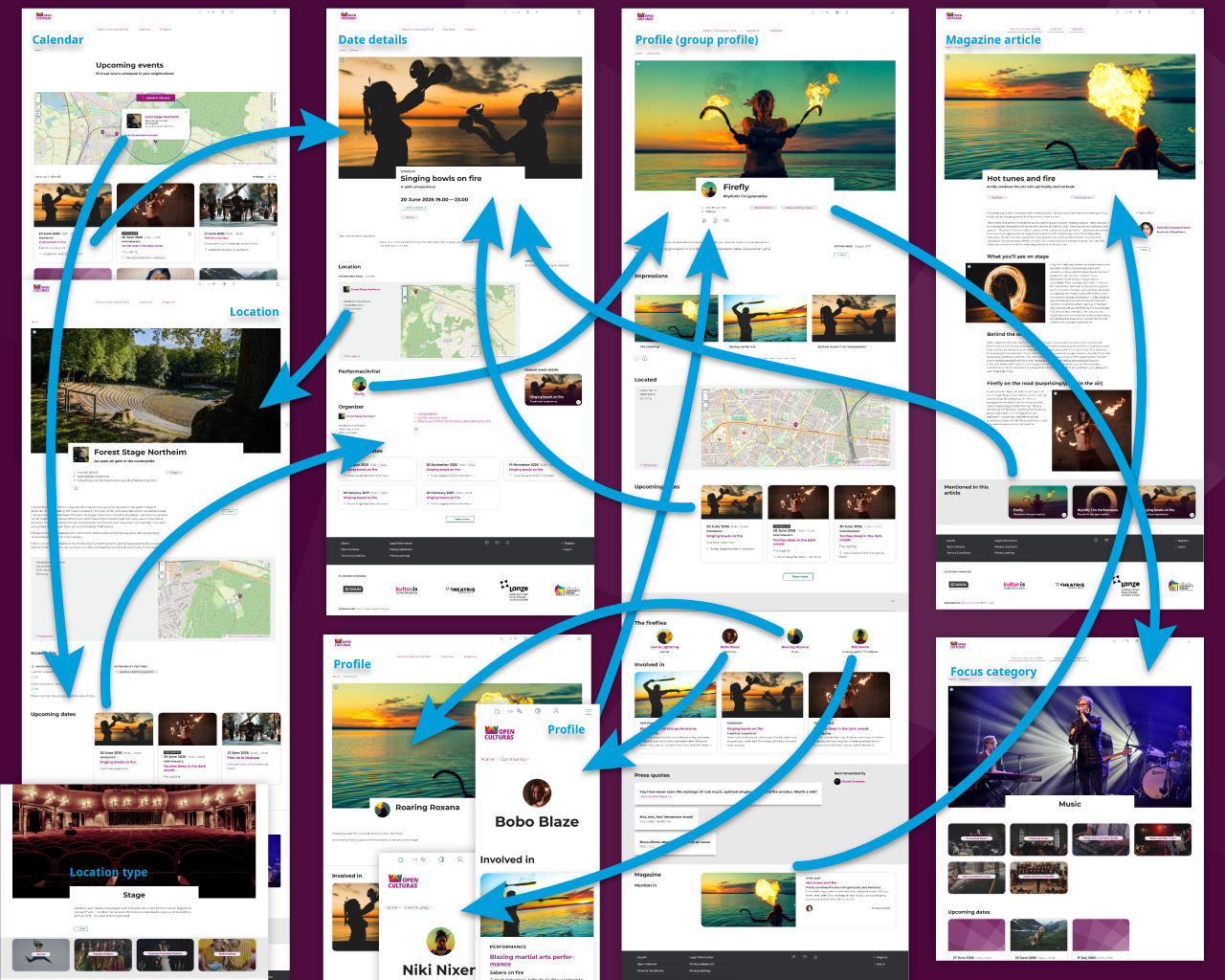
Based on repeating usability tests, there are yet more features on the roadmap.
Beyond the arts
With a strength in network visualization, event dates, multi-profile relations, and geolocalization, OpenCulturas has proven to be suitable, too, for
- FOSS community platforms (e. g. easy publication of repeating events, foster networking)
- Umbrella organizations (e. g. promoting a decentralized user-generated network, publishing press releases)
- Associations maintaining e. g. memorial sites all over the country
...and many more use cases.
Beginner-friendly
OpenCulturas focuses on the early part of the notorious Drupal learning curve. The mantra is: site-builder friendly. It was a deliberate decision to not solve in code what can be solved in the back-end. With this strategy we want to encourage Drupal beginners to take their first steps.
Design adjustments do not require speed studies of Twig or PostCSS. Web designers can adjust a handful of CSS custom properties to give their platform a unique look. There are a lot more custom properties available that work based on sensible color mixes or calculations but all of those can in principle be overridden via a CSS injector.
Built-in compliance
Typical projects are funded by the European public sector. Hence, OpenCulturas was built on compliant standards:
- Privacy by default (no tracking 3rd-party required)
- Accessibility by design (screen reader and keyboard accessible as well as structured data for accessibility features related to events + locations)
- Security-savvy development
- Truly Free and Open Source
- Software bill of materials available
Governance
Following what we've learned from FOSS communities, the distribution is not "owned" by a vendor. Instead, the OpenCulturas Association invites site-owners and cultural organizations to decide about further development and use their budgets in union.
 |
 |
 |
 |
Project information
 41 sites report using this distribution
- Created by tobiasb on , updated
 Stable releases for this project are covered by the security advisory policy.
Look for the shield icon below.


