

Who actually controls your company website?
Zoocha Puts Contribution at Centre of DrupalCon Rotterdam Plans
ExperienceKit: Drupal Canvas and AI Page Generation - What Digital Teams Should Know
The countdown is on: sovereignty on the Enterprise AI Summit
The Enterprise AI Summit takes place in one week, on 28 September aboard the SS Rotterdam, and the countdown is a good moment to properly introduce a session that's been on the agenda for a while: sovereign AI with Julien Blanchez.
Digital sovereignty has moved from a policy discussion into a boardroom question. Regulators, procurement teams and public sector organisations are asking the same thing in different ways: can we use world-class AI technology while keeping control over where our data lives, who can access it, and under what conditions?
With over a decade at Google working on data protection, security and digital sovereignty for large, highly regulated organisations, Julien will walk us through what's driving rising sovereignty expectations and how to keep access to leading AI technology on your own terms.
He joins a day full of similar questions answered with real numbers. The European Personnel Selection Office deployed a RAG-powered instant answer engine inside Drupal in under eight weeks, running in all 24 EU official languages, with 90% fewer repeat support questions and zero hallucinations on manual review. The American Diabetes Association will share what happened when editorial teams got real AI tools in their hands, including the honest lessons that came with it. And Moritz Arendt takes on a question that sits right next to Julien's: can AI strengthen digital communities, or does it risk hollowing them out?
With just days left, there’s still time to check the full agenda and save your seat. Tickets and details are available on the Enterprise AI Summit page.
Drupal vs WordPress enterprise: AI-era content operations

Choosing a CMS for a multilingual product catalogue is a content-operations decision, not a plugin shootout.
Drupal vs WordPress enterprise teams must compare field-level translation, moderation, entity APIs, and AI-ready outputs before assistants read conflicting specs. Maciej Lukianski explains when WordPress still wins, when Drupal fits connected complexity, and how to pilot migration without guessing.
Fifteen of 28 Drupal Core Maintainer Vacancies From 2025 Remain Unassigned
Your Drupal government website needs to meet WCAG 2.1 Level AA by April 26, 2027. Here's what's in scope, how Drupal helps, and how to plan your government site's remediation.
Drupack: Drupal infrastructure in a single binary
A few years ago I said Drupal needed infrastructure innovation, and I finally took the time to do something about it. While I really like DDEV, I'm really not a fan of having to use Docker for everything so I'm trying to do something about it.
theodore September 22, 2026New Engine, Same Keys
 The database under a hosted Drupal or Backdrop estate has to change generations one day, and that is the day most operators find out what their migration tooling was hiding. On a BOA box the move across Percona generations is a rehearsed road: a readiness check names the one account which would block the whole box, the single-account mover carries an account to the newer server with passwords, PHP versions and search indexes intact and the old box relaying traffic until DNS moves, and the whole-server mover refuses to cross a version at all, on purpose, because it replicates rather than dumps. Every transfer and every cutover is a dry run first, every dry run is spent on use, and the watchdog which rescues stuck databases stands down for exactly the minutes it would otherwise rescue you from your own migration.
 What EU Digital Identity Wallets Could Mean for Drupal
European Digital Identity Wallets are moving from technical framework and pilot programmes towards services that people will be able to use across the European Union. The European Commission says Member States must make wallets available to citizens, residents, and businesses by the end of 2026. For Drupal teams, that makes digital identity less a future policy topic and more an application-architecture question.
The wallet model changes what an online service can ask a user to prove. Instead of treating identity as one complete profile, users can present particular identity data or attestations and disclose only the information required for a transaction. Commission figures say more than 550 companies and public authorities across 26 Member States, Norway, Iceland, and Ukraine are participating in large-scale pilots covering government services, banking, education, health, transport, telecommunications, and other uses.
The relevant role for a Drupal application is the relying party. Under the European framework, organisations that use wallets for digital services must register their intended use and indicate the data they plan to request. That puts the request itself inside a defined trust and registration model rather than leaving every application to decide independently what identity information it wants to collect.
Drupal multilingual websites: how AI cuts translation workload while your team stays in control

Every update on a multilingual Drupal site must reach each market language - not just the source page.
Drupal multilingual websites can use AI-assisted translation drafts inside Content Translation workflows so editors review and publish without copying text between tools. Maciej Lukianski explains shared fields, editorial ownership, document links, and keeping localized pages consistent for people and AI search.
The AWS Migration: Building the Next Chapter of Drupal’s Infrastructure
This is the first post in a three-part series about the impact of the AWS Open Source Credits program on the Drupal community. Part one covers our testing infrastructure. Part two will cover the community programs we host beyond code. Part three will cover what the AI era is doing to open source infrastructure, and what we're building next.
Drupal is one of the open web's longest-running content management projects, in continuous development since 2001, and a recognized Digital Public Good. It runs a large share of the public web: government portals, universities, hospitals, cultural institutions, and international organizations, including the European Commission and agencies across the UN system. The Drupal Association is the small non-profit that keeps the project's home online. We build the tools that enable our community to build Drupal.
Since 2025, the AWS Open Source Credits program has supported the infrastructure behind that work. This series is our thank you, and impact report about what that support has made possible.
The scaleDrupal's collaboration happens on git.drupalcode.org, our self-hosted GitLab instance and one of the largest in open source. It hosts 42,382 contributed projects: 39,003 modules, 2,400 themes, and 979 distributions, alongside Drupal core itself.
The Drupal community opens more than 5,300 merge requests every month, about 65,000 a year, from 8,000 unique contributors annually. Drupal core alone has 15,256 issue forks.
Mautic Audiences for Drupal: personalisation built on the segments you already maintain
Your marketing team already knows who the VIPs are. They maintain the segment in Mautic, they send it a campaign every month, they add and remove people as orders and behaviour change. Then somebody asks for a VIP banner on the website, and the website turns out to know nothing about any of it. So "VIP" gets built a second time, as a Drupal role or a checkbox on the user: two definitions of the same audience, maintained by two teams, drifting apart from the first week.
The second problem arrives with the first. Personalisation on Drupal usually means varying the page per visitor, and a page that varies per visitor is a page nobody else can be served, so the banner meant to lift conversion ends up slowing the site down for everyone.
We build and run Mautic-driven marketing for our e-commerce clients, so we kept meeting both problems on the same projects. Mautic Audiences is our answer, now on drupal.org as free software (GPL-2.0-or-later) for Drupal 10.3 and 11, covered by Drupal's security advisory policy. It reads the segments and tags you already maintain in Mautic and turns them into native Drupal primitives: block visibility, Twig, tokens, JavaScript, Views, Search API and, since 1.1, a field.
What editors can build without a developerPlace any block, scroll to Visibility, pick Mautic segment, type vip. Save. That is the whole configuration, and it covers most of what people actually ask for:
Upcoming critical contributed project security release on September 23, 2026 - PSA-2026-09-21
There will be a security release for a widely used contributed module on September 23, 2026 between 17:00 and 21:00 UTC.
We are announcing this release in advance because the affected contributed module is used on a significant portion of Drupal sites, and the upcoming release will include a significant number of advisories. The advisory with the highest risk score for the release is currently rated as critical.
Drupal core is not affected.
Advisories may be published in batches (a few at a time)
The current rate of advisories may require changes to our practices going forward:
- The security team may publish advisories individually, at different times inside the window.
- We will try to publish batches grouped by module.
- We will announce in Slack when all planned releases for the day are complete.
- We will release mailing list emails about the security updates together at the end of the window, to reduce the risk of site owners updating multiple times while advisories are still being published.
These changes are intended to make the process easier for the team and to make communication from the team easier to follow.
No special release procedures
The planned update does not require special release procedures.
Shared Public-Sector Platforms Shape Big Blue Door’s DrupalCon Rotterdam Focus
Bento Showcase: Bento Grid Layouts for Drupal Views
DDEV Snapshots: Checkpoints, Restores, and Seeded Databases
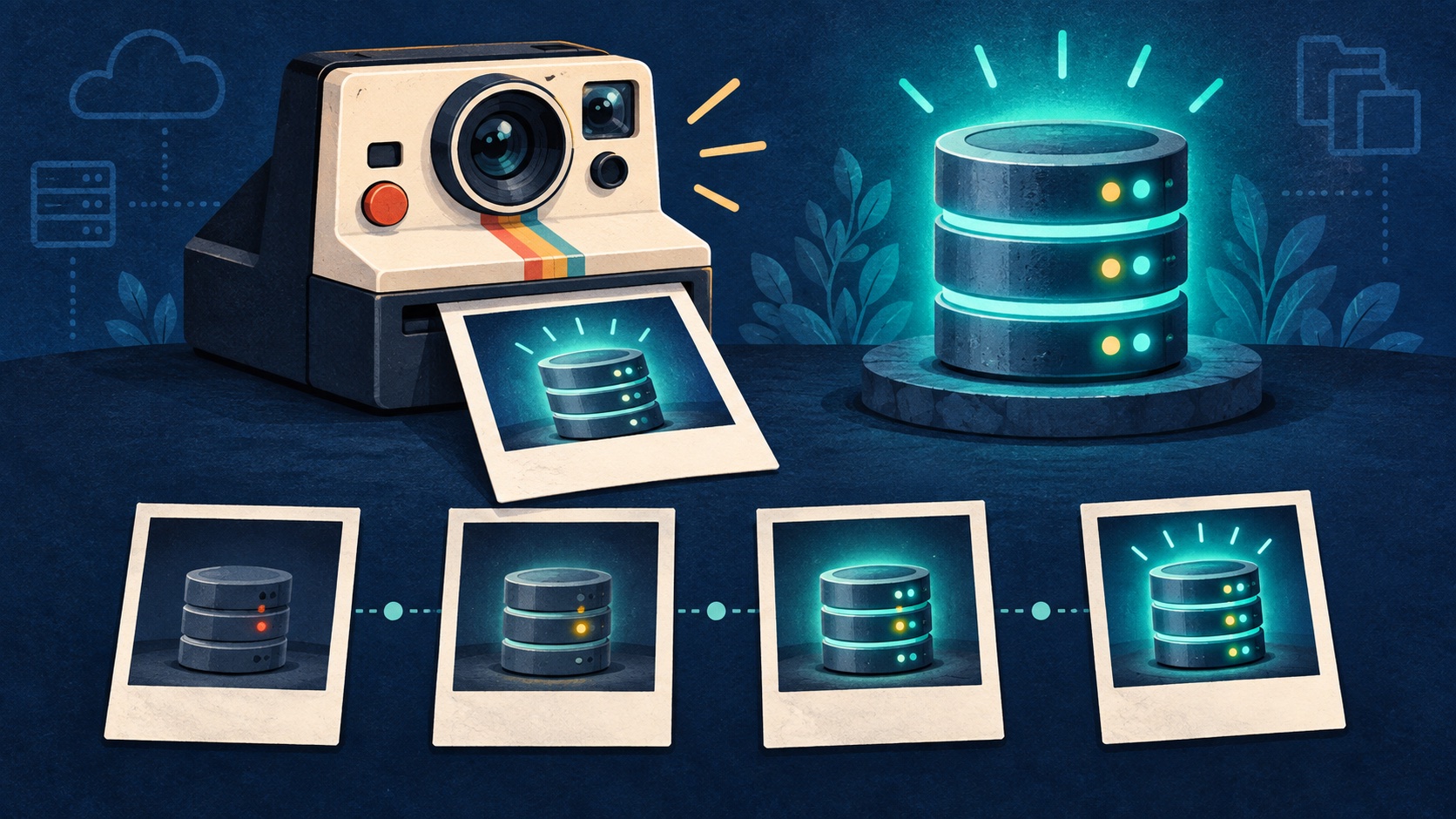
Snapshots have been a beloved feature of DDEV for years, but in v1.25.4 there is so much more.
Read on (or watch, or both) to see:
- Basic use of snapshots
- Use of a
seedsnapshot to automatically provide content to a project on first start - Committing a seed snapshot into a Git repository
- Starting/restarting with a seed snapshot
- Embedding a snapshot (usually for huge databases) into a custom database image
A DDEV snapshot is a physical, "hot" backup of your database — mariadb-backup/xtrabackup for MariaDB and MySQL, or pg_basebackup for Postgres — not a text-based mysqldump. Because it copies the database's on-disk files instead of dumping SQL statements, it's much faster to create and restore, especially on large databases. All the basics about snapshots are in the docs.
Normally snapshots live in .ddev/db_snapshots/, and the filename encodes the database type and version, for example mariadb_11.8. That's why a snapshot only restores against a matching engine and version — restoring a mariadb_11.8 snapshot into a mariadb_10.11 project will fail.
Snapshots are compressed with zstd by default. --uncompressed skips the decompression step on restore, trading a much larger file on disk for a faster restore. Postgres doesn't support uncompressed snapshots.
Picking a Drupal service at runtime with Symfony tagged locators
Or in other words - collecting and accessing services from the container, without injecting the whole container.
by lee.rowlands / 21 September 2026Sometimes you need to collect a group of services and pick the right one at runtime, based on some condition.
Drupal's render pipeline is a good example. It needs a different renderer depending on how a request wants its response back: HTML requests get HtmlRenderer, Ajax requests get AjaxRenderer, a modal dialog gets ModalRenderer. There are many of these in core, all implementing the same interface.
In the past, you might have handled this by injecting the whole service container. Then you'd pull out the service you needed by name, something like \Drupal::service('main_content_renderer.' . $format). While this would work, it would tie your class to the container. This would make it harder to test, and also wouldn't make it obvious which services your code expects to exist. Or, in other cases, you might have a compiler pass collect tagged services and inject the service IDs and the container. LazyContextRepository in core is an example of this pattern.
Since #3414208, Drupal can make use of a neat feature from Symfony instead. It's called a tagged locator. A locator builds the service only when you ask for it. The constructor lists exactly what it can provide, rather than the whole container.
A concrete example already in core is MainContentViewSubscriber, which picks the renderer for the current main content view.
What Adobe Experience Manager Actually Costs (and When to Leave)
Drupal Hosting Compared: Speed Data From 424 Government Sites
Pages
