

How to Personalize the Post-Login Experience in Drupal Based on User Roles
A user has logged in to your Drupal website. What happens next? Does their journey follow the same path as everyone else’s, or can your website tailor the experience to their roles and tasks?
Upgrading tmgmt_deepl from 2.2.x to 2.4.x with the DeepL setup wizard
The new tmgmt_deepl Upgrade Wizard assists with the upgrade from version 2.2.x to 2.4.x: key migration, new default values, custom code validation, and configuration validation. Here's how the upgrade works, step by step.
Drupal and the Missing Photographer
Consumer Node Preview 1.0.0-rc1; preview for Fully Decoupled Drupal sites
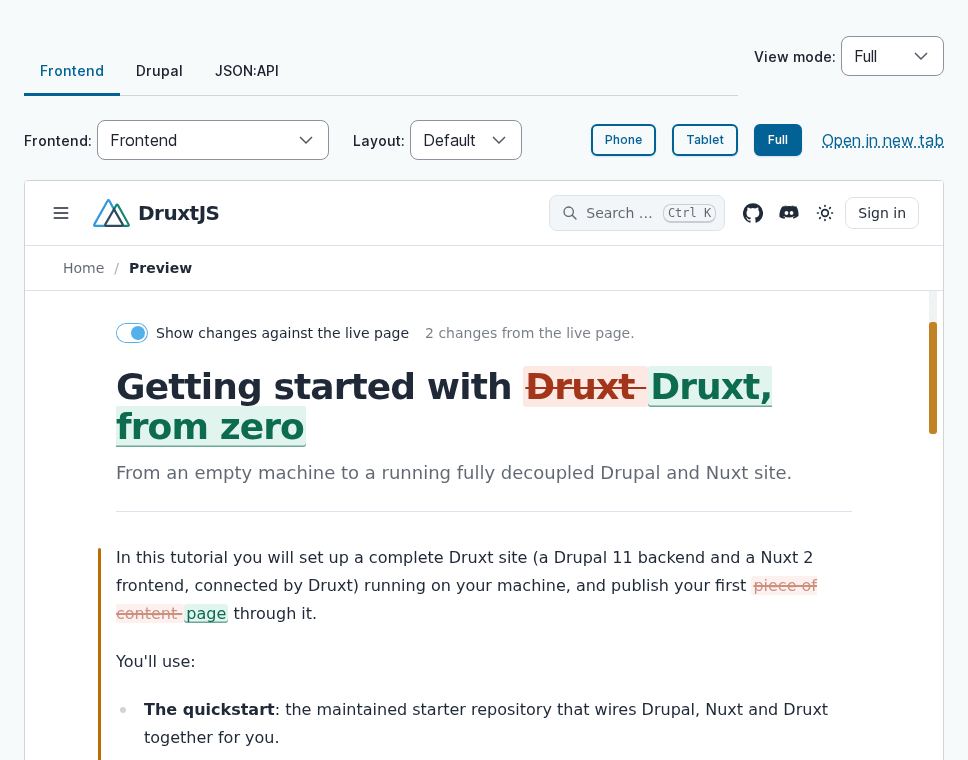
Press Preview on a Fully Decoupled Drupal site, and Consumer Node Preview 1.0.0-rc1 shows the unsaved page in the frontend your readers will see: the title you just changed and the text you just rewrote, rendered by the site that will publish them.
Drupal's own Preview renders the node in Drupal's theme, not your frontend, so editors save a draft to check it. Next.js draft mode smooths that workaround, but still needs a saved revision. Consumer Node Preview works on what's still in the edit form, for the person writing it, before anything is saved.
Anything that reads JSON:API can be on the other end. Druxt Node Preview 0.1.0 is the Nuxt one, already running druxtjs.org's previews.
Migration support for Drupal 6 and 7 sites will not be in Drupal 12
The Migrate Drupal module, which is required for migrating Drupal 6 and 7 sites, will be removed from Drupal core in the next major release, Drupal 12. Also removed is the Migrate Drupal UI module, which provides a basic user interface for running a migration. Both of these modules will not be moved to a contributed project, as is often done for removed extensions.
This means that legacy Drupal sites will not be able to migrate directly to Drupal 12 and later. Legacy sites should migrate to Drupal 11 and then upgrade to Drupal 12.
This was decided in [Policy] Migrate Drupal and Migrate Drupal UI after Drupal 7 EOL and also discussed in Future of migrate in core in a post Drupal 7 world.
Decreasing need for Migrate Drupal
The decision to remove the Migrate Drupal module is driven by several factors:
-
A strategic track for Drupal is modernization and we want all Drupal sites to enjoy the benefits of Drupal 11 and beyond.
-
Setting a clear deadline for sites to use Migrate Drupal in core may help some sites schedule the work without delay.
-
The percentage of Drupal sites using Drupal 6 or 7 continues to decline.
-
Sites can migrate to a supported release of Drupal up to 3 years after the end of life for Drupal 7 and 12 years after the end of life for Drupal 6. This is because Drupal 11 will be supported until mid to late 2028.
-
After 2028, it will still be possible to migrate to Drupal 11 in a development environment, then update to Drupal 12 (or beyond) prior to launching a site.
Migrate Drupal will not become a contributed project
Following from the above, Migrate Drupal will not become a contributed project
Does Drupal need cheap and easy hosting? Let's see!
The work that just happens: the DA Insider for October 2026
In Rotterdam, Dries asked the community to talk louder about Drupal. The response so far: 264 pieces of advocacy from nearly 150 people, in at least seven languages, on everything from Reddit threads to a major Italian daily. I spent the past week reviewing all of it, and I'm feeling incredibly optimistic about what this program can unlock.
This month's Insider leads with the full wrap-up: the numbers, the credit matrix we built along the way, and fifteen people whose work shows what the program is for. If you've been waiting to see whether the Advocacy Program is real before joining in, consider this your evidence.
Thanks for reading, and for telling Drupal's story.
Ryan Witcombe, Director, Product Marketing
The Advocacy Program by the numbersAt DrupalCon Rotterdam, Dries asked the community to talk louder about Drupal, and the Drupal Association launched the Advocacy Program to back it. The idea is simple: tell Drupal's story in your own voice, and earn contribution credits through the same system that recognizes code.
One month in, 264 pieces of advocacy have gone through review from nearly 150 contributors: blog posts, videos, conference talks, podcast episodes, Reddit replies, and press coverage, in at least seven languages. Around 2,400 contribution credits are now going out through Drupal.org.
The pattern we hoped for showed up in the data. Social posts made up more than half the volume but under a fifth of the credits, and the biggest scores went to work that travels furthest:
Why our Drupal sites now wait a day for updates
 Photo by Michael Marais on Unsplash
Jürgen Haas
Wed 11 Nov 2026 - 17:00
Composer 2.11 can hold back new releases for a cooldown period, counted from when the registry first saw them. LakeDrops now applies a one-day cooldown to its Drupal projects without changing a single composer.json or lock file: one central policy file, merged in memory by a plugin every project already has. Jürgen walks through why the policy couldn't live in composer.json, a Docker image or an environment variable, why drupal/* packages wait too, and why one week was too long. Three LakeDrops additions fill the gaps: lock trust prevents downgrades, a guard stops moves from stable to dev, and a fast lane lets fixes for Drupal Security Team advisories through early. Side stories: a release that was three years old on day one, a spell checker that reordered the rollout, and a composer outdated edge case reported upstream.
BADCamp 2026 Speakers Examine Drupal’s Progress and the Challenges of Putting It to Work
Labelling AI Content in Drupal Under the EU AI Act's Article 50
Government CMS Census: What 8,827 .gov Websites Run
A new approach to sales for Drupal's new era
Rebuilding a High-Traffic LMS Platform Mid-Flight
When an enterprise web platform reaches a certain scale, the standard advice for handling architectural debt (freeze feature development, spin up a fresh site, and migrate) stops being an option. At Tag1 Consulting, we maintain the e-learning infrastructure behind two of the largest labor organizations in the United States: the American Federation of Teachers (AFT) and the American Federation of Labor and Congress of Industrial Organizations, AFL-CIO.


Share My Lesson (SML) is AFT's resource hub. It has more than two million registered educators who collaborate on classroom materials and participate in on-demand professional development webinars. Meanwhile, on dedicated platforms like AFT eLearning and the AFL-CIO's LaborLab, union members and stewards across the country complete leadership tracks, health and safety courses, and workplace training.
These platforms carry years of member training records, completion histories, and certificate logs. They also place very different technical demands on the stack: Share My Lesson needed e-learning added to a large existing content repository, while the union portals needed deep, multi-tenant course structures.
Page and component permissions for Drupal Canvas
A new Canvas module for the times when team managing the site grows: decide who edits which pages and uses which components.
More than code: Community Infrastructure
This is the second post in a three-part series about the impact of the AWS Open Source Credits program on the Drupal community. Part one covered our testing infrastructure. Part three will cover the AI era and what we're exploring next.
When people talk about open source infrastructure, they usually mean git repositories and CI runners, and that's what our first post covered. But Drupal is a 25-year-old project with a global community, and the infrastructure that holds that community together goes well beyond code.
This post is about the rest of it: our translation platform, the contribution credit system, the tools for organizing events, and the community archives that AWS credits help keep online. We build the tools that enable our community to build Drupal, and many of those tools have nothing to do with merge requests.
Translating DrupalLocalize.drupal.org is our community translation platform, where more than 8,500 contributors work across 119 language groups. Together they have recorded nearly 1.8 million translations of more than 1.4 million source strings, across more than 33,000 projects.
AI-Assisted Drupal Migrations: Better Discovery, Faster QA
I've always been a big advocate of Drupal's Migrate API. It's incredibly flexible, allowing developers to pull data from just about anywhere. With contributed modules like Migrate Plus and Migrate Source CSV, that includes CSV files, SQL databases, JSON APIs, and other content management systems.
But migrations can be time-consuming. The process usually looks something like this:
- Discover the existing data and define the new content structures.
- Map source data to destination fields.
- Write migration configurations and transformations.
- Run migrations, QA the results, fix problems, and repeat.
That final step is often the most frustrating. Complex relationships, inconsistent legacy data, and unexpected edge cases can turn migration QA into a lengthy process of trial and error.
Drupal migrations are a particularly good fit for AI-assisted development. There's a lot of structured data to analyze, custom code to write, and repetitive testing to work through. I've found it especially valuable for data discovery, transformations, and QA.
Understanding the source dataBefore writing migration configurations, we often need to spend considerable time understanding the source data, especially when working with unfamiliar databases or legacy content structures.
How do you extend an existing Drupal site with AI agents?
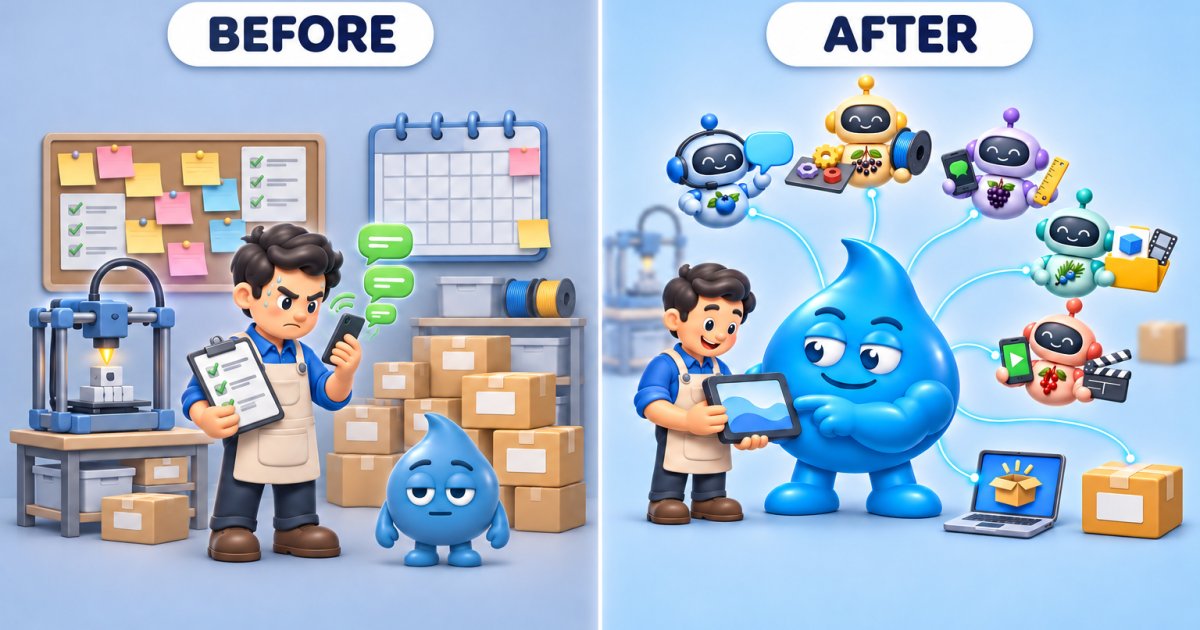
The owner of a 3D printing workshop could no longer keep up with client requests. Printing took little of that time. Most of it went into retyping an address on the GLS portal, digging through WhatsApp for a measurement sent days earlier, and opening the slicer just to learn how long a print takes. That is the problem the owner brought to me.
I analysed the workshop's workflow, from the client's first message to the delivered parcel, and split it into twelve operations. I started with the ones that repeat on every order and picked a fitting technology for each: a deterministic agent (no AI), an AI agent, or a Mac app.
The owner is left with three operations: designing the part, starting the print and checking the result. That is the craft of the job.
At the center sits Drupal 11, the CMS the workshop already used with its clients, and it stays the only source of orders and statuses. Anything that reaches a client or the public goes out after the owner's yes.
Drupal runs an unusual kind of e-commerce here: it gathers requirements more than it sells from a catalog. The client describes what they need, and many parts are made to measure for them and stay private. On their page they follow the steps of the job: which parts are already printed, what is missing, the payment and the shipment tracking.
The Maintainers Behind Drupal’s Company Contribution Rankings
Status codes your API is getting wrong
From AI Coding to Smarter Design, NEDCamp 2026 Speakers Challenge Familiar Workflows
Pages
