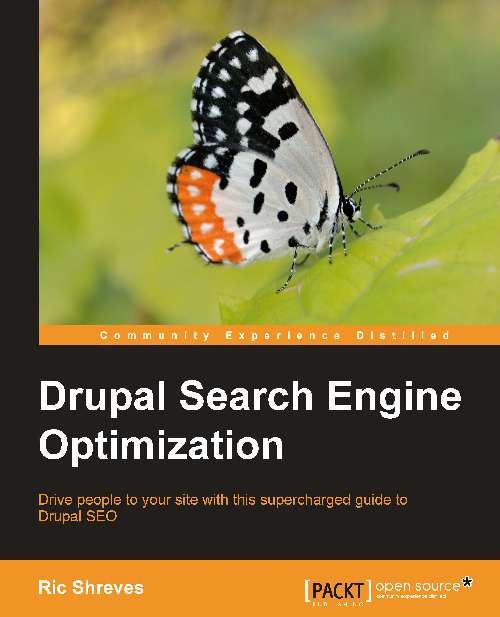
Drupal Search Engine Optimization

Cover image for this book
Sub-title: 
Drive people to your site with this supercharged guide to Drupal SEO
Authors: 
Publisher: 
Packt Publishing
Publication date: 
2012-09
Page count: 
116
ISBN-13: 
978-1849518789

What you will learn from this book

  • Gain an understanding of how the search engines function.
  • Develop an SEO strategy for your site.
  • Select the most effective key phrases.
  • Configure your Drupal site to be search engine friendly.
  • The top extensions to enhance your Drupal sites search engine optimization.
  • Execute a link building campaign.
  • Develop content that advances your search marketing goals.
  • What the most important factors to track with Google Analytics are.

In Detail

Drupal is a free and open-source content management system and content management framework written in PHP and distributed under the GNU General Public License. It is used as a back-end system for at least 1.5% of all websites worldwide ranging from personal blogs to corporate, political, and government sites. SEO, or Search Engine Optimization, is the process and techniques by which you optmize the content and style of your site in order to induce more people to view it.

Drupal SEO will help you develop and execute an effective search engine optimization strategy for your site. From planning to implementation, the book covers best practices in contemporary SEO.

In Drupal SEO you will learn how to develop a dynamic and productive SEO campaign. Covering both the basics of campaign development as well as the daily work it takes to maintain your SEO competitiveness, this book will show you how to produce a distinct and appropriate strategy for your site. In particular you will learn key phrase selection and competitor analysis and the correct groundwork for your dynamic SEO campaign.

Drupal SEO will then show you, by finding the right combination of extensions, how to supercharge your site. You will also be given a guided tour of key SEO services, like Google and Bing Webmaster, in order to implement a progressive and effective link building campaign. You will then learn key expert tips and tricks to enable you to build SEO-effective content which will take your site from invisible to unmissable with little effort.

Approach

The book will take a hands-on approach to the process involved in configuring a site for SEO. As SEO is an on-going process – it doesn’t stop once the site is built – the book will provide reusable tips and techniques in order to understand what they have to do after the site is live.

Who this book is for

This book targets site builders, webmasters and site owners. Advanced technical skills are not required, though the user should be familiar with administering a Drupal website.

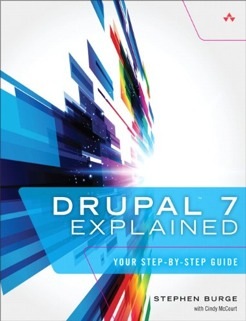
Drupal 7 Explained

Cover image for this book
Sub-title: 
Your Step-by-Step Guide
Authors: 
Publisher: 
Prentice Hall
Publication date: 
2013-05
Page count: 
480
ISBN-13: 
978-0133124231

Drupal 7 Explained is for people who want a fun and clear introduction to Drupal.

Drupal 7 Explained requires absolutely no experience with Drupal, content management, site construction, programming, scripting, or even HTML.

Discover what Drupal does and how it works; then install Drupal 7, master site administration, simplify site creation via workflows, create highly-usable navigation, and much more.

Quickly change site designs with themes; find, choose, install, and use modules, including Views; create advanced layouts with Display Suite Panels; customize user access; update and back up your sites; and build multiple site types, step by step!

Please note: This is book is 100% aimed at Drupal beginners. Drupal 7 Explained contains no code and that is absolutely deliberate. If you want to learn how to create themes or code modules, there are other books for you.

Drupal for Education and E-Learning - Second Edition

Cover image for this book
Sub-title: 
Create web-based, content-rich tools for teaching and learning
Authors: 

James G. Robertson
Bill Fitzgerald

Publisher: 
Packt Publishing
Publication date: 
2013-06
Page count: 
390
ISBN-13: 
9781782162766

What you will learn from this book

Build an intuitive structure to allow students and teachers to find relevant content by creating blogs for both teachers and students
Create roles and permissions for controlling access to different parts of the site
Share and manage bookmarks, podcasts, images, and video to support teaching and learning
Foster discussion and communication among teachers, students, and also the larger school community to collaborate on projects
Support multiple classes within the same site
Publish assignments for students in your courses, and track student responses to those assignments
Learn to exchange help with the Drupal community
Discover how to backup and maintain your site once it is built

In Detail

As social networks become more popular, their role in the classroom has come under scrutiny. Drupal offers a wide variety of useful tools for educators. Within a single Drupal site, you can set up social bookmarking, podcasting, video hosting, formal and informal groups, rich user profiles, and other features commonly associated with social web communities.

"Drupal for Education and E-Learning - Second Edition" teaches you how to create your own social networking site to advance teaching and learning goals in the classroom, while giving you complete control over features and access. Communicate with students, share learning resources, and track assignments through simple tasks with this hands-on guide.

In this book you will learn to install and configure the default Drupal distribution and then extend it to include blogs, bookmarks, a media sharing platform, and discussion forums.

The book also covers how to organize your site to easily track student work on the site, and how to control who has access to that information. Additionally, it teaches you how to make the site easy to use, how to maintain the site, and how to ask for and receive help in the Drupal community.

Approach

With clear instructions and plenty of screenshots, this book provides all the support and guidance you will need as you begin to create your classroom website. Step-by-step tutorials show you how to use Drupal in the most efficient and effective ways possible. People new to Drupal will find a good introduction of the basics; while more experienced users will learn useful tips and tricks for using Drupal in a classroom context.

Who this book is for

If you are an teacher, tutor or an educator who wants to build a website for your classroom, be it elementary or any higher education, "Drupal for Education and E-Learning - Second Edition" will guide you in achieving your goal at every step. No experience with programming languages, HTML, or CSS is needed to understand the examples in this book.
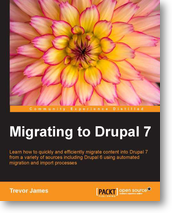
Migrating to Drupal 7

Cover image for this book
Sub-title: 
Learn how to quickly and efficiently migrate content into Drupal 7 from a variety of sources including Drupal 6 using automated migration and import processes.
Authors: 
Publisher: 
Packt Publishing
Publication date: 
2012-12
Page count: 
158
ISBN-13: 
9781782160540

What you will learn from this book

  • Configure your Drupal site to run imports of migrated content using the Feeds module
  • Run an import of migrated content using Feeds module and a Feed importer
  • Package your configuration using the Features module
  • Utilize the Migrate module and its benefits
  • Migrate blog posts from WordPress to Drupal
  • Upgrade your Drupal 6 site to Drupal 7
  • Configure the Feeds Tamper module to preprocess your Feeds imports
  • Run additional imports using the Feeds modules to update and add new data and content to your Drupal site

In Detail

This book will show you how to migrate your content into the Drupal content management system. You’ll start by building a content type in Drupal to hold your migrated content. You’ll then import your content into Drupal using the Feeds module. In order to be able to easily use them again and again, you will also learn the best methods of maintaining and packaging migration configurations.

In "Migrating to Drupal 7" you’ll learn how to quickly package your legacy site’s data into a format that’s easy to import into Drupal. You’ll then build a content type to hold migrated data in Drupal. To save time and hassle you will learn how to import content into Drupal using the Feeds module. You’ll then get a brief introduction to the Migrate module and its powerful features.

With this guide you’ll also learn how to upgrade your Drupal 6 website to Drupal 7 in short, simple steps. You’ll also learn how to package your configuration code in Drupal using the powerful Features module.

In "Migrating to Drupal 7" you’ll start by collecting your current site’s content and packaging it up into a CSV file so you can easily import it into Drupal. You’ll then build a content type to hold your migrated data and content.

Mastering migrations using the Feeds module will be the next invaluable tutorial before you get a closer look at the Migrate module’s powerful features. You’ll then upgrade your Drupal 6 site to Drupal 7 and use helper modules to help run the upgrade faster and with less hassle. This book will then take you through the process of migrating CCK-based Drupal 6 fields to Drupal 7 using the Content Migrate module.

Using the Features module you will then package up our Feeds importer and content types into code to help you to build an easily maintainable and flexible Drupal website with.

Approach

Written in a friendly and engaging style with practical tutorials and step-by-step examples which show you how to easily migrate your Drupal 6 or WordPress site to Drupal 7.

Who this book is for

"Migrating to Drupal 7" is for anyone interested in how to move content from an existing website into the Drupal content management system. Both novice and advanced Drupal users will gain practical hands-on knowledge in how to migrate content into Drupal using this book. You will become experts in using the Feeds module to migrate content, and in packaging your code using Features.

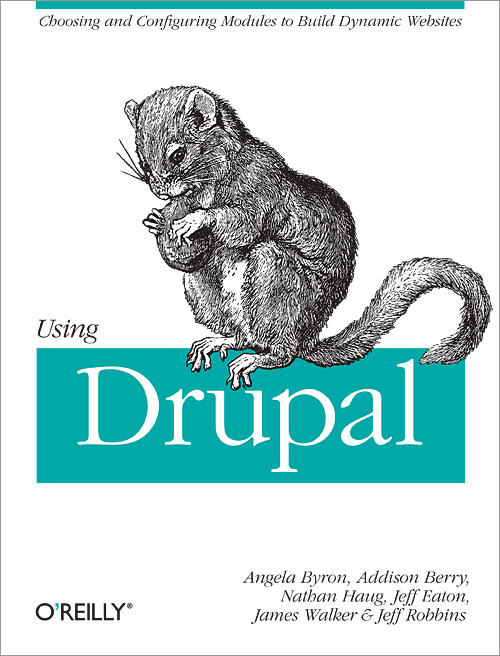
Using Drupal

Publisher: 
O'Reilly Media
Publication date: 
2008-12
Page count: 
496
ISBN-13: 
978-0596515805

A second edition of this book is now available.

See the original announcement about Using Drupal’s release in the Drupal news section.

Publisher’s description:

With the recipes in this book, you can take full advantage of the vast collection of community-contributed modules that make the Drupal web framework useful and unique. You'll get the information you need about how to combine modules in interesting ways (with a minimum of code-wrangling) to develop a variety of community-driven websites. Each chapter describes a case study and outlines specific requirements for one of several projects included in the book—a wiki, publishing workflow site, photo gallery, product review site, online store, user group site, and more.
With Using Drupal, you will:

  • Get an overview of Drupal concepts and key modules introduced in each chapter, with a bird's-eye view of each module's specialty and how it works
  • Explore various solutions within Drupal that meet the requirements for the project, with details about which modules are selected and why
  • Learn how to configure modules, with step-by-step recipes for building the precise functionality the project requires
  • Get information on additional modules that will make the project even more powerful
  • Be able to access the modules used in the chapter, along with other resources

Newcomers will find a thorough introduction to the framework, while experienced Drupal developers will learn best practices for building powerful websites. With Using Drupal, you’ll find concrete and creative solutions for developing the exact community website you have in mind.

Pages

Subscribe with RSS Subscribe to RSS - Site users