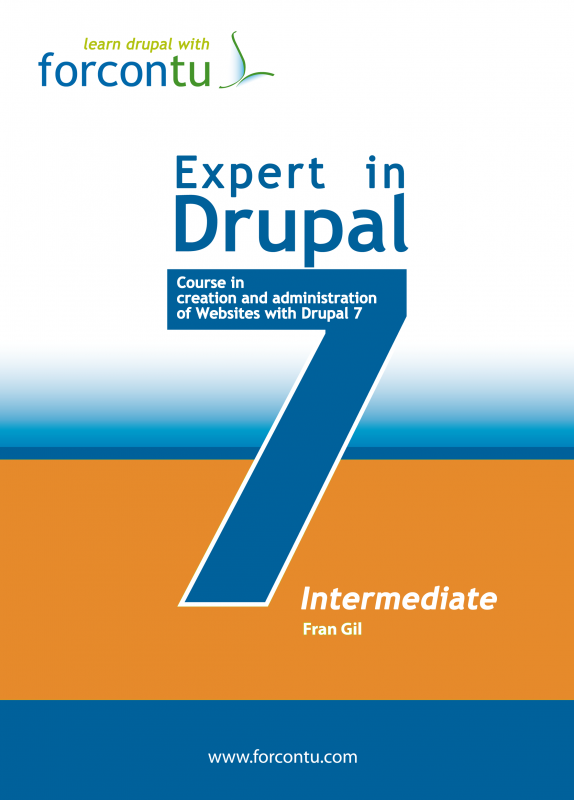
Expert in Drupal 7. Intermediate

Sub-title: 
Course in creation and administration of Websites with Drupal 7
Authors: 

Fran Gil

Publisher: 
Forcontu
Publication date: 
2014-11
Page count: 
653
ISBN-13: 
9788494276316

The Intermediate level complements the beginner level. It is aimed at people who already had previous contact with Drupal and want to understand it in depth and make better use of its full potential. Completing this level is very useful for building professional Websites with features that go far beyond company webs or personal blogs. Programming knowledge is not required to study intermediate level.

Contents:

  • 21. Creating forms with Webform
  • 22. Advanced content types
  • 23. Views
  • 24. Automatic image processing
  • 25. Extending menus with additional modules
  • 26. Extending blocks with additional modules
  • 27. Panels
  • 28. Display Suite
  • 29. Customizing Themes
  • 30. Actions and Triggers
  • 31. Rules
  • 32. Defining contexts
  • 33. Extending users
  • 34. Workflow
  • 35. Multilingual sites
  • 36. E-commerce: Introduction to Ubercart and Drupal Commerce
  • 37. SEO Positioning with Drupal
  • 38. Social tools: voting and sharing content
  • 39. Newsletter Subscription
  • 40. Other Features

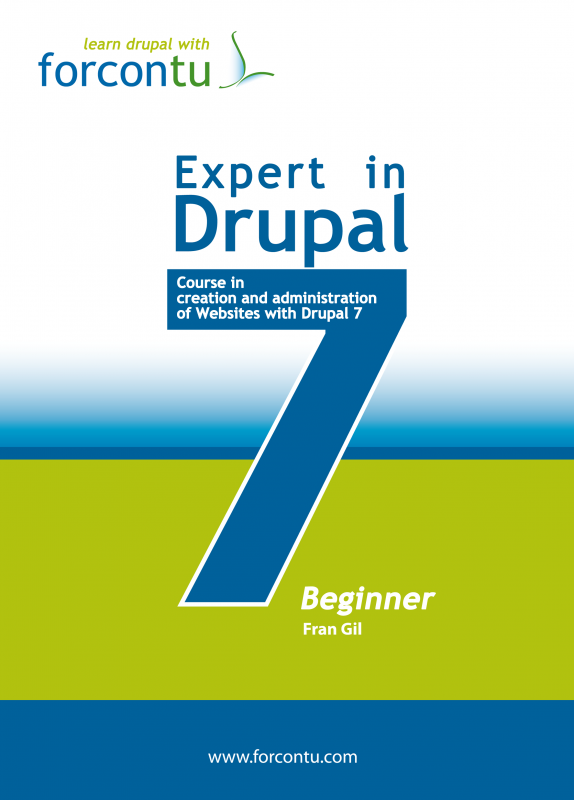
Expert in Drupal 7. Beginner

Sub-title: 
Course in creation and administration of Websites with Drupal 7
Authors: 

Fran Gil

Publisher: 
Forcontu
Publication date: 
2014-11
Page count: 
381
ISBN-13: 
9788493941093

Beginner level is aimed at those people with or without technical training, who want to start creating Websites. It is also very useful for companies or professionals who wish to create their professional or personal Website without depending on external assistance. At this level, the aim is for the student to acquire sound basic knowledge in order to tackle the following educational levels with guarantees.

Contents:

  • 1. Introduction to Drupal
  • 2. Drupal installation
  • 3. Administration area
  • 4. Content management
  • 5. Content types
  • 6. Menu management
  • 7. Blocks management
  • 8. Themes
  • 9. Extending functionality with modules
  • 10. Management of users, roles and permissions
  • 11. Taxonomy
  • 12. Text formats and WYSIWYG editors
  • 13. Blogs
  • 14. Forums
  • 15. Structured documents: Books
  • 16. Media Galleries
  • 17. Searches
  • 18. Languages and translation
  • 19. Access statistics
  • 20. Website management, maintenance and updating
  • Annex A. Configuration of the hosting and necessary tools
  • Annex B. Links and resources of interest

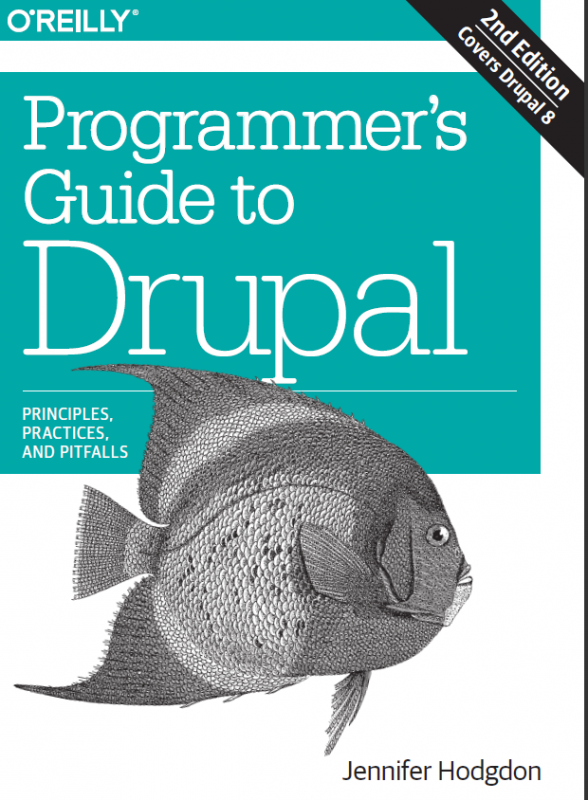
Programmer's Guide to Drupal, 2nd Edition

Sub-title: 
Principles, Practices, and Pitfalls
Publisher: 
O'Reilly Media
Publication date: 
2015-10
Page count: 
236
ISBN-13: 
9781491911464

If you’re a web programmer, your experiences have taught you certain lessons—and only some of them apply well to Drupal. Drupal has its own set of programming principles that require a different approach, and many programmers make mistakes when relying on skills they’ve used for other projects. This book will show you which programming techniques you can use—and which you should avoid—when building web applications with this popular content management framework.

Updated to cover both Drupal 7 and Drupal 8, the guidelines in this book demonstrate which programming practices conform to the "Drupal way" and which don’t. The book also serves as an excellent guide for Drupal 7 programmers looking to make the transition to Drupal 8.

  • Get an overview of Drupal, including Drupal core and add-on modules and themes
  • Learn Drupal’s basic programming principles, such as the ability to customize behavior and output with hooks
  • Compare Drupal 7 and Drupal 8 programming methods, APIs, and concepts
  • Discover common Drupal programming mistakes—and why hacking is one of them
  • Explore specific areas where you can put your programming skills to work
  • Learn about the new object-oriented Drupal 8 API, including plugins and services

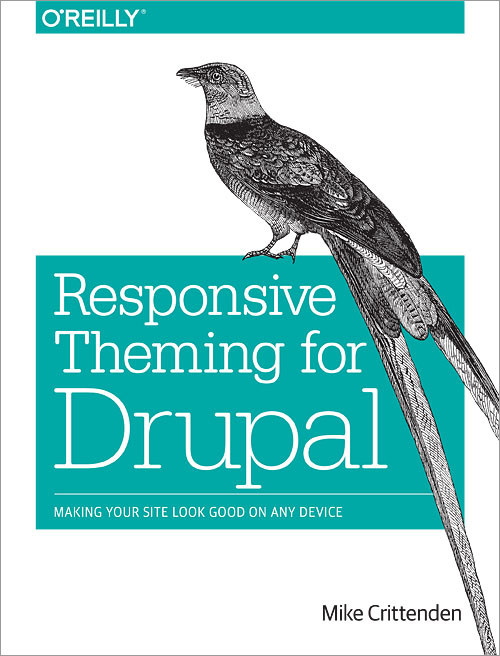
Responsive Theming for Drupal

Sub-title: 
Making Your Site Look Good on Any Device
Authors: 
Publisher: 
O'Reilly Media
Publication date: 
2014-02
Page count: 
78
ISBN-13: 
978-1449373313

If you want your Drupal website to work well on smartphones, tablets, and desktops, this practical guide shows you how to incorporate Responsive Web Design (RWD) with specific Drupal 7 themes. You’ll learn how to create attractive, easy-to-navigate layouts for everything from tiny phone screens to 30-inch desktop monitors—all with the same codebase.

Ideal for experienced Drupal developers, this book takes you through RWD basics and shows you how to build sites based on Aurora, Zen, and Omega—three popular base themes created by Drupal contributors. Whether you’re creating a new site with RWD or adapting an existing one, you’ll learn how to become a better, more efficient Drupal themer.

  • Understand how Responsive Web Design and CSS media queries work
  • Learn how the Sass stylesheet language and Compass framework support RWD
  • Adopt a mobile-first approach to RWD—and learn why it’s important
  • Get step-by-step instructions for creating custom subthemes on top of Aurora, Zen, and Omega
  • Tackle common problems when building and theming responsive Drupal sites
  • Explore alternative options for accommodating smartphone and tablet users

Instant Premium Drupal Themes

Sub-title: 
Learn how to create visually stunning themes to add the wow factor to all of your Drupal sites!
Authors: 
Publisher: 
Packt Publishing
Publication date: 
2013-10
Page count: 
40
ISBN-13: 
978-1783281756

What you will learn from this book

  • Understand Drupal theme structure and terminology
  • Configure raw HTML in a Drupal environment
  • Populate Drupal themes with dynamic content
  • Learn how to customize the search result page and how to add regions to your home page
  • Discover the best practices and conventions of using Drupal to speed up your development

In Detail

Drupal’s theme layer, and the themes that use it, are responsible for the look and feel of a Drupal web site. Themes have the final say and ultimate control over almost every aspect of each page. Good themes consist of all the same elements that you would find on any reputable web site, including standards-compliant XHTML markup, CSS, and JavaScript. How it all comes together is what is so special and what makes Drupal themes so flexible and powerful.

Premium Drupal Themes is a practical, hands-on guide filled with clear, step-by-step examples which shows you how to create Drupal themes using HTML. This book will show you the best practices and conventions that you should adopt and utilize so you can change the way Drupal looks using HTML without wasting energy digging through Drupal’s code.

Starting with the essentials including Drupal terminology and Drupal theme structures, this book will show you how to configure raw HTML in a Drupal environment. You will learn about the Drupal template variables and also how to populate a Drupal theme with dynamic content. You will also discover how to customize the search result page and how to add regions to your home page. This book will help you familiarize yourself with the theme engines and will help you learn about the core of Drupal’s theme rendering system. Finally, you will learn how to create your very own Drupal theme that will take people’s breath away!

Approach

Filled with practical, step-by-step instructions and clear explanations for the most important and useful tasks. A step-by-step guide filled with recipes that will show you how to create your very own Drupal themes using HTML.

Who this book is for

This book is great for developers who are new to Drupal. It is assumed that you have some experience in HTML, PHP, and CSS. You’ll need a PHP (LAMP/WAMP) environment to install Drupal. It is also assumed that you know how to install Drupal. Some familiarity with CMS will be useful but is not essential.
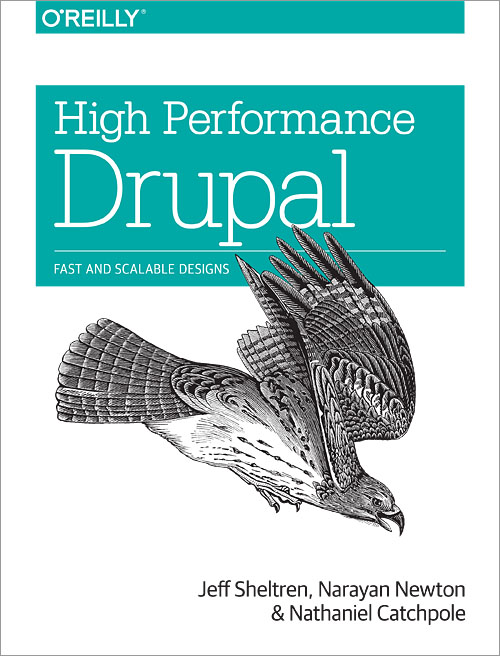
High Performance Drupal

Sub-title: 
Fast and Scalable Designs
Publisher: 
O'Reilly Media
Publication date: 
2013-10
Page count: 
264
ISBN-13: 
978-1449392611

How can you help your Drupal website continue to perform at the highest level as it grows to meet demand? This comprehensive guide provides best practices, examples, and in-depth explanations for solving several performance and scalability issues. You’ll learn how to apply coding and infrastructure techniques to Drupal internals, application performance, databases, web servers, and performance analysis.

Covering Drupal versions 7 and 8, this book is the ideal reference for everything from site deployment to implementing specific technologies such as Varnish, memcache, or Solr. If you have a basic understanding of Drupal and the Linux-Apache-MySQL-PHP (LAMP) stack, you’re ready to get started.

  • Establish a performance baseline and define goals for improvement
  • Optimize your website’s code and front-end performance
  • Get best and worst practices for customizing Drupal core functionality
  • Apply infrastructure design techniques to launch or expand a site
  • Use tools to configure, monitor, and optimize MySQL performance
  • Employ alternative storage and backend search options as your site grows
  • Tune your web servers through httpd and PHP configuration
  • Monitor services and perform load tests to catch problems before they become critical

Pages

Subscribe with RSS Subscribe to RSS - Available